NVIDIA Groq 3 LPX Enters Full Production Delivering 3,400 Tokens per Second for Agentic Inference

At Hot Chips 2026, NVIDIA announced that the Groq 3 LPX dedicated inference accelerator has entered full commercial production. Built as a workload-optimized extension to the Vera Rubin data center architecture, the accelerator addresses the decode bottlenecks inherent in multi-step agentic AI workloads by offloading token generation from primary GPU clusters onto specialized Language Processing Units (LPUs). In independent benchmarking conducted by Artificial Analysis, the Groq 3 LPX delivered

2 min
NVIDIA Groq 3 LPX Enters Full Production Delivering 3,400 Tokens per Second for Agentic Inference

At Hot Chips 2026, NVIDIA announced that the Groq 3 LPX dedicated inference accelerator has entered full commercial production. Built as a workload-optimized extension to the Vera Rubin data center architecture, the accelerator addresses the decode bottlenecks inherent in multi-step agentic AI workloads by offloading token generation from primary GPU clusters onto specialized Language Processing Units (LPUs).

In independent benchmarking conducted by Artificial Analysis, the Groq 3 LPX delivered 3,400 output tokens per second on the open-source Gemma 4 31B model with a 100,000-token input context. According to NVIDIA, this marks the fastest token generation speed recorded for the model, providing roughly four times the interactive responsiveness of alternative hardware platforms on latency-sensitive agentic tasks.

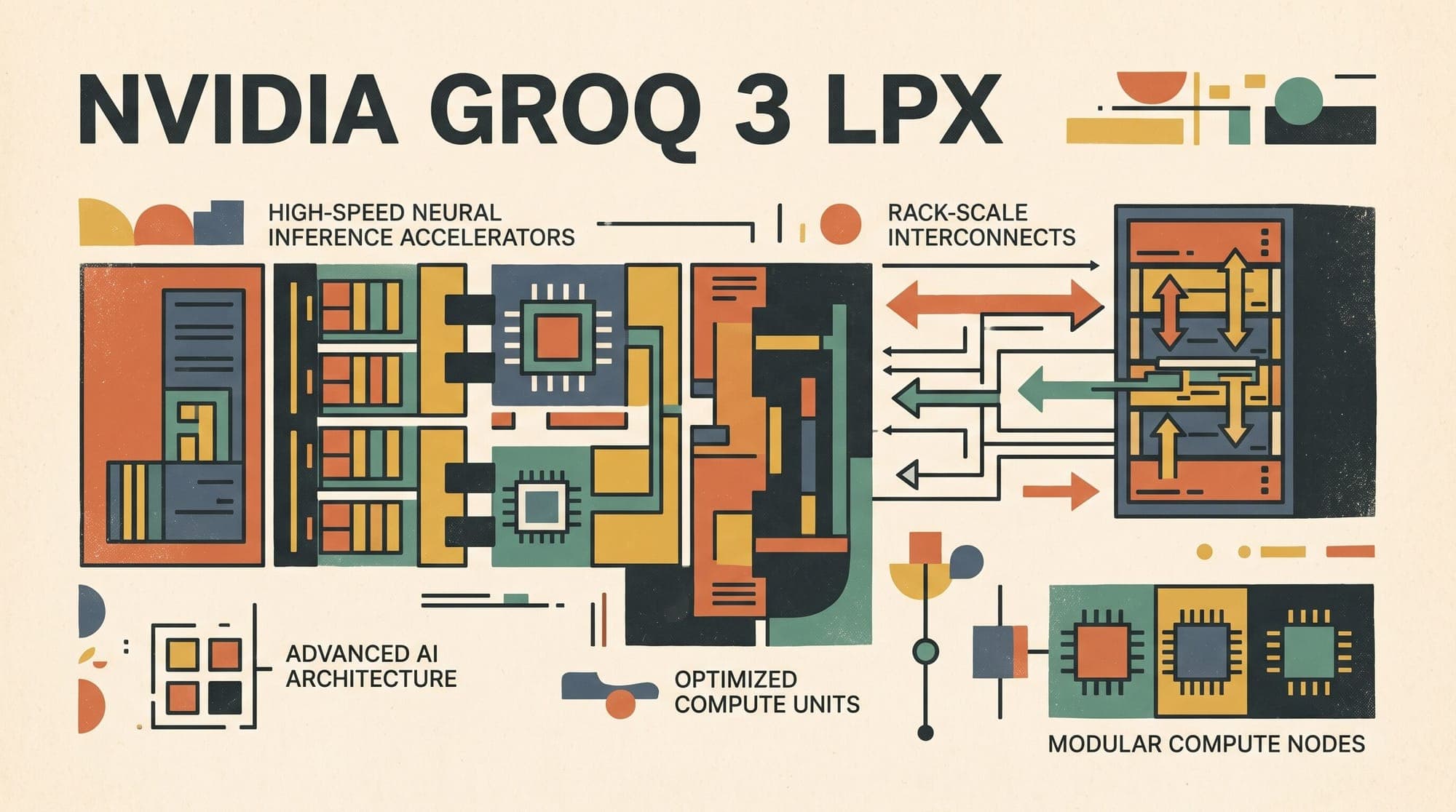
NVIDIA Groq 3 LPX Disaggregated Architecture

Disaggregating Prefill and Decode in Agentic Architectures

Modern agentic loops require models to repeatedly inspect file trees, evaluate tool outputs, verify reasoning traces, and execute code in iterative sequences. While rack-scale GPU systems such as the Vera Rubin NVL72 efficiently ingest large context windows during the prefill phase, sequential token generation remains memory-bandwidth bound.

Groq 3 LPX decouples this execution path. In a full rack deployment, systems can integrate up to 256 LP30 accelerators linked across high-bandwidth interconnects. While Vera Rubin GPUs handle large-scale context processing and multimodal ingestion, the LPX accelerators process the sequential autoregressive decode steps, maintaining interactive token output rates even across long context windows.

Neocloud and Hardware Deployments

Nebius Group N.V. has signed on as the launch cloud partner, integrating Groq 3 LPX into its Nebius Token Factory production inference platform. Nebius CTO Danila Shtan noted that the integration exposes the hardware through standard inference APIs without requiring customer stack migrations.

Purpose-built inference cloud provider Groq Inc., whose technology NVIDIA licensed in December for $20 billion alongside bringing on founder Jonathan Ross, is also among the early deployment partners. In parallel announcements at Hot Chips, NVIDIA disclosed that SpaceX will adopt Vera CPUs for terrestrial and orbital orchestration workloads, while previewing Spectrum-X Multiplane networking fabrics designed to support clusters of up to 512,000 GPUs.


Sources

Written by

More to read

  • Test-Driven Development in AI Coding Agents: Architecture, Reproduction Harnesses, and Execution-Guided Verification

    Autonomous coding agents face a fundamental structural limitation when operating in open-loop, single-turn, or ungrounded generative modes: without dynamic feedback from runtime execution, large language models generate syntactically plausible code that frequently fails subtle interface contracts, breaks existing edge cases, or introduces silent regressions. While early benchmark evaluations relied heavily on zero-shot or few-shot code completion, modern production coding architectures such as S

    1 min
  • The Score Function Estimator: Mathematical Foundations of REINFORCE, Log-Derivative Tricks, and Baseline Variance Reduction

    In modern artificial intelligence, standard backpropagation relies on continuous differentiability: every operation between model parameters and the final loss must provide well-behaved analytical Jacobian matrices. However, many of the most critical optimization challenges in machine learning break this continuity. Autoregressive token generation in large language models, discrete tool invocation, programmatic compiler execution, and black-box reward environments are fundamentally non-different

    1 min
  • Lancium and NVIDIA Partner on Gigawatt-Scale AI Factories Across 15GW Pipeline

    Texas energy infrastructure provider Lancium has entered a strategic partnership with NVIDIA to deploy NVIDIA's full AI factory technology stack across Lancium's multi-gigawatt clean energy data center portfolio. As part of the transaction, NVIDIA has taken a direct equity stake in Lancium, which is backed by funds managed by Blackstone Energy Transition Partners and Blackstone Multi-Asset Investing. The partnership combines Lancium's 4 gigawatts of operational and leased capacity and a pipelin

    1 min

