
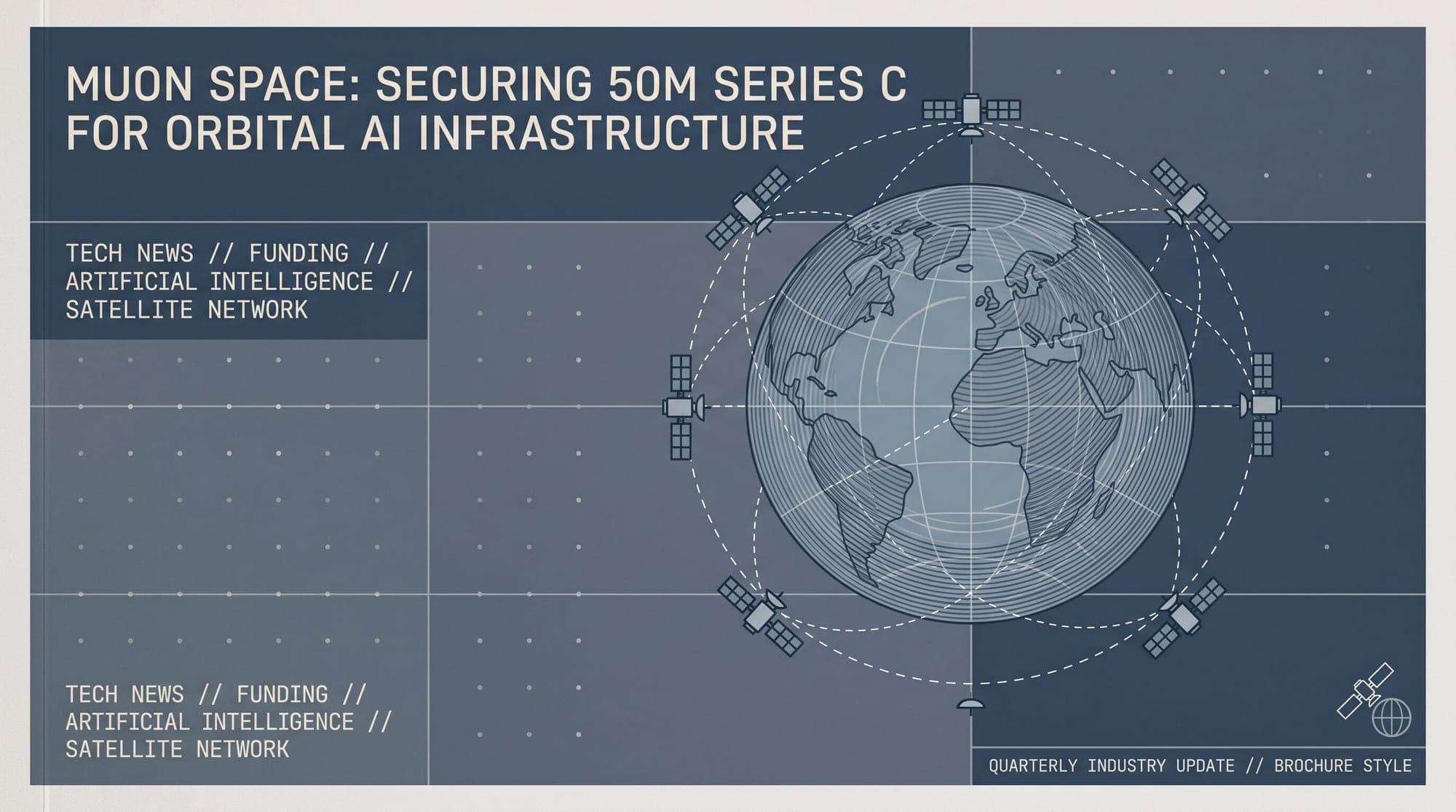
Muon Space Closes $250M Series C to Scale Orbital AI Infrastructure

Satellite manufacturer Muon Space has closed a $250 million Series C round led by Eclipse Capital, with participation from Google, Salesforce Ventures, Wellington Management, I Squared Capital, and Woven Capital. The funding values the Mountain View startup at approximately $1.5 billion and will accelerate production of its Condor-Ultra spacecraft platform designed for orbital data centers and AI compute.
The five-year-old company has deployed 11 satellites across six launches with a 100% mission success rate, including three launches in the first half of 2026. Muon recently opened a San Jose manufacturing facility targeting 500 satellites annually by 2027, a tenfold capacity increase.
Orbital Compute as the Next Infrastructure Layer
Muon's Condor-Ultra platform features a 20 kW initial power architecture scaling to 100 kW, over 18 square meters of nadir payload area, and 100 Gbps inter-satellite optical mesh networking. The platform integrates with Nvidia's Space-1 Vera Rubin module, a purpose-built AI inference accelerator delivering up to 25x the compute performance of an H100 for space applications.
Google's participation signals strategic interest in orbital AI infrastructure. The company previously partnered with Muon on FireSat, a global wildfire-monitoring constellation developed with Earth Fire Alliance and Google.org that was named one of TIME's Best Inventions of 2025. Google Research has also published feasibility analyses on space-based AI infrastructure, noting that sustained launch cost reductions could make orbital data centers cost-competitive with terrestrial facilities on a per-kilowatt basis by the mid-2030s.
Mission Foundry Model
Unlike traditional satellite builders that supply spacecraft or components, Muon's "Mission Foundry" delivers complete, mission-ready constellations by integrating mission design, spacecraft, payloads, software, operations, and data into a single platform. The company claims this reduces deployment timelines from years to months.
Two customer constellations are entering operation in 2026: Vindlér 2.0 for SNC (RF data and analytics) and FireSat (wildfire monitoring). Muon has over 50 satellites in development for customers, with 13 manifested for launch over the next year.

Sources
- Muon Space Closes $250 Million Series C to Scale Space Infrastructure (GlobeNewswire via Yahoo Finance)
- Muon Space Raises $250 Million With Google, Salesforce Backing (Bloomberg)
- Muon Space Raises $250 Million to Ramp Up Satellite Production (SpaceNews)
- Exploring a Space-Based, Scalable AI Infrastructure System Design (Google Research Blog)



