
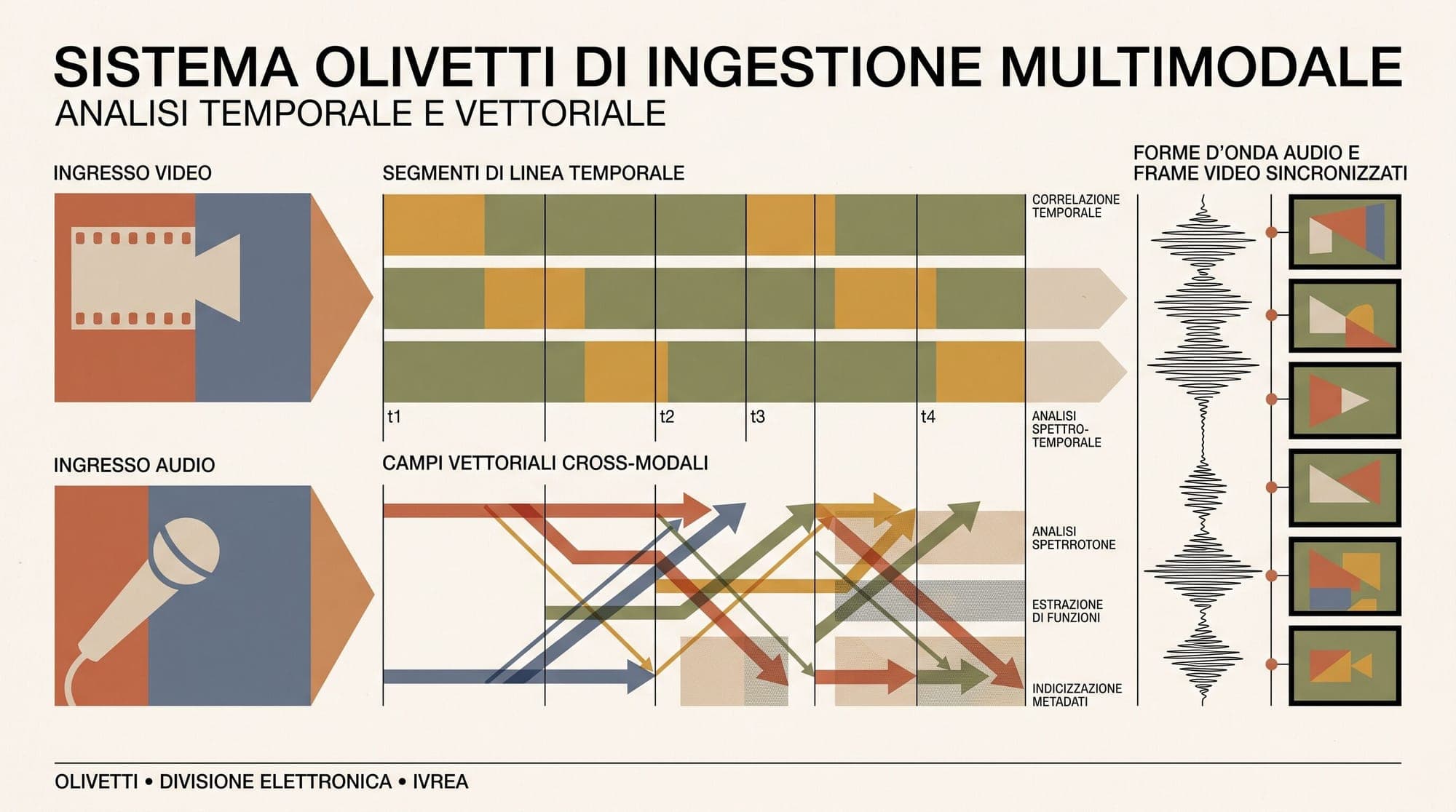
Multimodal RAG in Production: Video Chunking, Cross-Modal Embeddings, and Temporal Retrieval Architecture
Enterprise adoption of large language models is rapidly expanding beyond static text corpora into rich video, audio, and visual archives. Recorded meetings, technical webinars, security camera feeds, product walkthroughs, and surgical recordings hold critical institutional knowledge. However, querying multi-hour video and audio streams presents severe architectural challenges.
While modern vision-language models (VLMs) support context windows reaching one to two million tokens, streaming raw high-definition video directly into model context windows for every ad-hoc query is economically and operationally prohibitive. Processing a single hour of 1080p video sampled at one frame per second consumes approximately 900,000 to 1.2 million tokens, generating several dollars in inference cost per request while introducing time-to-first-token (TTFT) latencies of 15 to 30 seconds. Furthermore, needle-in-a-haystack degradation persists when models attempt to locate brief, five-second visual actions across vast video contexts.
Multimodal Retrieval-Augmented Generation (Multimodal RAG) solves this bottleneck. By indexing hours of video across synchronized audio, visual, and on-screen text tracks, Multimodal RAG systems locate precise temporal windows within milliseconds, conditioning downstream VLMs on only the relevant video clips and transcript segments.

Multi-Track Video Ingestion and Segmentation
A video stream is not a monolithic data type. It is a composite container composed of at least three distinct information channels: spoken audio, continuous visual frames, and embedded on-screen text. Ingesting video into a retrieval pipeline requires decomposing the container into these constituent tracks while maintaining strict temporal synchronization.
+-------------------------------------------------------------------+
|                        Raw Video Container                        |
+-------------------------------------------------------------------+
        |                          |                         |
        v                          v                         v
+---------------+          +---------------+         +---------------+
| Spoken Audio  |          | Visual Stream |         | On-Screen Text|
+---------------+          +---------------+         +---------------+
        |                          |                         |
        | [ASR / Whisper]          | [Scene / Keyframes]     | [OCR Pipeline]|
        v                          v                         v
+---------------+          +---------------+         +---------------+
| Timestamped   |          | Visual Vector |         | Extracted OCR |
| Text Chunks   |          | / VLM Caption |         | Text Blocks   |
+---------------+          +---------------+         +---------------+
        \                          |                         /
         +-------------------------+------------------------+
                                   |
                                   v
             +-------------------------------------------+
             | Synchronized Multi-Track Vector Index     |
             +-------------------------------------------+
1. Audio Ingestion and ASR
The audio track contains dense semantic information via spoken dialogue. The audio stream is extracted using FFmpeg and passed to an Automatic Speech Recognition (ASR) model such as OpenAI Whisper or faster-whisper. The ASR engine outputs word-level timestamps alongside confidence scores and optional speaker diarization tokens.
Unlike standard text document chunking that operates purely on character or token counts, audio chunking must respect sentence boundaries and natural speech pauses. Standard practice creates sliding windows of 30 to 60 seconds with a 10-second overlap, attaching exact start and end millisecond timestamps (t_start, t_end) to each segment.
2. Visual Segmentation and Keyframe Extraction
Video frames are highly redundant; adjacent frames within the same camera shot convey virtually identical semantic meaning. Indexing every frame bloats vector stores and downstream inference budgets without improving retrieval recall.
Two primary strategies govern visual extraction:
- Uniform Time Sampling: Extracting frames at a fixed cadence (e.g., 0.5 to 1 frame per second). This approach is computationally trivial but either misses fast visual events or generates redundant keyframes during static talking-head segments.
- Scene Boundary Detection (SBD): Using content-aware algorithms (such as PySceneDetect or OpenCV optical flow) to detect shot transitions, cut points, and significant changes in pixel intensity histograms. Keyframes are selected at scene transition points and local visual entropy peaks.
Recent research on SceneRAG demonstrates that scene-level semantic segmentation outperforms uniform chunking by aligning retrieval units with natural narrative shifts, improving retrieval win rates by over 13% compared to flat video chunking.
3. On-Screen Text Extraction (Video OCR)
In technical presentations, screencasts, and lectures, the most critical semantic payload often resides in slide bullet points, code blocks, or diagram labels that are never spoken aloud. Running optical character recognition (OCR) via engines like PaddleOCR or Tesseract on extracted keyframes generates a dedicated textual metadata layer tied to the frame timestamp.
Feature Extraction and Embedding Paradigms
Once multi-track data is segmented, the core architectural decision is how to project these heterogeneous representations into searchable vector indexes. Production systems typically adopt one of three paradigms.
Paradigm A: Dual-Channel Independent Indexing
In a dual-channel architecture, textual artifacts (ASR transcripts and OCR text) and visual keyframes are indexed into separate vector namespaces:
- Text Channel: Encoded using standard dense text bi-encoders (e.g.,
text-embedding-3-large,bge-large-en-v1.5) and lexical BM25 indexes. - Visual Channel: Encoded using contrastive vision-language models such as SigLIP or ImageBind, mapping images and text queries into a shared embedding space.
During retrieval, an incoming text query is evaluated simultaneously against the text index (matching speech and OCR) and the visual index (matching scene appearance). The results are merged using rank fusion.
Paradigm B: Synthetic Visual Captioning (Text-Centric Grounding)
Rather than maintaining a separate visual vector space, each extracted scene or keyframe is passed to a fast, lightweight Vision LLM (e.g., Qwen2.5-VL-7B or Gemini Flash) to generate a detailed synthetic text description. The prompt instructs the model to describe actions, visible entities, background settings, and spatial interactions.
The generated visual captions are merged with the ASR transcripts and indexed in a single unified text retrieval pipeline. As detailed in systems like VideoRAG, textual grounding of visual signals simplifies indexing infrastructure, preserves standard BM25/hybrid search tooling, and allows standard text rerankers to operate over visual descriptions.
Paradigm C: Joint Multimodal Dense Embeddings
Unified multimodal embedding models (such as Google Vertex AI Multimodal Embeddings or Voyage Multimodal) accept video clips, audio segments, and images directly, outputting a single vector per temporal clip. This approach enables any-to-any retrieval (searching video via audio, image, or text queries) without explicit intermediate captioning. However, it provides less granular interpretability and cannot leverage lexical keyword matching for specialized technical terms.
Comparison of Indexing Strategies
- Dual-Channel (ASR + SigLIP):
- Latency / Storage: Moderate storage overhead; fast parallel vector search across text and image indices.
- Strengths: High visual precision for physical objects, UI elements, and distinct scenes; native cross-modal similarity.
- Failure Modes: Struggles with complex temporal action reasoning spanning multiple minutes.
- Synthetic Visual Captioning (Vision LLM):
- Latency / Storage: High pre-processing GPU compute; standard text storage footprint and low vector index size.
- Strengths: Seamlessly integrates with existing lexical BM25 search, hybrid retrieval, and standard text cross-encoder rerankers.
- Failure Modes: Visual details omitted or hallucinated by the captioning prompt cannot be recovered at query time.
- Joint Multimodal Dense Embeddings:
- Latency / Storage: Low storage footprint; single-index vector architecture across all media types.
- Strengths: Native any-to-any search (audio-to-video, image-to-video); zero prompt tuning or caption drift.
- Failure Modes: Reduced precision for rare domain-specific acronyms, code symbols, and exact keyword matching.
Temporal Grounding and Reciprocal Rank Fusion
Retrieving video clips requires resolving discrepancies between speech, visual cues, and query semantics. A user querying "how to calibrate the optical sensor" might match a spoken explanation in the ASR track at minute 12:30 and a silent visual demonstration at minute 14:15.
from collections import defaultdict

def reciprocal_rank_fusion(
    ranked_lists: dict[str, list[dict]],
    k: int = 60
) -> list[dict]:
    """
    Fuses ranked results from multiple modalities (ASR, OCR, Visual).
    Each item contains 'video_id', 'start_sec', 'end_sec', and 'metadata'.
    """
    scores = defaultdict(float)
    item_map = {}

    for modality, items in ranked_lists.items():
        for rank, item in enumerate(items):
            # Create a discrete temporal key rounded to 10-second boundaries
            interval_key = (
                item["video_id"],
                round(item["start_sec"] / 10) * 10,
                round(item["end_sec"] / 10) * 10
            )
            scores[interval_key] += 1.0 / (k + rank + 1)
            if interval_key not in item_map:
                item_map[interval_key] = item

    sorted_intervals = sorted(scores.items(), key=lambda x: x[1], reverse=True)
    return [item_map[k] | {"fusion_score": score} for k, score in sorted_intervals]
Temporal Window Stitching and Context Clustering
Raw search hits often consist of disjointed 5-second or 15-second fragments. Passing disconnected fragments to a generation model creates hallucination and missing context.
A temporal stitching module merges adjacent and overlapping intervals:
- Cluster Identification: Group retrieved intervals from the same video where
start_time(i+1) - end_time(i) <= delta_threshold(typically 15 to 30 seconds). - Interval Expansion: Expand the boundary of the merged cluster by a contextual padding window (e.g., 5 seconds before and after) to ensure conversational or visual actions are not cut off mid-sentence.
- Multi-Track Context Assembly: Extract the full ASR transcript and sample representative keyframes across the unified temporal bounding box
[T_start, T_end].
Conditioning the Downstream Vision-Language Model
Once top-k temporal intervals are isolated and stitched, they are formatted for input to a frontier VLM (such as GPT-4o, Gemini 1.5 Pro, or Qwen2.5-VL).
The prompt structure provides both chronological text context and interleaved visual keyframes:
You are analyzing retrieved segments from corporate video archives to answer the user query.
Base your answer strictly on the provided transcript segments, OCR text, and keyframes.
Every factual assertion must include a temporal citation in [HH:MM:SS - HH:MM:SS] format.

---
[VIDEO: engineering_all_hands_2026.mp4]
[TIME RANGE: 00:14:20 - 00:15:10]
TRANSCRIPT:
Speaker 1: "We migrated the primary database cluster to Aurora PostgreSQL multi-region last Tuesday."
OCR DETECTED: "Slide 4: Migration Architecture - Target RTO < 30s"
KEYFRAME_1: [Image URL / Base64 Tensor at 00:14:30]
KEYFRAME_2: [Image URL / Base64 Tensor at 00:14:50]
---

USER QUERY: When was the database migration completed and what is the target RTO?
By providing localized multi-track context, the system achieves the comprehension accuracy of full video analysis while consuming less than 2% of the token budget required by raw full-video ingestion.
Production Pitfalls and Failure Modes
Engineering teams deploying multimodal RAG systems frequently encounter three critical failure modes:
- Audio-Visual Desynchronization in Demonstration Videos: In software tutorials or physical repair videos, a speaker frequently explains a concept 30 seconds before or after performing the corresponding action on screen. Relying on narrow temporal chunk boundaries severs the causal link between voice and visuals. Maintaining a minimum context expansion window of 30 seconds is essential.
- Talking-Head Token Bloat: Interviews and podcasts contain thousands of visual frames with zero incremental semantic information beyond the speaker's face. Running dense visual feature extraction on such videos wastes GPU cycles. Implementing dynamic visual entropy filtering allows the ingestion pipeline to skip visual indexing when frame differences fall below noise thresholds.
- Temporal Hallucination in Long Answers: When VLMs generate synthesis answers across multiple video intervals, they frequently conflate timecodes from separate scenes. Enforcing strict schema-aligned structured outputs (e.g., requiring JSON output with distinct
timestamp_start,timestamp_end, andclaimfields) prevents cross-scene timecode drift.
Summary
Multimodal RAG bridges the gap between massive multimedia archives and real-time enterprise AI applications. By decomposing video into synchronized speech, visual, and OCR channels, indexing them through hybrid text-visual representations, and reconstructing coherent temporal scenes via reciprocal rank fusion, engineering teams can deliver accurate, verifiable video retrieval without incurring the latency and cost penalties of brute-force long-context processing.
Sources
- SceneRAG: Scene-level Retrieval-Augmented Generation for Video Understanding (arXiv:2506.07600)
- VideoRAG: Retrieval-Augmented Generation with Extreme Long-Context Videos (arXiv:2502.01549)
- TV-RAG: A Temporal-aware and Semantic Entropy-Weighted Framework for Long Video Retrieval (arXiv:2512.23483)
- SigLIP: Sigmoid Loss for Language-Image Pre-Training (arXiv:2303.15343)
- OpenAI Whisper Automatic Speech Recognition Repository



