
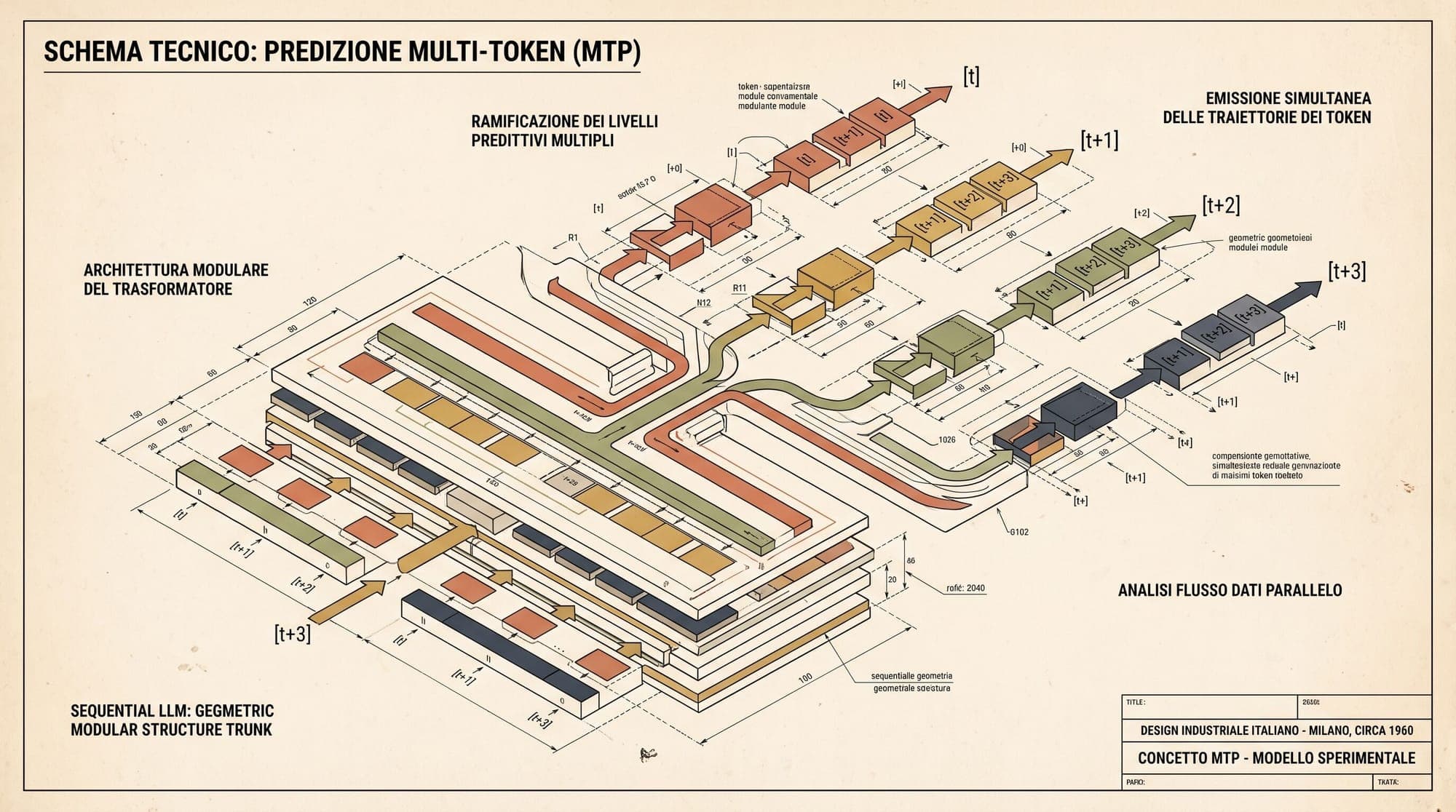
Multi-Token Prediction (MTP): Mathematical Foundations, Sequential Latent Stacking, Auxiliary Loss Schedules, and Speculative Inference Acceleration
Autoregressive language models have traditionally been trained under a single-token objective: predicting the immediate next token given the causal context . While this next-token prediction (NTP) paradigm scales predictably with parameter count and dataset volume, it suffers from severe structural limitations. NTP optimizes exclusively for immediate local token transitions, leaving models prone to greedy search myopia, teacher-forcing exposure bias, and inefficient gradient utilization.
Multi-Token Prediction (MTP) fundamentally reformulates the pre-training and fine-tuning objective. Instead of predicting only the subsequent token, the model is trained to simultaneously forecast future tokens at each sequence position . Pioneered theoretically by Gloeckle et al. at Meta FAIR (2024) and deployed at scale in frontier architectures such as DeepSeek-V3 (2024), MTP alters both the representation geometry of transformer backbones and the mechanics of LLM inference serving.
This guide provides an end-to-end technical breakdown of Multi-Token Prediction: its mathematical formulation, architectural implementations across independent and sequential paradigms, gradient dynamics, pre-training loss schedules, and its dual role in native self-speculative decoding.

1. The Next-Token Prediction Bottleneck
To understand why Multi-Token Prediction improves both sample efficiency and downstream capabilities, we first formalize the failure modes of standard autoregressive pre-training.
1.1 Mathematical Formulation of Next-Token Prediction
Given a sequence of discrete tokens from a vocabulary , standard language modeling minimizes the empirical negative log-likelihood (NLL):
The conditional probability is computed by passing the sequence through an embedding layer, causal transformer blocks, and a linear unembedding head :
1.2 Structural Limitations of NTP
While computationally tractable, NTP introduces three distinct pathologies:
- Local Decision Myopia and Planning Deficits: NTP assigns equal optimization weight to all token positions, regardless of their semantic information density. The model receives identical supervisory feedback when predicting trivial syntactic formatting (e.g., semicolons, commas) as it does when selecting critical algorithmic branching logic. Because the objective does not require reasoning beyond , representations in the upper layers frequently over-index on immediate lexical transitions rather than long-horizon sequence trajectories.
- Exposure Bias and Compounding Rollout Errors: During pre-training, the model always conditions on ground-truth prefix tokens (teacher forcing). At inference time, errors made at step pollute the context for step , causing rapid distributional drift. NTP provides no gradient pressure to build representations that are robust to multi-step divergence.
- Low Gradient Signal per Forward Pass: In standard NTP, a sequence of length yields exactly supervisory scalar losses. Each token position informs only a single step of forward prediction, discarding the rich statistical dependencies that connect position to positions .
2. Multi-Token Prediction Architectures
Two primary architectural paradigms have emerged for multi-token prediction: parallel independent prediction heads and sequential causal latent stacking.
PARALLEL HEADS (Meta FAIR)            SEQUENTIAL LATENT STACKING (DeepSeek-V3)

   [x_{t+1}]  [x_{t+2}]  [x_{t+3}]                  [x_{t+1}]     [x_{t+2}]
       ^          ^          ^                          ^             ^
     Head 1     Head 2     Head 3                     Head 0        Head 1
       |          |          |                          |             |
   +-----------------------------+                  +--------+    +--------+
   |    Shared Backbone (h_t)    |                  |  Trunk |    | MTP L1 |<-- Emb(x_{t+1})
   +-----------------------------+                  +--------+    +--------+
                                                        |             |
                                                     Input x       h_t^0
2.1 Meta FAIR Parallel Multi-Head Formulation
The formulation by Gloeckle et al. (2024) uses a single shared transformer trunk followed by distinct output heads . Each head is tasked with predicting the token at offset :
Each head can be implemented either as a simple linear projection or as a lightweight transformer layer. All heads share the primary unembedding matrix to regularize the representation space and reduce parameter expansion.
2.2 DeepSeek-V3 Sequential Latent Stacking
While parallel heads predict future tokens independently from the trunk representation , they cannot condition the prediction of on the intermediate representation of . To address this limitation, DeepSeek-V3 introduces sequential MTP modules that maintain causal conditioning across the prediction horizon.
For a depth- MTP setup (predicting additional tokens ahead), sequential modules are stacked on top of the main transformer trunk. The -th MTP module () consists of:
- A linear projection matrix .
- A shared token embedding layer .
- An auxiliary transformer block .
- A shared output head .
At sequence position , the -th MTP module takes the hidden state from the previous depth and concatenates it with the embedding of the ground-truth future token :
where denotes concatenation along the channel dimension. The projected representation is normalized and passed through the shared unembedding matrix:
By concatenating , the -th module is strictly conditioned on the actual intermediate token, preserving causal autoregressive structure throughout the entire multi-token forward chain.
3. Loss Formulations, Optimization Dynamics, and Scheduling
3.1 The Composite MTP Loss Objective
The complete training objective combines the primary next-token loss with the averaged auxiliary multi-token losses across the prediction horizon :
where represents the cross-entropy loss at depth :
and is a balancing hyperparameter that scales the auxiliary gradient contributions.
3.2 Gradient Backpropagation Dynamics
To understand how MTP modifies the internal representations of the base trunk, we examine the gradient of the composite loss with respect to the trunk hidden state :
This composite gradient introduces key inductive biases into the model:
- Multi-Step Horizon Backpropagation: Gradients from predicting flow directly backward into . This forces the primary transformer layers to construct representations that contain invariant features predictive of broader multi-step trajectory dynamics.
- Mitigation of Representation Collapse: In standard NTP, intermediate representations can collapse into narrow subspaces that only distinguish the immediate next token. MTP prevents this by forcing to retain sufficient mutual information with future sequence states: .
                            LOSS BACKPROPAGATION

   Loss_NTP (x_{t+1})    Loss_MTP1 (x_{t+2})    Loss_MTP2 (x_{t+3})
          |                     |                      |
          v                     v                      v
     Trunk Head             MTP Head 1             MTP Head 2
          |                     |                      |
          |                     +------> MTP Layer 1 <-+
          |                                 |
          +---------------------------------+
                            |
                            v
               Composite Gradient -> Trunk h_t^0
3.3 Auxiliary Loss Weight Scheduling
In production pre-training runs, maintaining a static loss weight throughout the entire training duration can destabilize learning during early warmup or over-constrain the trunk during final convergence.
DeepSeek-V3 adopted a two-phase scheduled weighting strategy across its 14.8-trillion token pre-training curriculum:
- Phase 1 (0 to 10.0 Trillion Tokens): . High auxiliary weighting forces the model to prioritize dense semantic representations and long-horizon planning early in pre-training.
- Phase 2 (10.0 to 14.8 Trillion Tokens): . The auxiliary weighting is decayed to allow the model to fine-tune its high-precision next-token calibration on late-stage domain data.
4. Empirical Scaling and Downstream Performance
Empirical evaluations across both Meta FAIR's benchmarks and DeepSeek-V3 reveal that Multi-Token Prediction exhibits distinct scaling behaviors across model sizes and task domains.
4.1 Parameter Scaling Threshold
A critical finding from Gloeckle et al. (2024) is that MTP displays strong positive parameter scaling:
- Small Models (< 1B parameters): Gains from MTP are modest or negligible. Small models lack the capacity to simultaneously model local syntax and multi-token semantic futures, leading to underfitting on both objectives.
- Medium to Large Models (7B to 70B+ parameters): Gains scale significantly with parameter count. At 13B parameters, 4-token prediction models achieve a 12% absolute improvement on HumanEval pass@1 and a 17% improvement on MBPP pass@1 over compute-equivalent next-token baselines.
4.2 Benchmark Gains on Algorithmic and Reasoning Tasks
The performance advantages of MTP are heavily concentrated in tasks requiring strict hierarchical planning, such as programming and mathematical derivation:
| Model Architecture | HumanEval (Pass@1) | MBPP (Pass@1) | GSM8K | Codeforces Rating | | :--- | :--- | :--- | :--- | :--- | | Llama-style 7B (Standard NTP) | 31.4% | 53.4% | 48.2% | 412 | | Llama-style 7B (4-Token MTP) | 39.6% (+8.2%) | 63.7% (+10.3%) | 54.1% (+5.9%) | 580 (+168) | | DeepSeek-V3 (Base, NTP-only ablation) | 61.2% | 72.8% | 84.1% | 1240 | | DeepSeek-V3 (Base, 1-Depth MTP) | 65.4% (+4.2%) | 76.1% (+3.3%) | 86.5% (+2.4%) | 1385 (+145) |
The outsized gains in code generation occur because programming languages contain rigid syntactic boilerplate (e.g., function signatures, loop declarations) followed by branching logic. MTP allows the trunk to treat boilerplate as predictable multi-token chunks, reserving its representational capacity for algorithmic decisions.
5. Inference Acceleration via Native Speculative Decoding
Beyond pre-training gains, MTP provides a dual utility: the auxiliary prediction heads can be directly repurposed as a zero-overhead speculative drafting engine during inference.
5.1 The Standard Speculative Decoding Dilemma
Standard speculative decoding requires hosting two distinct models: a large target model and a smaller draft model (e.g., Llama-3-70B paired with Llama-3-8B). This introduces operational overhead:
- Maintaining two separate sets of model weights in GPU VRAM.
- Managing dual KV-caches with differing memory layouts and context fragmentation.
- Handling tokenizer distribution discrepancies between independent models.
5.2 Self-Speculative Decoding with MTP Modules
Because MTP modules share the trunk representations, embeddings, and unembedding matrices, they provide native draft candidates in a single forward execution graph.
For an MTP depth (predicting 2 tokens per step):
- Draft Generation (Step ): The base model computes logits for . The MTP module 1 takes and the greedily sampled (or top-ranked) embedding to produce candidate .
- Verification (Step ): In the next forward pass, the main model evaluates the candidate sequence in parallel. If matches the main model's verified distribution, two tokens are emitted in a single target forward pass. Simultaneously, MTP module 1 generates candidate .
                 SELF-SPECULATIVE GENERATION CYCLE

Forward Pass t:
  Context: [x_1, ..., x_t]
  Main Model Output:       x_{t+1} (Accepted)
  MTP Module 1 Output:     x_{t+2} (Proposed Draft)

Forward Pass t+1 (Verification + Proposal):
  Context: [x_1, ..., x_t, x_{t+1}, x_{t+2}]
  Main Model Output:       Verifies x_{t+2} (Accepted) -> Generates x_{t+3}
  MTP Module 1 Output:     Proposes x_{t+4}

Throughput Gain: 2 tokens accepted per single model verification step.
In production inference frameworks such as SGLang and vLLM, enabling MTP speculative decoding on DeepSeek-V3 yields an end-to-end inference acceleration factor of to with zero degradation in generation quality.
6. PyTorch Implementation: Sequential MTP Module and Training Loss
The following production-ready implementation defines a complete Sequential Multi-Token Prediction module adhering to the DeepSeek-V3 specification, including shared embeddings, RMSNorm projection stacking, and composite loss computation.
import torch
import torch.nn as nn
import torch.nn.functional as F
from typing import List, Tuple, Optional


class RMSNorm(nn.Module):
    """Root Mean Square Layer Normalization."""
    def __init__(self, dim: int, eps: float = 1e-6):
        super().__init__()
        self.eps = eps
        self.weight = nn.Parameter(torch.ones(dim))

    def forward(self, x: torch.Tensor) -> torch.Tensor:
        variance = x.pow(2).mean(-1, keepdim=True)
        return x * torch.rsqrt(variance + self.eps) * self.weight


class MTPModule(nn.Module):
    """
    Single Sequential Multi-Token Prediction (MTP) Module (Depth k).
    Combines hidden state from depth (k-1) with the ground-truth token embedding
    at position (t+k), passes through a Transformer block, and emits logits for (t+k+1).
    """
    def __init__(
        self,
        hidden_dim: int,
        num_heads: int,
        ffn_dim: int,
        shared_embedding: nn.Embedding,
        shared_unembedding: nn.Linear,
        eps: float = 1e-6
    ):
        super().__init__()
        self.hidden_dim = hidden_dim
        self.shared_embedding = shared_embedding
        self.shared_unembedding = shared_unembedding

        # Projection matrix M_k mapping concatenated [h^{k-1}; emb(x_{t+k})] from 2d -> d
        self.proj = nn.Linear(2 * hidden_dim, hidden_dim, bias=False)
        self.norm_h = RMSNorm(hidden_dim, eps=eps)
        self.norm_emb = RMSNorm(hidden_dim, eps=eps)

        # Dedicated Transformer Block for this MTP depth
        self.attn_norm = RMSNorm(hidden_dim, eps=eps)
        self.attn = nn.MultiheadAttention(
            embed_dim=hidden_dim,
            num_heads=num_heads,
            batch_first=True
        )
        self.ffn_norm = RMSNorm(hidden_dim, eps=eps)
        self.ffn = nn.Sequential(
            nn.Linear(hidden_dim, ffn_dim, bias=False),
            nn.SiLU(),
            nn.Linear(ffn_dim, hidden_dim, bias=False)
        )
        self.final_norm = RMSNorm(hidden_dim, eps=eps)

    def forward(
        self,
        prev_h: torch.Tensor,       # [B, T, d] - hidden state from depth k-1
        future_tokens: torch.Tensor, # [B, T] - token IDs at position (t+k)
        causal_mask: Optional[torch.Tensor] = None
    ) -> Tuple[torch.Tensor, torch.Tensor]:
        """
        Returns:
            next_h: [B, T, d] - hidden state at depth k
            logits: [B, T, vocab_size] - prediction logits for token (t+k+1)
        """
        # Embed future tokens
        future_emb = self.shared_embedding(future_tokens) # [B, T, d]

        # Normalize and concatenate along channel dimension
        normed_h = self.norm_h(prev_h)
        normed_emb = self.norm_emb(future_emb)
        combined = torch.cat([normed_h, normed_emb], dim=-1) # [B, T, 2d]

        # Linear projection to hidden dimension
        h = self.proj(combined) # [B, T, d]

        # Transformer Block forward pass
        attn_out, _ = self.attn(
            query=self.attn_norm(h),
            key=self.attn_norm(h),
            value=self.attn_norm(h),
            attn_mask=causal_mask,
            need_weights=False
        )
        h = h + attn_out
        h = h + self.ffn(self.ffn_norm(h))

        # Final prediction logits via shared unembedding matrix
        logits = self.shared_unembedding(self.final_norm(h)) # [B, T, V]
        return h, logits


class MultiTokenPredictionEngine(nn.Module):
    """
    Complete Multi-Token Prediction training engine managing sequential MTP modules.
    """
    def __init__(
        self,
        vocab_size: int,
        hidden_dim: int,
        num_heads: int,
        ffn_dim: int,
        mtp_depth: int = 1,
        lambda_mtp: float = 0.3
    ):
        super().__init__()
        self.vocab_size = vocab_size
        self.hidden_dim = hidden_dim
        self.mtp_depth = mtp_depth
        self.lambda_mtp = lambda_mtp

        # Shared weights
        self.embedding = nn.Embedding(vocab_size, hidden_dim)
        self.unembedding = nn.Linear(hidden_dim, vocab_size, bias=False)
        self.unembedding.weight = self.embedding.weight # Weight tying

        # Sequential MTP modules
        self.mtp_modules = nn.ModuleList([
            MTPModule(
                hidden_dim=hidden_dim,
                num_heads=num_heads,
                ffn_dim=ffn_dim,
                shared_embedding=self.embedding,
                shared_unembedding=self.unembedding
            )
            for _ in range(mtp_depth)
        ])

    def compute_loss(
        self,
        trunk_h: torch.Tensor,   # [B, T, d] - final representations from main transformer
        input_ids: torch.Tensor, # [B, T] - input token sequence
        labels: torch.Tensor     # [B, T] - ground truth next-token labels (x_{t+1})
    ) -> Tuple[torch.Tensor, dict]:
        """
        Computes composite NTP + MTP loss across sequence batch.
        """
        B, T, d = trunk_h.shape
        metrics = {}

        # 1. Primary Next-Token Prediction Loss (Depth 0)
        main_logits = self.unembedding(RMSNorm(d).to(trunk_h.device)(trunk_h))
        loss_ntp = F.cross_entropy(
            main_logits.view(-1, self.vocab_size),
            labels.view(-1),
            ignore_index=-100
        )
        metrics["loss_ntp"] = loss_ntp.item()

        total_mtp_loss = torch.tensor(0.0, device=trunk_h.device)
        current_h = trunk_h

        # Build causal attention mask for MTP blocks
        causal_mask = torch.triu(
            torch.full((T, T), float("-inf"), device=trunk_h.device), diagonal=1
        )

        # 2. Sequential Auxiliary Losses (Depths 1..D)
        for k, module in enumerate(self.mtp_modules, start=1):
            # Target token for depth k prediction is x_{t+k+1}
            # Conditioned token is x_{t+k}
            if k >= T:
                break

            # Slice valid temporal horizon
            # prev_h corresponds to positions [0 .. T - k - 1]
            prev_h_slice = current_h[:, :-k, :]
            future_token_slice = labels[:, : -k] # Token x_{t+k}
            target_token_slice = labels[:, k:]   # Token x_{t+k+1}

            mask_slice = causal_mask[: T - k, : T - k]

            next_h, mtp_logits = module(
                prev_h=prev_h_slice,
                future_tokens=future_token_slice,
                causal_mask=mask_slice
            )

            loss_k = F.cross_entropy(
                mtp_logits.reshape(-1, self.vocab_size),
                target_token_slice.reshape(-1),
                ignore_index=-100
            )
            metrics[f"loss_mtp_depth_{k}"] = loss_k.item()
            total_mtp_loss = total_mtp_loss + loss_k

            # Pad next_h with zeros to maintain temporal alignment if cascaded further
            current_h = F.pad(next_h, (0, 0, 0, k), mode="constant", value=0.0)

        # Composite Objective
        avg_mtp_loss = total_mtp_loss / max(1, self.mtp_depth)
        composite_loss = loss_ntp + self.lambda_mtp * avg_mtp_loss
        metrics["loss_composite"] = composite_loss.item()

        return composite_loss, metrics


if __name__ == "__main__":
    torch.manual_seed(42)
    B, T, V, D = 2, 32, 1000, 128
    engine = MultiTokenPredictionEngine(
        vocab_size=V,
        hidden_dim=D,
        num_heads=4,
        ffn_dim=256,
        mtp_depth=2,
        lambda_mtp=0.3
    )

    dummy_trunk_h = torch.randn(B, T, D)
    dummy_input_ids = torch.randint(0, V, (B, T))
    dummy_labels = torch.roll(dummy_input_ids, shifts=-1, dims=-1)
    dummy_labels[:, -1] = -100 # Mask terminal position

    loss, logs = engine.compute_loss(dummy_trunk_h, dummy_input_ids, dummy_labels)
    print("Optimization Metrics:")
    for key, val in logs.items():
        print(f"  {key}: {val:.4f}")
7. Comparative Analysis: Speculative and Multi-Token Paradigms
Multi-token prediction interacts with several related inference acceleration and speculative drafting techniques. The table below outlines structural differences:
| Technique | Parameter Overhead | Training Requirement | Draft Model Needed? | Verification Strategy | Primary Benefit | | :--- | :--- | :--- | :--- | :--- | :--- | | Standard NTP | None (Baseline) | Standard Pre-training | No | Autoregressive (1 token/step) | Minimal memory footprint | | Meta FAIR Parallel MTP | +2% to +5% (Heads) | Pre-training with MTP Loss | No | Self-speculative greedy check | Stronger code/reasoning scaling | | DeepSeek-V3 Sequential MTP | +1 Layer per Depth | Pre-training with MTP Loss | No | Sequential self-speculation | Best causal calibration & 2x serving speed | | Medusa | +1% to +3% (Heads) | Post-training fine-tuning | No | Tree-structured attention | Fast post-hoc inference acceleration | | EAGLE / EAGLE-2 | +1 Lightweight Layer | Post-training fine-tuning | No | Feature-level draft autoregression | High acceptance rate on general text | | Classic Speculative Decoding | +10% to +25% (Draft LLM) | None (Pre-trained pair) | Yes (Separate Model) | Target model forward pass | General acceleration without architecture modifications |
8. Key Architectural Takeaways
- Dual Utility: Multi-Token Prediction provides simultaneous pre-training representation enhancement and inference serving acceleration. Models develop long-horizon planning capabilities while gaining native speculative decoding support.
- Sequential over Parallel: Sequential latent stacking (as introduced in DeepSeek-V3) outperforms parallel independent heads by conditioning deeper prediction modules on intermediate token embeddings, preserving strict causal coherence.
- Task-Specific Scaling: MTP yields outsized performance gains in structured, algorithmic domains (code generation, formal mathematics) where mitigating local decision myopia directly improves multi-step execution paths.
- Scheduled Loss Weighting: Decaying the auxiliary loss weight (e.g., from 0.3 down to 0.1) across pre-training phases balances early global representation formation with late-stage next-token calibration.
Sources
- Gloeckle, F., Youbi Idrissi, B., Rozière, B., Lopez-Paz, D., & Synnaeve, G. (2024). Better & Faster Large Language Models via Multi-token Prediction. arXiv:2404.19737.
- DeepSeek-AI. (2024). DeepSeek-V3 Technical Report. arXiv:2412.19437.
- AMD ROCm AI Developer Hub. (2025). Accelerating DeepSeek-V3 Inference Using Multi-Token Prediction in SGLang. AMD Documentation.
- NVIDIA Megatron-LM Bridge. (2025). Multi-Token Prediction (MTP) Training Recipe. NVIDIA Documentation.
- Cai, T., Li, Y., Geng, Z., Peng, B., Lee, J. D., & Chen, T. (2024). Medusa: Simple LLM Inference Acceleration with Multiple Decoding Heads. arXiv:2401.10774.
- Li, Y., Wei, F., Zhang, C., & Zhang, H. (2024). EAGLE: Speculative Sampling Requires Rethinking Feature Uncertainty. arXiv:2401.15077.



