
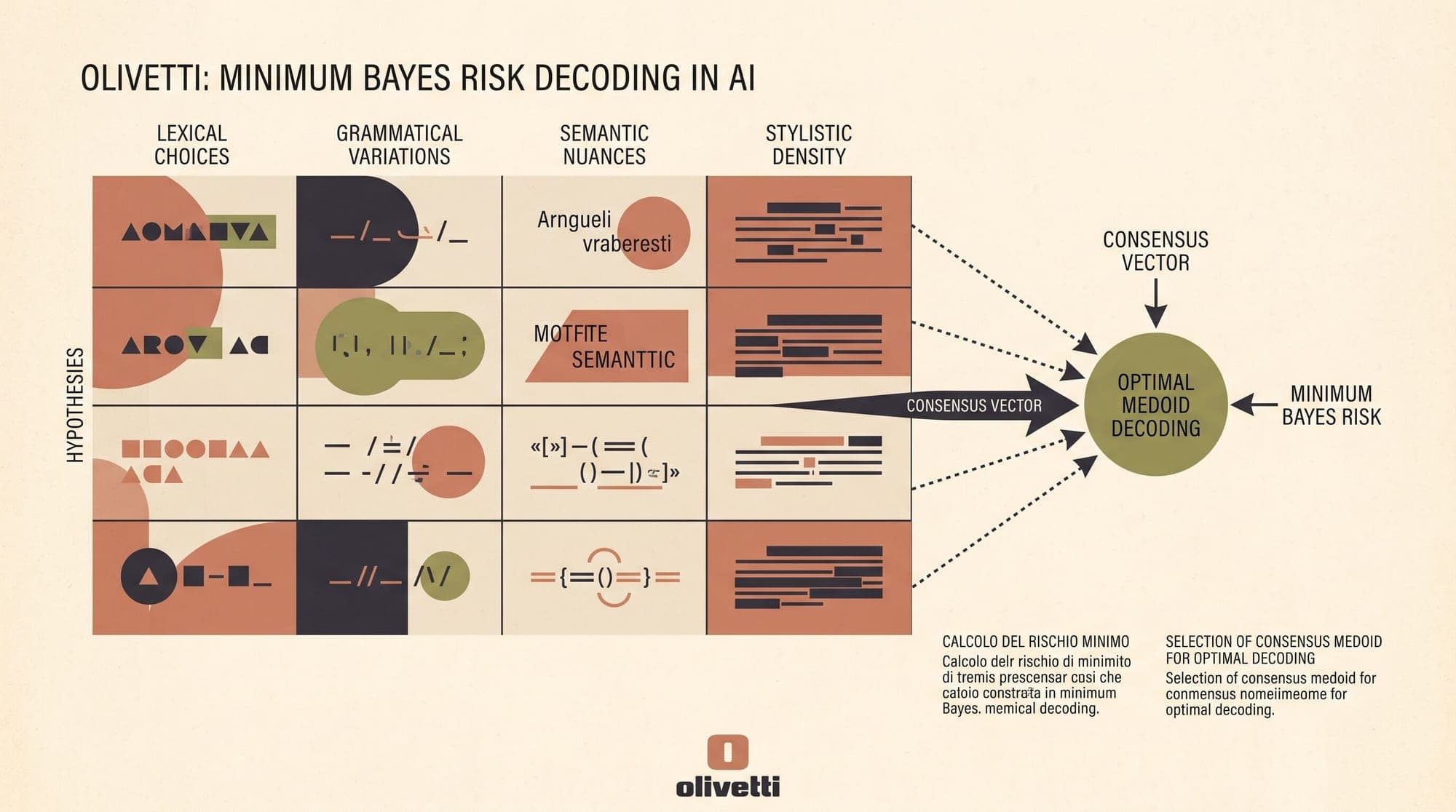
Autoregressive large language models generate text by estimating conditional probability distributions over token sequences. In conventional inference pipelines, generating the final output sequence relies almost entirely on search algorithms designed to locate high-probability trajectories: greedy decoding, beam search, or stochastic sampling with temperature and top-p filtering.
However, theoretical and empirical analyses demonstrate that the most probable sequence under a model's distribution (the mode) is frequently degenerate, repetitive, or unrepresentative of high-quality human text. Minimum Bayes Risk (MBR) decoding replaces the objective of finding the single most probable string with a statistical decision-theoretic framework: selecting the candidate output that maximizes expected utility across a sampled pool of plausible hypotheses.
The Failure Modes of Maximum A Posteriori (MAP) Decoding
An autoregressive language model decomposes the joint probability of a sequence y = (y_1, y_2, ..., y_T) conditioned on prompt x through the chain rule of probability:
P(y|x) = Product_{t=1}^T P(y_t | y_{<t}, x)
Standard sequence generation seeks the Maximum A Posteriori (MAP) estimate, defined as:
y_MAP = argmax_{y in Y} P(y|x)
Because the search space Y grows exponentially with sequence length (|V|^T for vocabulary V and sequence length T), exact MAP search is computationally intractable. In practice, decoding engines approximate MAP search using beam search or greedy decoding.

Research by Eikema and Aziz (2020) uncovered fundamental pathologies in MAP decoding for neural sequence models:
- The Empty String and Length Bias: In open vocabulary generation, every additional token multiplies the sequence probability by a conditional probability P(y_t | y_{<t}, x) < 1. Consequently, raw joint probabilities strongly favor shorter outputs. In unconstrained search, the absolute global mode of standard neural translation models is often the empty string or an unnaturally truncated fragment.
- Probability Mass Dispersion: In high-dimensional discrete token spaces, probability mass is dispersed across billions of reasonable alternative phrasings. The single sequence with the highest joint probability typically accounts for an infinitesimally small fraction of total posterior mass (often P(y|x) < 1e-5). Finding the mode isolates a sharp statistical spike that rarely corresponds to the semantic center of the distribution.
- Degeneracy and Hallucination: Beam search often traps the decoder in local probability loops ("loops of death") or hallucinated named entities that achieve high local confidence while deviating from factual ground truth.
Decision-Theoretic Formulation of Minimum Bayes Risk
Minimum Bayes Risk decoding frames text generation as a statistical decision problem under uncertainty (Goel and Byrne, 2000; Kumar and Byrne, 2004).
Instead of assuming the model's highest-probability sequence is optimal, MBR assumes the model's conditional distribution P(y|x) represents the true posterior distribution over acceptable outputs. Given a task-specific utility function u(y, y) that quantifies the quality of candidate sequence y against true target y*, the Bayes risk is the expected loss:
R(y|x) = E_{y* ~ P(y|x)} [L(y, y)]
Maximizing expected utility u(y, y) = -L(y, y) yields the MBR decision rule:
y_MBR = argmax_{y in Y} E_{y* ~ P(y|x)} [u(y, y)] = argmax_{y in Y} Sum_{y* in Y} P(y|x) u(y, y)
Because marginalizing over the infinite space Y is intractable, Eikema and Aziz (2020) and Freitag et al. (2022) introduced Sample-Based MBR Decoding.
In sample-based MBR, the continuous expectation is approximated via Monte Carlo integration:
- Draw a candidate pool of hypotheses H_cand = {y_1, y_2, ..., y_N} from the model posterior P(y|x) using stochastic sampling (such as ancestral sampling or temperature sampling with T in [0.6, 0.8]).
- Draw a reference pool of pseudo-ground-truth sequences H_ref = {r_1, r_2, ..., r_M} from the same distribution (often H_cand = H_ref).
- Score each candidate hypothesis y_i by its average pairwise utility against all pseudo-references r_m:
y_MBR = argmax_{y_i in H_cand} (1 / M) * Sum_{m=1}^M u(y_i, r_m)
The candidate that demonstrates the highest consensus across the empirical distribution is selected as the final output.
Utility Functions Across the MBR Hierarchy
The effectiveness of MBR decoding depends on the choice of utility function u(y, r):
- Lexical Overlap Metrics (BLEU, ROUGE-L, chrF, METEOR): These metrics evaluate surface token and character n-gram overlap in O(1) string operations per pair. While fast, they penalize valid synonym substitutions and stylistic paraphrasing.
- Dense Semantic Embeddings (BERTScore, Sentence-Transformers Cosine Similarity): Dense encoders project sequences into continuous latent spaces. Utility is measured via vector similarity, capturing semantic equivalence across distinct surface forms.
- Learned Neural Cross-Encoders (COMET, MetricX, BLEURT): Metrics like COMET (Rei et al., 2020) and MetricX (Juraska et al., 2023) feed source prompt, candidate hypothesis, and pseudo-reference through transformer layers to compute continuous quality scores. Freitag et al. (2022) demonstrated that MBR equipped with neural quality metrics substantially outperforms beam search on human evaluation benchmarks.
- Reference-Based LLM Judges: Recent studies by Bertsch et al. (2024) show that using compact open models (such as Prometheus 7B) as reference-based pairwise utility evaluators in MBR allows small judge models to supervise and steer much larger 70B generation models.
Comparative Architecture: MBR vs. Best-of-N vs. Self-Consistency
Modern inference strategies employ varied test-time compute patterns:
+-------------------------------------------------------------------------------------------------------+
|                                          TEST-TIME DECODING PARADIGMS                                |
+-------------------------------------------------------------------------------------------------------+
|  1. BEAM SEARCH (MAP Approximation)                                                                  |
|     Prompt (x) ---> [ Autoregressive Expansion ] ---> Single High-Probability Sequence (Argmax P(y|x))|
|     * Weakness: Pathological modes, repetition loops, length penalties.                              |
+-------------------------------------------------------------------------------------------------------+
|  2. SELF-CONSISTENCY (Majority Voting)                                                                |
|     Prompt (x) ---> [ Sample N Solutions ] ---> Exact Match Grouping ---> Majority Discrete Label    |
|     * Weakness: Restricted to discrete/symbolic answers; fails on open-ended prose.                  |
+-------------------------------------------------------------------------------------------------------+
|  3. BEST-OF-N / REJECTION SAMPLING                                                                    |
|     Prompt (x) ---> [ Sample N Solutions ] ---> Pointwise Reward Model R(x, y_i) ---> Argmax R(x, y_i)|
|     * Weakness: Susceptible to Reward Hacking and Goodhart's Law; outlier exploits win.              |
+-------------------------------------------------------------------------------------------------------+
|  4. MINIMUM BAYES RISK (Distributional Consensus)                                                    |
|     Prompt (x) ---> [ Sample N Solutions ] ---> N x N Pairwise Cross-Utility Matrix ---> Medoid Output|
|     * Strength: Intrinsically regularized against reward hacking and single-point hallucinations.     |
+-------------------------------------------------------------------------------------------------------+
MBR vs. Best-of-N Rejection Sampling
In Best-of-N (BoN) sampling, an external scalar Reward Model R(x, y) evaluates each candidate in isolation:
y_BoN = argmax_{y_i in H} R(x, y_i)
Because the reward model evaluates samples independently, BoN is vulnerable to Goodhart's Law: candidates that trigger false-positive reward activations (such as verbosity biases, formulaic formatting, or confidently phrased falsehoods) receive high scores.
In contrast, MBR evaluates each candidate against the collective sample distribution. If one candidate exploits a reward anomaly but diverges from the semantic consensus of the remaining N-1 samples, its pairwise utility across the reference pool drops sharply. MBR acts as an intrinsic distributional filter.
MBR vs. Self-Consistency
Self-Consistency (Wang et al., 2022) aggregates multiple reasoning paths by grouping final answers via exact string equality:
ans_hat = argmax_a Sum_{i=1}^N I(ans(y_i) = a)
Self-Consistency is highly effective for symbolic, arithmetic, and coding benchmarks with verifiable discrete answers. However, in open-ended text generation (summarization, translation, report writing), no two sampled sequences are character-identical. MBR generalizes the consensus principle to continuous semantic spaces through soft utility metrics u(y, r).
Computational Complexity and Acceleration Techniques
The primary barrier to deploying MBR in production systems is computational complexity:
- Quadratic Pairwise Scoring: Evaluating N candidate hypotheses against M pseudo-references requires N * M metric evaluations (O(N^2) when N = M). For N = 64, this requires 4,096 pairwise comparisons per prompt.
- Inference Latency: When using heavy neural cross-encoders (such as COMET or MetricX), computing 4,096 forward passes introduces prohibitive latency.
Several algorithmic innovations resolve these bottlenecks:
1. Linear-Time Centroid and Medoid Decoding
When the utility function is defined as the cosine similarity between dense sentence embeddings e(y) = f(y) / ||f(y)||_2, the quadratic sum factors into a single vector inner product (Deguchi et al., 2024):
(1 / M) * Sum_{m=1}^M u(y_i, r_m) = (1 / M) * Sum_{m=1}^M e(y_i)^T e(r_m) = e(y_i)^T * ((1 / M) * Sum_{m=1}^M e(r_m)) = e(y_i)^T * c
where c = (1 / M) * Sum_{m=1}^M e(r_m) is the mean centroid embedding of the sample pool.
Instead of performing O(N^2) pairwise operations, the engine:
- Computes N dense embeddings e(y_1), ..., e(y_N) in a single batched forward pass (O(N)).
- Computes centroid c via a single vector mean (O(N)).
- Evaluates N dot products e(y_i)^T * c to identify the medoid hypothesis (O(N)).
This reduces the scoring complexity from O(N^2) to O(N), enabling real-time MBR execution within milliseconds.
2. Coarse-to-Fine and Pruned MBR
Cheng and Vlachos (2023) and Deguchi et al. (2024) developed two-stage pruning pipelines:
- Stage 1: Fast lexical or embedding metrics filter the candidate set from N=64 down to K=8 top hypotheses.
- Stage 2: Heavy neural metrics (such as MetricX or COMET) evaluate only the top K candidates against the reference pool, cutting cross-encoder evaluations by over 80%.
3. MBR Policy Distillation
Rather than running sample-based MBR at test time, recent architectures distill MBR selections directly into model parameters during post-training (Finkelstein and Freitag, 2024; Ramos et al., 2024):
- Generate candidate pools offline across pre-training or fine-tuning datasets.
- Apply MBR decoding to identify the consensus sequence for each training prompt.
- Train the student model via Supervised Fine-Tuning (SFT) or DPO on the MBR-selected targets.
This transfers the distributional robustness and factual fidelity of MBR decoding into single-pass greedy inference.
Empirical Impact and Production Trade-Offs
Across standardized language generation benchmarks, MBR decoding demonstrates consistent performance advantages over traditional search strategies:
- Machine Translation: On WMT benchmarks, MBR with neural utility metrics (COMET/BLEURT) consistently outscores beam search by 1.5 to 3.0+ points across high-resource and low-resource language pairs, virtually eliminating omission and repetition errors.
- Hallucination Suppression: In multi-document summarization, MBR reduces factual inconsistency rates by up to 40% compared to greedy decoding. Because hallucinated facts appear inconsistently across stochastic samples, they receive low average utility across the reference distribution.
- Length and Style Calibration: Unlike beam search (which requires empirical length penalty tuning alpha) and Best-of-N (which often selects disproportionately verbose responses), MBR naturally converges on the median length and structural density of the model's posterior.
By shifting the generation objective from mode-seeking search to expected utility maximization, Minimum Bayes Risk decoding bridges the gap between raw probabilistic modeling and human evaluation standards.
Sources
- Is MAP Decoding All You Need? The Inadequacy of the Mode in Neural Machine Translation (Eikema & Aziz, 2020)
- High Quality Rather than High Model Probability: Minimum Bayes Risk Decoding with Neural Metrics (Freitag et al., Google Research, 2022)
- Better Instruction-Following Through Minimum Bayes Risk (Bertsch et al., 2024)
- Centroid-Based Efficient Minimum Bayes Risk Decoding (Deguchi et al., 2024)
- Self-Consistency Improves Chain of Thought Reasoning in Language Models (Wang et al., 2022)
- Faster Minimum Bayes Risk Decoding with Confidence-Based Pruning (Cheng & Vlachos, EMNLP 2023)
- Minimum Bayes-Risk Decoding for Statistical Machine Translation (Kumar & Byrne, 2004)



