Fine-tuning large language models on custom datasets presents a significant hardware challenge. While running inference on a 70-billion parameter model requires only the model weights in memory, full-parameter fine-tuning (FPFT) demands an order of magnitude more resources. During standard 16-bit mixed-precision training with optimizers such as AdamW, each parameter requires 2 bytes for the static weight, 2 bytes for the gradient, 4 bytes for the 32-bit master weight copy, and 8 bytes for the first and second optimizer momentum states. Storing these model states requires at least 16 bytes per parameter, translating to more than 1.1 terabytes of GPU memory for a 70-billion parameter architecture before accounting for intermediate activation tensors.
Parameter-efficient fine-tuning (PEFT) methods resolve this bottleneck by freezing the pre-trained base model and training a small set of auxiliary parameters. Among these techniques, Low-Rank Adaptation (LoRA) and its 4-bit quantized extension (QLoRA) have become the standard architectures for model adaptation in research and production.
The Intrinsic Low-Rank Hypothesis
The theoretical foundation of low-rank adaptation rests on the intrinsic dimensionality of neural network representations. Research by Aghajanyan et al. (2020) demonstrated that over-parameterized language models reside on a low-dimensional manifold during downstream task adaptation. Although the full parameter matrix contains millions of entries across high-dimensional space, the parameter update matrix necessary to adapt the network to a specialized domain exhibits a very low intrinsic rank , where .
This observation implies that the update matrix can be decomposed into the product of two low-rank matrices without sacrificing the representation capacity needed for task adaptation.
Mathematical Architecture of LoRA
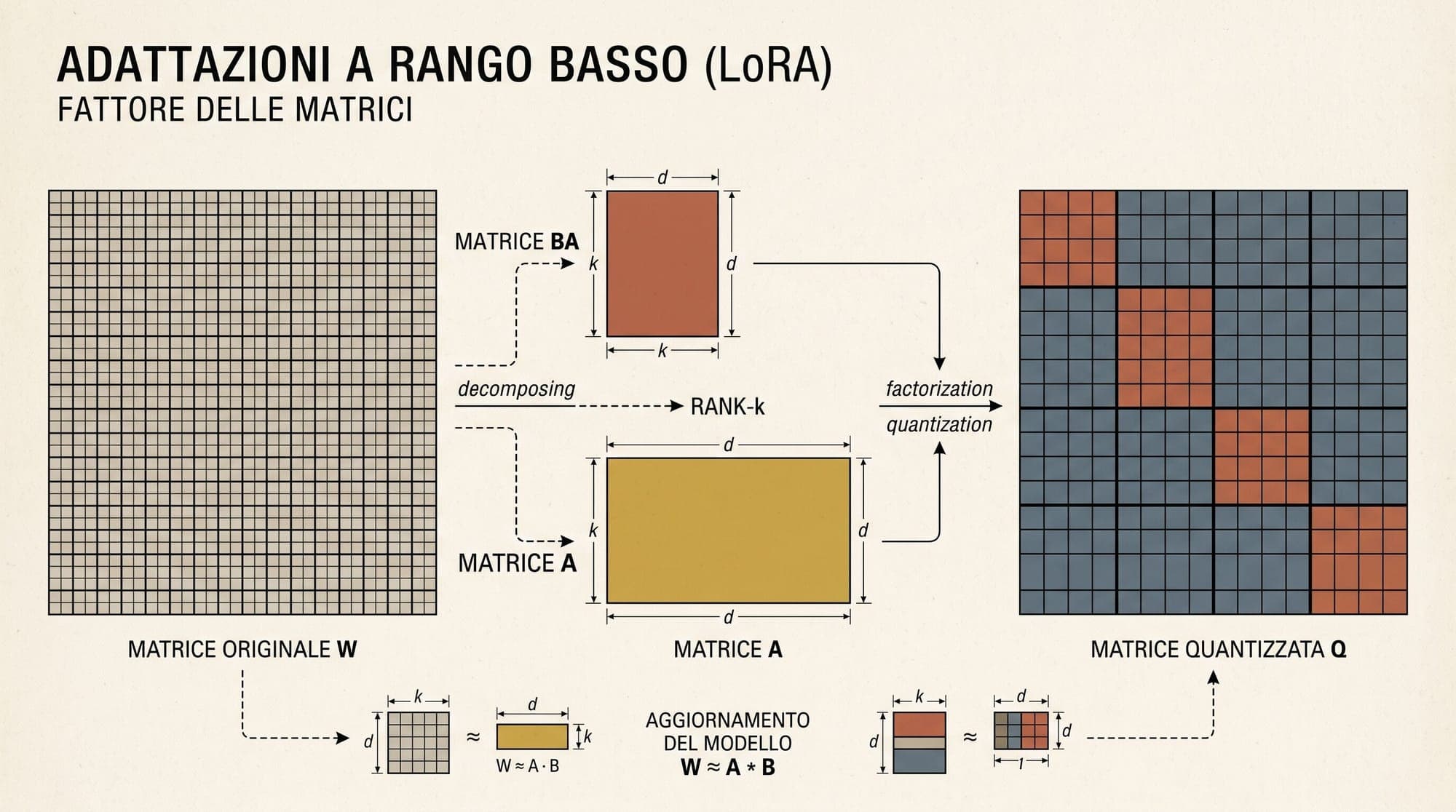
Introduced by Hu et al. (2021), LoRA parameterizes the weight update matrix as the product of two low-rank matrices and . For a pre-trained linear layer with frozen weights , the updated forward computation is defined as:
h = W_0 x + \Delta W x = W_0 x + \frac{\alpha}{r} B A xIn this formulation:
- represents the frozen pre-trained weight matrix.
- and are trainable adapter matrices.
- The rank parameter satisfies , typically configured between 4 and 64.
- is a constant scaling hyperparameter.
       Input x (k-dimensional)
          /               \
         /                 \
  Frozen Base W_0      Down-projection A (k -> r)
    (d x k)                 |
         \             Up-projection B (r -> d)
          \                 |
           \           Scaling factor (\alpha / r)
            \              /
             \            /
            Output h (d-dimensional)
Initialization and Scaling Dynamics
To ensure training begins with the exact behavior of the base pre-trained model, the adapter matrices are initialized asymmetrically:
- Matrix is initialized using a random Gaussian distribution with zero mean: .
- Matrix is initialized to exact zeros: .
At step zero of training, the product evaluates to zero, preventing any initial perturbation of the base model's representations.
The scaling factor stabilizes the learning process when exploring different rank values. When tuning , setting proportional to (or fixing as a constant) ensures that the magnitude of the adapter gradient updates remains stable, allowing practitioners to change without re-tuning optimizer learning rates.
Zero Latency Deployment and Multi-Tenant Serving
In single-tenant production deployments, LoRA introduces zero additional inference latency. Because matrix multiplication is distributive, the trained low-rank matrices can be merged directly into the base weights prior to inference:
W_{serving} = W_0 + \frac{\alpha}{r} B AFor multi-tenant environments serving hundreds of specialized task adapters concurrently, systems such as S-LoRA (Sheng et al., 2023) keep a single copy of the base model weights in GPU memory and dynamically route activation vectors through small task-specific and matrices during batched inference, reducing serving memory footprints by up to 90 percent.
QLoRA: 4-Bit NormalFloat and Quantized Base Models
While standard LoRA reduces trainable parameter memory and optimizer states by over 99 percent, the frozen base model weights still consume 16-bit precision memory (around 140 GB for a 70B parameter model). Dettmers et al. (2023) introduced QLoRA, a method that quantizes the base model to 4-bit precision while preserving 16-bit fine-tuning performance.

QLoRA introduces three architectural components:
1. 4-Bit NormalFloat (NF4) Data Type
Standard integer (INT4) and floating-point (FP4) quantization methods divide numeric ranges into uniform or logarithmic bins. However, pre-trained neural network weights typically follow a zero-mean normal distribution:
W \sim \mathcal{N}(0, \sigma^2)When using uniform quantization bins, values near the center of the distribution share bins with higher discretization errors. The 4-bit NormalFloat (NF4) data type constructs an information-theoretically optimal quantile quantization grid. In NF4, the 16 bin boundaries are calculated so that each interval contains an equal probability area under a standard normal distribution:
q_i = \frac{1}{2} \left( Q_X\left(\frac{i}{2^k}\right) + Q_X\left(\frac{i+1}{2^k}\right) \right)where is the quantile function of the standard normal distribution for bits. This guarantees equal information entropy across all 16 discrete levels.
2. Double Quantization (DQ)
Block quantization groups weight tensors into blocks of size and calculates a 32-bit floating-point scale factor for each block. Storing these quantization constants adds a memory overhead of:
\frac{32\text{ bits}}{64\text{ parameters}} = 0.5\text{ bits per parameter}Double Quantization treats the first-stage quantization constants as inputs to a second 8-bit quantization stage with a block size of . This secondary compression step yields an overhead of:
\frac{8\text{ bits}}{64} + \frac{32\text{ bits}}{64 \times 256} \approx 0.127\text{ bits per parameter}This reduces the memory footprint of quantization constants from 0.5 bits per parameter to 0.127 bits per parameter, saving roughly 0.373 bits per parameter across the entire model.
3. Paged Optimizers and Register Dequantization
To prevent memory spikes caused by activation checkpointing and temporary gradient allocations, QLoRA utilizes CUDA Unified Memory to allocate 32-bit optimizer states as paged memory. When memory pressure spikes during backward passes, the GPU driver automatically evicts idle optimizer pages to CPU RAM and pages them back before parameter updates.
During computation, the base model weights remain in 4-bit NF4 format in VRAM. When computing forward or backward passes for a layer, the 4-bit weights are dequantized on the fly into 16-bit Brain Floating Point (BF16) or FP16 tensors directly within GPU registers:
Y^{BF16} = \text{dequantize}(c_1, c_2, W^{NF4}) \cdot X^{BF16} + \frac{\alpha}{r} (B \cdot (A \cdot X^{BF16}))Because dequantization happens in fast local memory, matrix multiplications execute at full 16-bit tensor core precision without material throughput degradation.
Layer Selection and Hyperparameter Dynamics
Empirical evaluations in PEFT literature highlight several critical configuration guidelines for practitioners:
- Target Module Coverage: Early LoRA implementations adapted only the attention projection matrices (). Subsequent evaluations by Dettmers et al. demonstrated that targeting all linear layers in the transformer architecture (query, key, value, output, gate, up, and down projection matrices) with a smaller rank or consistently outperforms higher-rank adapters restricted to attention layers alone.
- Rank () and Scaling () Allocation: For most instruction-tuning and downstream classification tasks, ranks between 8 and 32 provide sufficient expressive capacity. Setting the scaling factor or maintains stable gradient updates.
- Hardware Footprint: QLoRA enables fine-tuning a 65-billion parameter model on a single 48 GB GPU or a 70-billion parameter model across two consumer 24 GB GPUs, reducing total hardware entry barriers while matching full 16-bit fine-tuning performance.
Sources
- Hu, E. J., Shen, Y., Wallis, P., Allen-Zhu, Z., Li, Y., Wang, S., Wang, L., & Chen, W. (2021). LoRA: Low-Rank Adaptation of Large Language Models. arXiv preprint arXiv:2106.09685.
- Dettmers, T., Pagnoni, A., Holtzman, A., & Zettlemoyer, L. (2023). QLoRA: Efficient Finetuning of Quantized LLMs. arXiv preprint arXiv:2305.14314.
- Aghajanyan, A., Gupta, S., & Zettlemoyer, L. (2020). Intrinsic Dimensionality Explains the Effectiveness of Language Model Fine-Tuning. arXiv preprint arXiv:2012.13255.
- Sheng, Y., Cao, S., Li, D., Hooper, C., Jiang, C., Chen, N., Pinto, B., Chou, P., & Stoica, I. (2023). S-LoRA: Serving Thousands of Concurrent LoRA Adapters. arXiv preprint arXiv:2311.03285.