
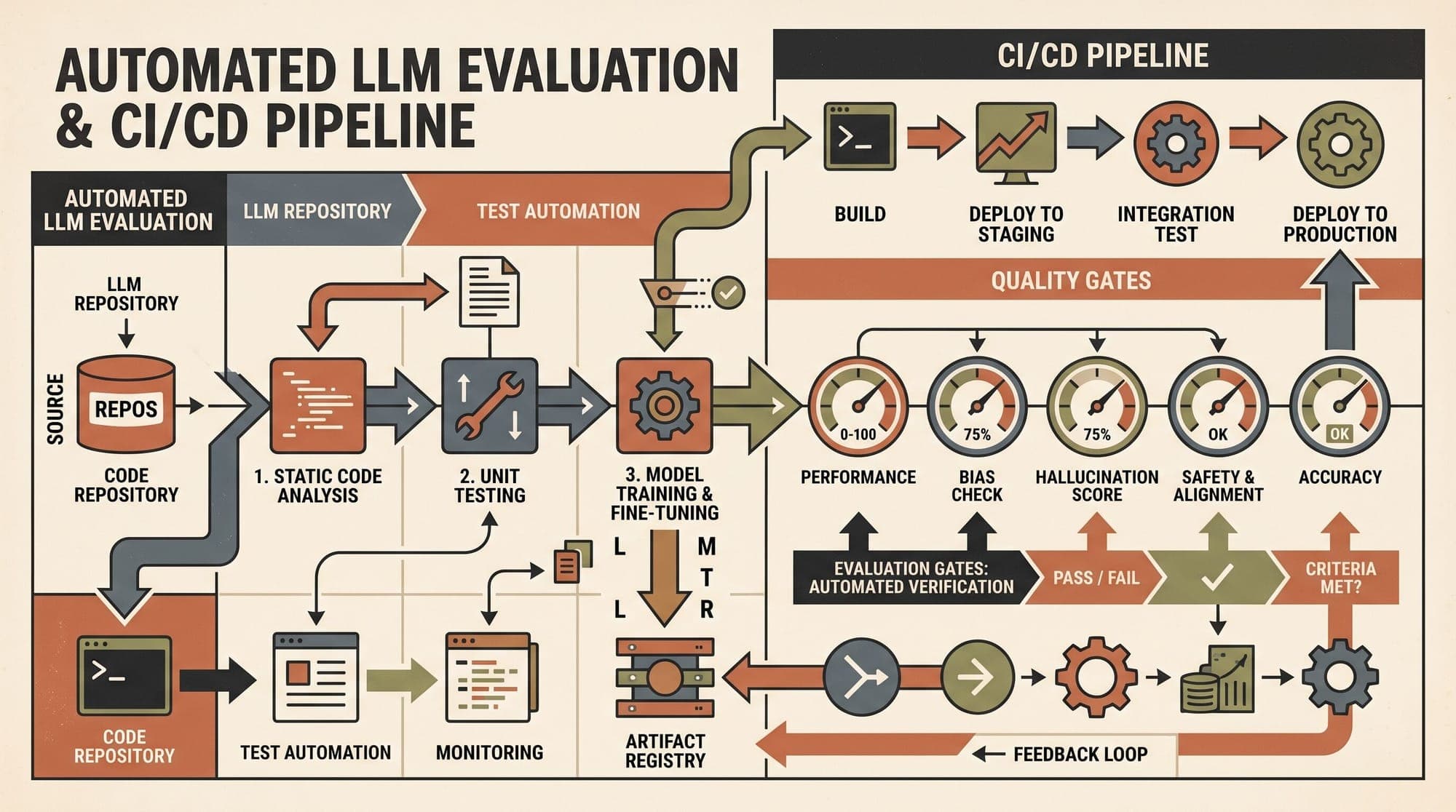
Moving large language model applications from exploratory prototypes to production systems requires automated quality validation. Relying on manual inspection or unstructured testing introduces regression risk across model updates, prompt edits, and retrieval modifications.
Automated evaluation frameworks address this by converting probabilistic model outputs into measurable, repeatable software assertions. While traditional unit testing relies on deterministic assertions, production LLM testing uses a combination of deterministic rules, statistical heuristics, and model-graded evaluators.
Four primary frameworks have emerged to handle LLM evaluation and continuous integration quality gates: DeepEval, Ragas, Promptfoo, and TruLens. Each framework targets distinct architectural patterns, from Pytest-native unit tests and component-level RAG scoring to declarative YAML matrices and trace-level feedback instrumentation.

Core Architectural Paradigms
Understanding how each framework approaches test execution helps teams align tooling with their existing stack and deployment topology.
1. DeepEval: Code-First Pytest Integration
DeepEval, developed by Confident AI, is designed to make LLM testing feel identical to Python unit testing. It extends Python's native pytest harness, allowing engineering teams to run evaluations via standard test commands in local environments and CI pipelines.
DeepEval structures evaluations around explicit test cases containing inputs, actual outputs, expected outputs, and context passages. Developers write assertions using the assert_test() function, which executes one or more scoring metrics and validates that the resulting score satisfies a predefined threshold.
import pytest
from deepeval import assert_test
from deepeval.test_case import LLMTestCase
from deepeval.metrics import GEval, FaithfulnessMetric
from deepeval.test_case import LLMTestCaseParams

def test_customer_support_response():
    test_case = LLMTestCase(
        input="How do I reset my API key?",
        actual_output="Navigate to Settings > API Keys and click Revoke and Regenerate.",
        retrieval_context=["API keys can be regenerated under Account Settings > API Keys by selecting Revoke and Regenerate."]
    )

    faithfulness = FaithfulnessMetric(threshold=0.8)
    assert_test(test_case, [faithfulness])
DeepEval also supports the G-Eval metric framework, conversational DAG evaluation, agent tool-call correctness checks, and synthetic dataset generation.
2. Ragas: Component-Level RAG Decomposition
Ragas (Retrieval Augmented Generation Assessment), developed by Exploding Gradients and detailed in research by Es et al. (arXiv:2309.15217), focuses specifically on reference-free evaluation of RAG architectures.
Rather than evaluating a RAG system as an opaque black box, Ragas isolates the retrieval module from the generation module. It computes specialized metrics for each step in the pipeline:
- Faithfulness: Measures whether the generated answer relies strictly on retrieved context or contains ungrounded hallucinations.
- Answer Relevance: Evaluates whether the generated response directly answers the user prompt, calculated by generating synthetic queries from the answer and comparing semantic embeddings.
- Context Precision: Measures the signal-to-noise ratio in retrieved passages by calculating Mean Average Precision (mAP) against relevant context chunks.
- Context Recall: Evaluates whether the retrieved context contains all necessary information present in the ground-truth answer.
from ragas import evaluate
from ragas.metrics import faithfulness, answer_relevancy, context_precision
from datasets import Dataset

eval_dataset = Dataset.from_dict({
    "question": ["What is the context window of Claude 3.5 Sonnet?"],
    "contexts": [["Claude 3.5 Sonnet features a standard 200,000 token context window."]],
    "answer": ["Claude 3.5 Sonnet supports a 200k token context window."]
})

results = evaluate(
    eval_dataset,
    metrics=[faithfulness, answer_relevancy, context_precision]
)
print(results.to_pandas())
3. Promptfoo: Declarative Matrix and Security Testing
Promptfoo is a Node.js-based, CLI-driven evaluation tool configured via declarative YAML files. It is optimized for prompt engineering iteration, multi-provider benchmarking, and automated security red-teaming.
Promptfoo allows teams to define matrices combining multiple prompt variations, model endpoints (such as OpenAI, Anthropic, AWS Bedrock, and local Ollama instances), and variable datasets. Assertions can mix fast deterministic checks with LLM-graded rubrics.
# promptfooconfig.yaml
prompts:
  - "Summarize this technical update in three bullet points: {{update}}"

providers:
  - openai:gpt-4o-mini
  - anthropic:claude-3-5-haiku-20241022

tests:
  - vars:
      update: "We deployed v2.4 containing patch fixes for connection pooling."
    assert:
      - type: contains
        value: "connection pooling"
      - type: llm-rubric
        value: "Ensure the summary contains exactly three bullet points without editorial filler."
      - type: latency
        threshold: 2500
Promptfoo also includes built-in security scanners that execute automated red-teaming attacks, probing applications for direct prompt injections, jailbreak vulnerabilities, PII leaks, and harmful generation risks before deployment.
4. TruLens: Instrumented Tracing and Feedback Functions
TruLens, developed by TruEra (acquired by Snowflake), approaches evaluation from an instrumentation and observability angle. It integrates with orchestration libraries like LangChain and LlamaIndex using wrapper classes (TruChain, TruLlama, and TruCustom).
TruLens formalizes the "RAG Triad" (Context Relevance, Groundedness, and Answer Relevance) through modular constructs called Feedback Functions. A feedback function inspects intermediate execution records and generates a numeric score between 0.0 and 1.0.
from trulens_eval import Tru, Feedback, TruChain
from trulens_eval.feedback.provider.openai import OpenAI as TruOpenAI

tru = Tru()
provider = TruOpenAI()

# Define RAG Triad feedback functions
f_groundedness = Feedback(provider.groundedness_measure_with_cot_reasons).on(
    TruChain.select_context()
).on_output()

f_answer_relevance = Feedback(provider.relevance).on_input().on_output()

# Wrap application for automatic evaluation recording
tru_recorder = TruChain(
    chain=rag_chain,
    app_id="production-kb-assistant",
    feedbacks=[f_groundedness, f_answer_relevance]
)

with tru_recorder as recording:
    response = rag_chain.run("How does raft consensus handle leader election?")
TruLens tracks operational metadata (latency, prompt tokens, completion tokens, and dollar cost) alongside qualitative feedback, storing results in a relational database for dashboard visualization.
Algorithmic Evaluation Mechanics
Automated LLM evaluation relies on several underlying algorithms to score complex natural language outputs reliably.
G-Eval and Probability-Weighted Scoring
Standard LLM-as-a-judge approaches often ask a model to produce a direct integer score (for example, 1 to 5). As demonstrated by Liu et al. (arXiv:2303.16634), direct numerical scoring suffers from poor human alignment and calibration instability.
G-Eval improves alignment through two mechanisms:
- Chain-of-Thought Rubric Generation: The evaluation model first produces step-by-step reasoning explaining why the output meets or fails specific criteria.
- Log-Probability Weighting: Instead of taking a raw single-token integer output, G-Eval inspects the model output log-probabilities for score tokens (1, 2, 3, 4, 5) and computes the expected value:
This continuous expectation smooths score variance across repeated runs and correlates significantly higher with human judgments than raw categorical scores.
Ragas Mathematical Formulation
Ragas evaluates RAG pipeline quality by measuring specific proportions of atomic statements:
- Faithfulness Calculation: The model decomposes the generated answer into a set of distinct atomic factual statements . Each statement is classified against the retrieved context passages . The score is the ratio of supported statements to total statements:
- Answer Relevance Calculation: The evaluator generates potential questions from the generated answer . Using a text embedding model , it computes the average cosine similarity between each generated question and the original input prompt :
CI/CD Quality Gates and Pipeline Architecture
Integrating evaluation into continuous delivery pipelines prevents prompt drift and bad deployments. Implementing these gates effectively requires balancing evaluation depth against CI execution time and API costs.
Tiered Testing Strategy
Running exhaustive LLM-as-a-judge suites on every pull request can be slow and expensive. High-velocity engineering teams use a tiered testing pipeline:
- Tier 1: Deterministic Checks (Pre-Commit / PR Smoke Test)
Fast, local, zero-cost assertions. Validate JSON schema compliance, regex patterns, minimum length, prohibited keyword filters, and latency caps using Promptfoo or Pytest. Execution time: under 10 seconds.
- Tier 2: Fast-Model Semantic Checks (PR Merge Gate)
Lightweight LLM judges (such as GPT-4o-mini or Claude 3.5 Haiku) scoring a curated regression dataset of 20 to 50 critical edge cases. Evaluate faithfulness and intent adherence. Execution time: 1 to 3 minutes.
- Tier 3: Comprehensive Regression and Red-Teaming (Nightly / Pre-Release)
Deep evaluation across hundreds of test cases using frontier models (GPT-4o, Claude 3.5 Sonnet) as judges. Includes Ragas precision/recall scoring, automated security scans via Promptfoo, and synthetic dataset evaluations via DeepEval.
# .github/workflows/llm-eval.yml
name: LLM Quality Gate

on:
  pull_request:
    paths:
      - 'prompts/**'
      - 'app/rag/**'

jobs:
  evaluate:
    runs-on: ubuntu-latest
    steps:
      - uses: actions/checkout@v4
      - name: Set up Python
        uses: actions/setup-python@v5
        with:
          python-version: '3.11'
      - name: Install dependencies
        run: pip install pytest deepeval ragas
      - name: Run Pytest Quality Gate
        env:
          OPENAI_API_KEY: ${{ secrets.OPENAI_API_KEY }}
        run: |
          pytest tests/evals/ -v --junitxml=reports/eval-report.xml
Architectural Comparison and Tradeoffs
Choosing the appropriate evaluation framework depends on application architecture, language ecosystem, and team workflow.
DeepEval
- Primary Interface: Python / Pytest
- Core Philosophy: Unit testing and integration tests for Python LLM applications and autonomous agents.
- RAG Evaluation: Comprehensive (Faithfulness, Contextual Relevancy, Precision, Recall).
- Agent and Tool Evaluation: Native support for tool call validation, conversational DAGs, and multi-turn workflows.
- Security and Red-Teaming: Built-in safety, toxicity, and bias metrics.
- Best Suited For: Python backend teams that want unified unit testing with Pytest and need agent evaluation.
Ragas
- Primary Interface: Python library (Pandas / Hugging Face Datasets)
- Core Philosophy: Component-level mathematical evaluation and dataset curation for RAG pipelines.
- RAG Evaluation: Deepest available metric suite (Faithfulness, Relevance, Precision, Recall, Noise Sensitivity).
- Agent and Tool Evaluation: Focused primarily on retrieval and synthesis rather than complex multi-agent execution.
- Security and Red-Teaming: Primarily retrieval-oriented; requires external plugins for safety probing.
- Best Suited For: Teams fine-tuning and evaluating dedicated RAG systems with complex retrieval and chunking strategies.
Promptfoo
- Primary Interface: Node.js CLI / YAML configuration
- Core Philosophy: Fast matrix testing across prompts, models, and providers with automated red-teaming.
- RAG Evaluation: Basic RAG checks (semantic similarity, context assertions) via plugins.
- Agent and Tool Evaluation: Validates structured JSON schema and output formatting.
- Security and Red-Teaming: Comprehensive automated penetration testing, jailbreak scans, and PII leakage probes.
- Best Suited For: Multi-language teams, CI/CD automated security gates, and prompt optimization across model providers.
TruLens
- Primary Interface: Python wrapper classes (
TruChain,TruLlama) - Core Philosophy: Runtime instrumentation, execution tracing, and RAG Triad feedback logging.
- RAG Evaluation: Core RAG Triad (Context Relevance, Groundedness, Answer Relevance).
- Agent and Tool Evaluation: Tracing tool inputs and outputs within instrumented frameworks.
- Security and Red-Teaming: Customizable feedback functions for toxic language and moderation checks.
- Best Suited For: Enterprise environments requiring deep telemetry, trace logging, and Snowflake ecosystem integration.
Sources
- DeepEval Documentation and Repository
- Ragas: Automated Evaluation of Retrieval Augmented Generation (Es et al., arXiv:2309.15217)
- G-Eval: NLG Evaluation using GPT-4 with Better Human Alignment (Liu et al., arXiv:2303.16634)
- Promptfoo Documentation and Evaluation Framework
- TruLens RAG Triad Concepts and Documentation



