
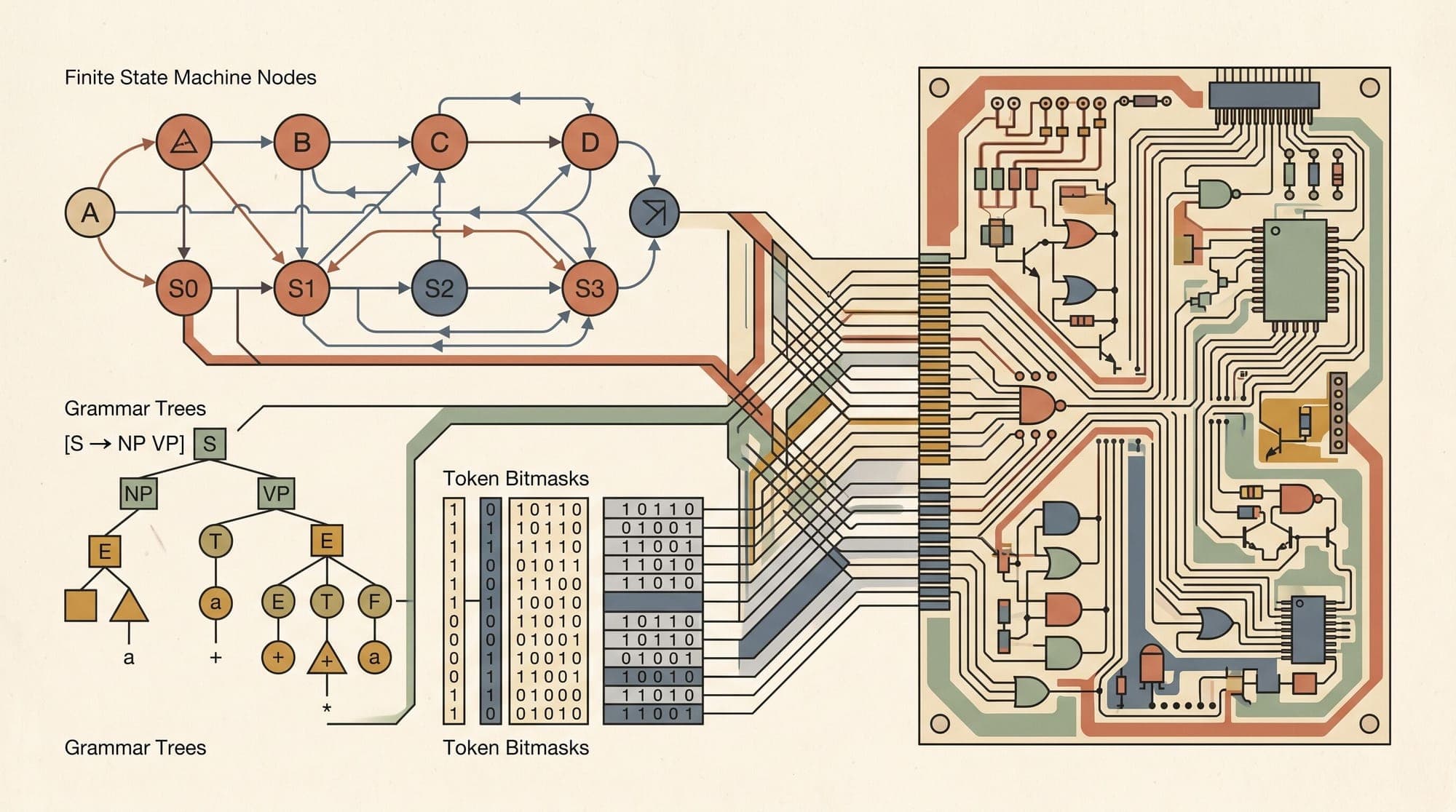
Autoregressive language models generate tokens sequentially by sampling from a probability distribution over a vocabulary. While this mechanism excels at natural language generation, it provides no structural guarantees when producing machine-readable data formats such as JSON, SQL, or structured tool calls. A single missing quotation mark, mismatched bracket, or hallucinated enum value invalidates the downstream payload.
Prompt engineering, few-shot examples, and setting sampling temperature to zero reduce error rates but cannot eliminate syntactic failures across long-tail distributions. To guarantee structural validity, modern inference engines apply grammar-constrained decoding, filtering model logits at each autoregressive step so only syntactically valid tokens can be sampled.
Over the past three years, structured decoding has evolved through three distinct architectural generations, shifting from slow parser loops and memory-heavy finite state machines to zero-overhead asynchronous grammar engines.

Generation 1: Finite State Automata and Vocabulary Indexing
The first practical approach to high-speed constrained decoding converted regular expressions and simplified JSON schemas into Deterministic Finite Automata (DFAs), popularized by libraries such as Outlines (Willard & Louf, 2023).
In a DFA-based system:
- The target structure (such as a regex pattern or fixed schema) is compiled into a graph of states and transitions.
- A tokenizer index maps each DFA state to the exact subset of vocabulary tokens that represent valid character transitions.
- At runtime, sampling reduces to an O(1) table lookup: the engine retrieves the precomputed token mask for the current DFA state and masks out invalid logits before applying softmax.
While DFA indexing achieves near-zero per-token overhead during generation, it suffers from two major limitations:
- State Space Explosion: Regular expressions and DFAs cannot represent arbitrary context-free grammars (such as arbitrarily nested JSON objects, arrays, or recursive programming languages) without severe state duplication.
- Compilation Latency: Precomputing vocabulary transitions across every DFA state requires evaluating hundreds of thousands of token-prefix combinations upfront. For dynamic, per-request schemas in multi-tenant serving, compilation latency often exceeds the actual model prefill and decode time.
Generation 2: Context-Free Grammar Parsers and Pushdown Automata
To support arbitrary nesting and full programming language grammars, engines such as llama.cpp (via GBNF grammars) and research frameworks such as SynCode (Ugare et al., 2024) implemented pushdown automata and LR/LALR grammar parsers.
Instead of flattening rules into finite state machines, a context-free grammar (CFG) maintains a parser stack. At each generation step:
- The engine evaluates the current parser stack state.
- It tests candidate tokens in the vocabulary to determine whether appending each token allows the parser to remain in a valid state.
- Tokens that lead to parser errors are masked out.
While CFG parsers handle complex recursive syntax, naive implementations create a severe compute bottleneck. Testing an entire vocabulary (typically 32,000 to 128,000+ tokens) against a parser stack sequentially on the host CPU takes tens to hundreds of milliseconds per token. This CPU latency stalls GPU decoders, causing severe token throughput collapse in high-concurrency environments.
Generation 3: Vocabulary Partitioning, Persistent Stacks, and Bitmask Compression
Modern high-performance inference engines, including vLLM, SGLang, and TensorRT-LLM, have converged on hybrid grammar execution architectures, led by engines such as XGrammar (MLC.ai, 2024) and llguidance.
Third-generation engines resolve the trade-off between expressive context-free grammars and execution speed through several key techniques:
- Vocabulary Partitioning: The vocabulary is divided into context-independent tokens (tokens whose validity depends solely on the current lexical category, pre-checked once) and context-dependent tokens (which require dynamic stack interpretation).
- Grammar Transformation and Inlining: Grammars undergo preprocessing to inline character rules, maximizing the proportion of context-independent tokens and minimizing dynamic stack operations during decode steps.
- Persistent Stack Caching: Rather than reparsing prefix sequences or reallocating stack frames on every token, the matcher maintains a persistent backtracking-capable stack representation that advances in O(1) operations.
- Compressed Bitset Masks: Token acceptance masks are stored as compact int32 bitsets (1 bit per vocabulary token). For a 128,000-token vocabulary, a mask occupies only 16 KB of memory, allowing rapid host-to-device memory copies and custom CUDA kernel logit masking.
Asynchronous Engine Overlap and Jump Decoding
Beyond algorithmic optimizations inside the grammar engine, modern serving systems co-design the grammar matcher with the inference batching loop.
Pipelined CPU-GPU Execution
During standard autoregressive generation, GPU compute is bounded by memory bandwidth during the decode phase. Third-generation grammar engines exploit this by overlapping CPU and GPU execution:
- While the GPU executes the forward pass for step t, the host CPU evaluates the grammar matcher for step t+1 based on the sampled token.
- The CPU generates the int32 bitmask and transfers it to device memory before the GPU reaches the sampling phase.
- On CUDA devices, an in-place kernel applies the bitmask to logits, setting disallowed token logits to negative infinity with minimal GPU overhead.
This pipelining hides grammar computation latency entirely behind the neural network forward pass.
Jump-Forward String Splicing
Many structured formats contain deterministic boilerplate strings (such as JSON keys, punctuation, and structural tags). Modern grammar matchers detect the longest deterministic string guaranteed to follow the current state.
Instead of running full autoregressive forward passes to generate fixed structural literals character by character, the engine splices the predetermined token sequence directly into the key-value (KV) cache in a single prefill step. This eliminates unnecessary decoding steps and accelerates overall generation speed.
Speculative Decoding Integration
When deploying speculative decoding, a lightweight draft model proposes candidate token trees or chains verified by a target model in a single forward pass.
Third-generation grammar matchers support draft tree traversal APIs, traversing proposed token trees on the CPU and constructing multi-position bitmasks concurrently while the target model verifies draft tokens on the GPU. If draft branches are rejected, the matcher rolls back its persistent stack state to the last verified branch point without re-evaluating earlier tokens.
Production Implications for AI Systems
Implementing grammar-constrained decoding transforms reliability in structured production pipelines:
- Elimination of Retries: Enforcing structural validity at the logit level prevents malformed outputs, eliminating parsing failure retries and reducing tail latency.
- Cost Amortization: Thread-safe compilation caches allow multi-tenant serving engines to compile common schemas (such as OpenAPI tool definitions) once, serving subsequent requests with zero compilation overhead.
- Prompt Simplification: Because syntax is strictly enforced by the decoding mask, prompts can omit repetitive formatting instructions, reducing input context length and saving KV cache capacity.
As agent frameworks and structured APIs continue to replace unstructured text interfaces, grammar-constrained decoding has transitioned from an external post-processing filter into a core component of the modern LLM inference stack.
Sources
- XGrammar: Flexible and Efficient Structured Generation Engine for Large Language Models (arXiv:2411.15100)
- Efficient Guided Generation for Large Language Models (arXiv:2307.09702)
- Grammar-Aligned Decoding (arXiv:2405.21047)
- XGrammar GitHub Repository (MLC.ai)
- vLLM Structured Outputs Documentation
- SGLang Structured Generation Architecture



