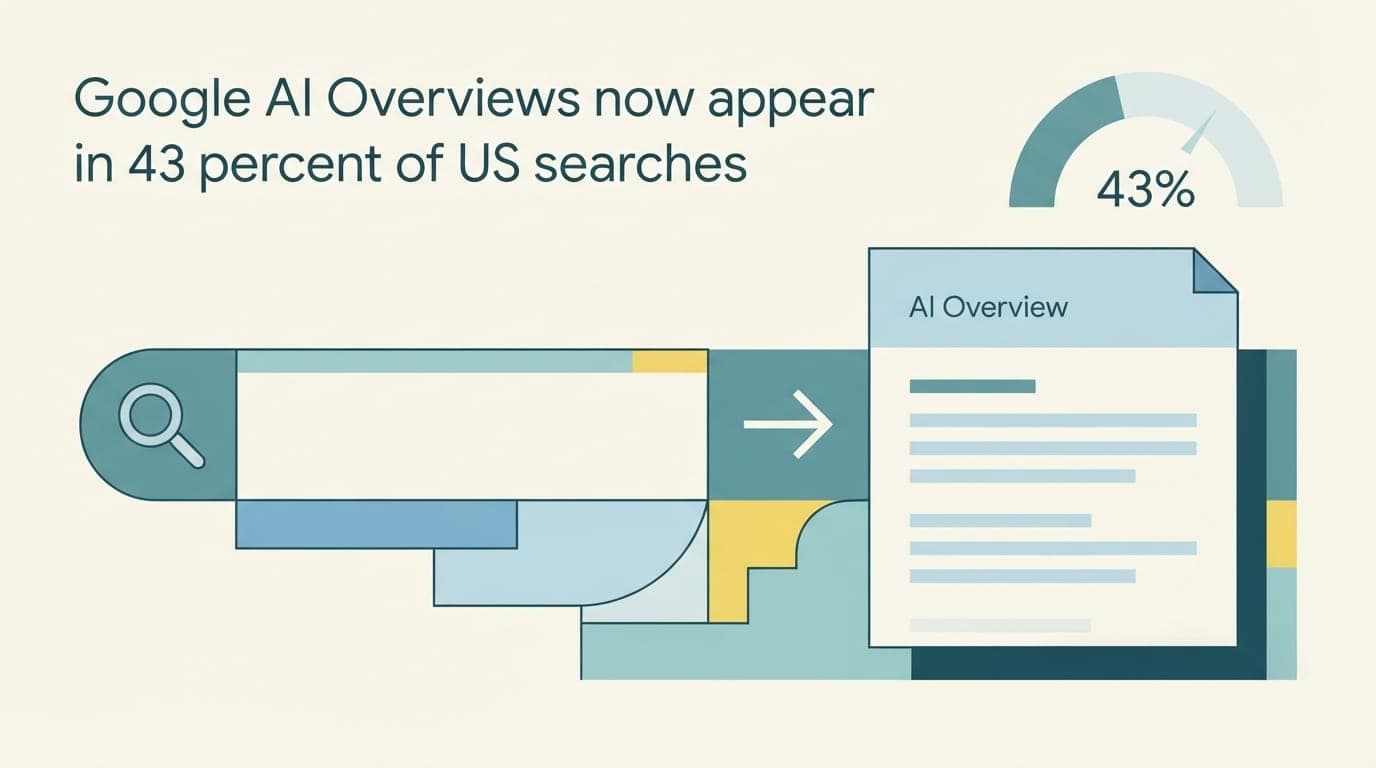
Google AI Overviews now appear in 43 percent of US searches

Google's AI-generated summaries now appear in 43 percent of US search results, up from 15 percent a year earlier, according to Similarweb's 2026 Generative AI Landscape report. The figure tracks the share of US searches displaying AI Overviews, the generated summaries that appear at the top of conventional Google results. Google also operates AI Mode, a separate conversational interface for longer queries and follow-up prompts, which uses a technique called query fan-out to split questions into

2 min
Google AI Overviews now appear in 43 percent of US searches

Google's AI-generated summaries now appear in 43 percent of US search results, up from 15 percent a year earlier, according to Similarweb's 2026 Generative AI Landscape report.

AI Overviews growth: 15% to 43% of US searches

The figure tracks the share of US searches displaying AI Overviews, the generated summaries that appear at the top of conventional Google results. Google also operates AI Mode, a separate conversational interface for longer queries and follow-up prompts, which uses a technique called query fan-out to split questions into subtopics and run multiple searches in parallel.

Similarweb estimated that visits to Google's AI Mode web experience grew from 126 million in June 2025 to 279 million in May 2026. Google separately reported in May that AI Mode had surpassed one billion monthly users, though that figure covers users rather than web visits and is not directly comparable.

The introduction of AI Mode correlated with a 5.4 percent increase in average Google search length, as users shifted toward longer natural-language queries resembling prompts used with AI assistants rather than traditional keyword combinations.

The broader generative AI market also grew. Similarweb estimated that generative AI websites received an average of 9.5 billion monthly visits between June 2025 and May 2026, up 70 percent year over year. Monthly unique visitors rose 57 percent to 655 million, and mobile app downloads increased 58 percent to 4.4 billion.

The report found that most ChatGPT users continued to use Google, with audience overlap among ChatGPT, Gemini, and Claude indicating that people use multiple services rather than committing exclusively to one platform.

Similarweb said its estimates draw on first-party analytics, anonymised device information, external data partnerships, and publicly available web data, meaning its figures are modelled estimates rather than direct counts from Google.

Sources

Google AI Overviews become more common in search - AI News

Similarweb 2026 Generative AI Landscape report - Similarweb

Written by

More to read

  • Anthropic Demonstrates Autonomous De Novo Protein Design and Chemical Analysis with Claude

    Anthropic Demonstrates Autonomous De Novo Protein Design and Chemical Analysis with Claude Anthropic has published experimental results demonstrating Claude's ability to autonomously design de novo protein binders with physical wet-lab validation and automate complex analytical chemistry workflows. The findings show frontier LLMs acting as autonomous agents across computational biology and molecular characterization pipelines. In the primary experiment, Anthropic evaluated Claude Mythos Previe

    1 min
  • Cerebras Unveils CS-4 Rack-Scale System Powered by Three WSE-3 Turbo Chips and Nexus Architecture

    Cerebras Unveils CS-4 Rack-Scale System Powered by Three WSE-3 Turbo Chips and Nexus Architecture Cerebras Systems has announced the CS-4, a rack-scale AI accelerator system designed around three of its next-generation Wafer Scale Engine 3 Turbo (WSE-3 Turbo) chips and a modular hardware architecture dubbed Nexus. Cerebras confirmed that initial customer shipments for the CS-4 are scheduled to begin in the current quarter. The new system marks a structural shift from Cerebras's single-wafer CS

    1 min
  • AI FinOps: Cutting LLM Inference Costs by 30-60% Through Model Tiering, Caching, and GPU Optimization

    AI FinOps: Cutting LLM Inference Costs by 30-60% Through Model Tiering, Caching, and GPU Optimization Inference costs have become the second-largest line item in enterprise AI budgets, trailing only talent spend according to RapidData's State of Enterprise AI 2026. This shift represents a fundamental inversion from the 2021-2023 era when training dominated AI expenditure. The compounding nature of serving costs—accumulating every hour as long as users hit the API—means that even modest producti

    1 min


