FlashAttention: IO-Aware Exact Attention, Tiling, Online Softmax, and the Evolution to FlashAttention-3
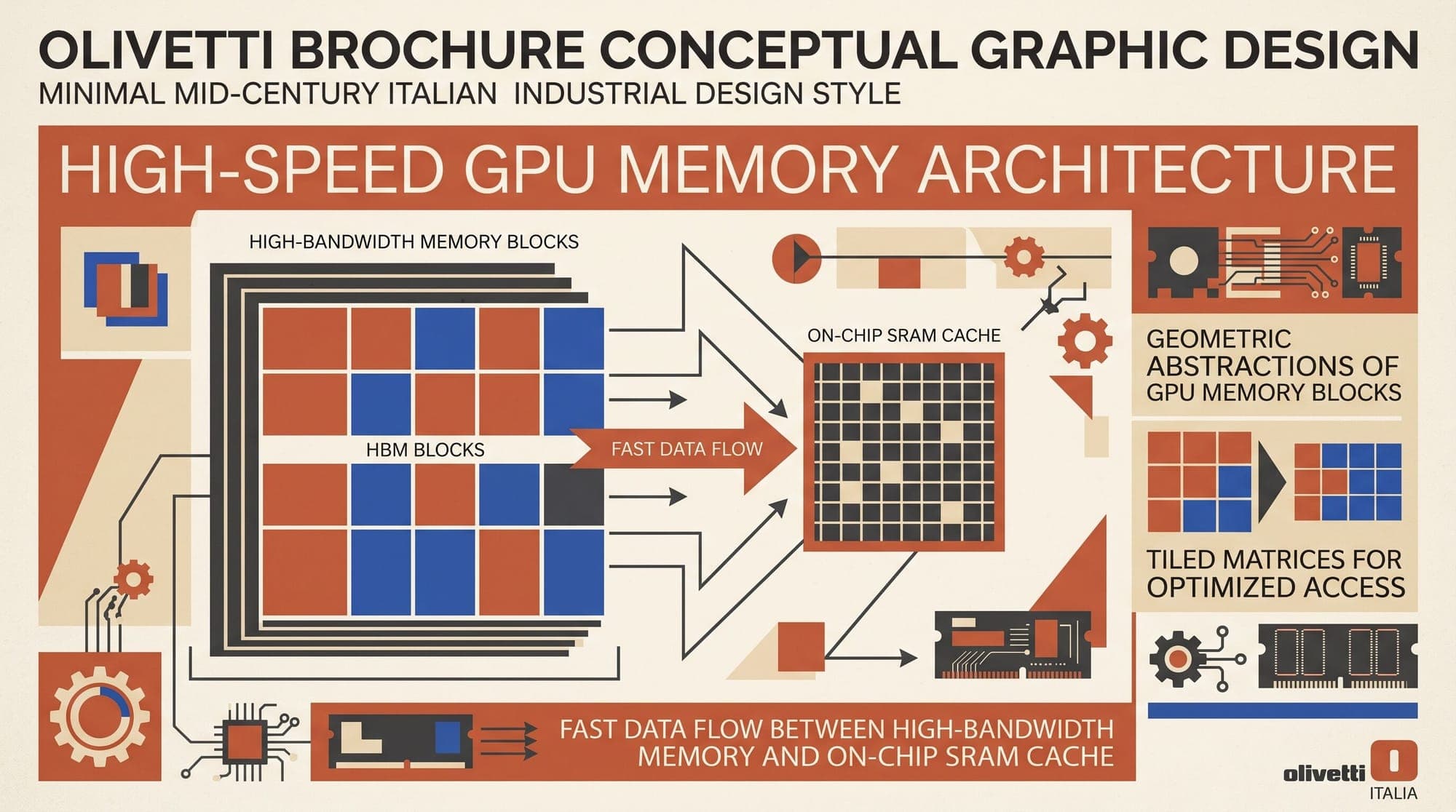
The attention mechanism is the computational bottleneck of every Transformer model. Standard implementations materialize the full attention matrix in high-bandwidth memory (HBM), incurring memory reads and writes that dominate runtime long before arithmetic intensity saturates the GPU. FlashAttention and its successors eliminate this bottleneck by restructuring the attention computation around the GPU memory hierarchy—trading redundant recomputation for dramatically reduced data movement.
This explainer covers the algorithmic foundations, the progression through FlashAttention-2 and FlashAttention-3, and the practical implications for training and serving long-context LLMs.

1. The IO Problem in Standard Attention
Given query, key, and value matrices (sequence length , head dimension ), standard attention computes:
The matrix is written to HBM, read back for softmax, and written again as ; then is read for the multiplication. On an A100 with 1.5 TB/s HBM bandwidth and 19.5 TFLOPs/s FP16 peak, attention at spends >90% of cycles moving data rather than computing. The arithmetic intensity (FLOPs/byte) is far below the hardware ridge point.
2. FlashAttention (v1): Tiling, Recomputation, and Online Softmax
2.1 Tiling by Blocks
FlashAttention partitions into blocks that fit in on-chip SRAM (shared memory). For block sizes (rows of , columns of ), the outer loop iterates over blocks of and , the inner loop over blocks of . Each block loads , , into SRAM, computes the local , and updates the output block incrementally.
This reduces HBM accesses from to where is SRAM capacity—linear in for fixed .
2.2 Online Softmax (No Materialization)
Standard softmax requires the full row of to compute the normalization constant . FlashAttention computes softmax online using the classic stable formulation:
Initialize , , for each output row .
For each block: Update , .
After the loop, normalize: .
No matrix ever leaves SRAM. The backward pass recomputes from saved blocks—trading extra FLOPs for saved bandwidth.
2.3 Block-Sparse Attention
FlashAttention extends naturally to block-sparse patterns (local window, strided, random). Only selected blocks are loaded, and the same online softmax accumulates over the chosen sparsity pattern. This yields an approximate attention algorithm faster than any dense baseline while retaining exact computation within attended blocks.
3. FlashAttention-2: Better Parallelism and Work Partitioning
FlashAttention-1 parallelized over batch and heads but kept sequence-length loops sequential within a block. FlashAttention-2 (Dao, 2023) introduces three key changes:
- Parallelism over sequence length: The outer loop over blocks is parallelized across thread blocks. Each thread block computes a disjoint chunk of the output rows. This requires a reduction across thread blocks for the softmax statistics , implemented via atomicAdd in shared memory followed by a cross-block sync.
- Work partitioning for load balance: For causal attention, the number of blocks per row varies (first row attends to 1 block, last to ). FlashAttention-2 assigns work by backward block index so each thread block handles a contiguous range of rows with roughly equal iterations.
- Tuning for Hopper/Ampere: Block sizes are chosen to maximize occupancy— for ; for —and kernel fusion eliminates intermediate stores.
Results: FlashAttention-2 reaches 230 TFLOPs/s (73% MFU) on A100, 1.7–3.0× faster than v1, and 2.8× end-to-end training speedup on GPT-style models at 8K context.
4. FlashAttention-3: Asynchrony, Warp Specialization, and FP8
FlashAttention-3 (Shah et al., 2024) targets the H100 (Hopper) architecture and introduces:
4.1 Asynchronous Tensor Memory Accelerator (TMA) + Warp Specialization
Hopper's TMA enables asynchronous copies between HBM and shared memory without SM involvement. FlashAttention-3 dedicates warps to:
- Producer warps: Issue TMA loads for blocks.
- Consumer warps: Execute MMA (tensor core) matrix multiplies on data already in shared memory.
- Scheduler warps: Overlap softmax reduction with the next TMA load.
This pipeline hides HBM latency behind computation, sustaining 740 TFLOPs/s (75% MFU) on H100 FP16.
4.2 FP8 with Block Quantization and Incoherent Processing
FlashAttention-3 supports FP8 E4M3/E5M2 with per-block quantization scales. Crucially, it uses incoherent processing: the softmax exponent is computed in FP32 from FP8-dequantized values, avoiding the catastrophic error accumulation of naive FP8 softmax. With this scheme, FP8 FlashAttention-3 achieves 2.6× lower error than standard per-tensor FP8 attention under outlier features, and approaches 1.2 PFLOPs/s on H100.
4.3 Variable-Length Sequences and Packed Kernels
A single kernel handles variable-length sequences via a packed representation with cuSeqlens, eliminating padding overhead and enabling efficient training on datasets with diverse sequence lengths.
5. Practical Impact
| Metric | Standard Attention | FlashAttention-2 (A100) | FlashAttention-3 (H100 FP16) | FlashAttention-3 (H100 FP8) | |--------|-------------------|------------------------|------------------------------|----------------------------| | Peak TFLOPs/s | ~30 | 230 | 740 | ~1200 | | MFU | ~15% | 73% | 75% | ~75% | | Context length feasible | 4K–8K | 128K+ | 128K–1M+ | 1M+ | | Memory (N=128K, d=128) | OOM | ~20 GB | ~20 GB | ~10 GB |
FlashAttention is now the default attention kernel in PyTorch (torch.nn.functional.scaled_dot_product_attention with torch.backends.cuda.enable_flash_sdp), xFormers, Hugging Face Transformers, vLLM, and TensorRT-LLM. It directly enabled the context-length explosion from GPT-3's 2K to Llama-3's 128K and beyond.
6. When Not to Use FlashAttention
- Very short sequences (): Launch overhead and SRAM pressure can make standard attention faster.
- Non-GPU accelerators without shared memory / tensor core analogues: The algorithm assumes a fast on-chip scratchpad and warp-level MMA.
- Custom attention variants (e.g., rotary embeddings computed outside the kernel, attention sinks, ALiBi) may require kernel modifications or fall back to the standard path.
Sources
- Dao, Fu, Ermon, Rudra, Ré. FlashAttention: Fast and Memory-Efficient Exact Attention with IO-Awareness. NeurIPS 2022. https://arxiv.org/abs/2205.14135
- Dao. FlashAttention-2: Faster Attention with Better Parallelism and Work Partitioning. ICLR 2024. https://arxiv.org/abs/2307.08691
- Shah, Bikshandi, Zhang, Thakkar, Ramani, Dao. FlashAttention-3: Fast and Accurate Attention with Asynchrony and Low-precision. arXiv 2024. https://arxiv.org/abs/2407.08608
- PyTorch Blog. FlashAttention-3: Fast and Accurate Attention with Asynchrony and Low-precision. https://pytorch.org/blog/flashattention-3
- Dao AILab. FlashAttention GitHub Repository. https://github.com/dao-ailab/flash-attention