
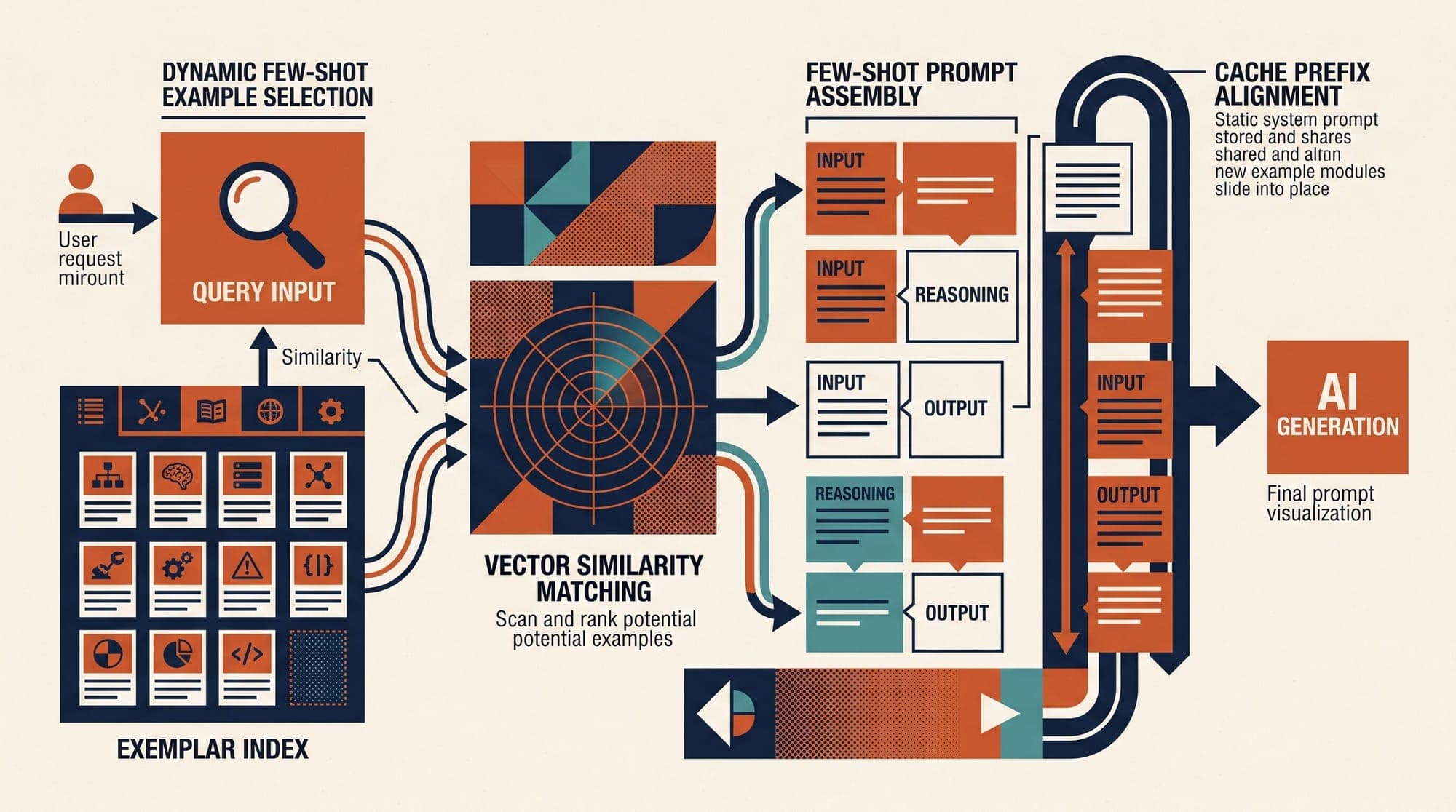
In-context learning (ICL) remains one of the most practical mechanisms for steering large language models on specialized tasks, structured output parsing, domain-specific classification, and API tool calling. While zero-shot prompts rely entirely on the model's parametric memory, few-shot prompting provides concrete input-output demonstrations that anchor the model's generation trajectory.
In enterprise production environments, however, static few-shot prompting quickly hits operational limits. Hardcoding three to five fixed demonstrations into a prompt template fails when handling heterogeneous workloads, long-tail user queries, or evolving edge cases. Conversely, stuffing hundreds of static examples into expanding 128k+ context windows inflates prefill latency, degrades output precision through distraction, and drives up token costs.
To solve this, modern production architectures deploy Dynamic Few-Shot Example Selection (also termed retrieval-augmented in-context learning). Instead of static templates, the system maintains an offline repository of curated, validated exemplars and dynamically retrieves a query-specific subset at inference time. However, implementing dynamic exemplar selection in high-throughput systems introduces complex architectural trade-offs between semantic relevance, demonstration diversity, permutation sensitivity, and KV cache efficiency.

The Limitations of Static Exemplar Sets
Static few-shot prompts operate under the assumption that a small, fixed set of demonstrations can represent the entirety of a task's input distribution. In production pipelines, this assumption breaks down across three vectors:
- Distributional Mismatch and Long-Tail Queries: A fixed set of examples cannot cover the semantic variance of user requests. When an incoming query differs significantly in domain, syntax, or complexity from the static exemplars, the model frequently misinterprets edge cases.
- Context Window Inefficiency and Distraction: While modern models accommodate large contexts, empirical research indicates that adding irrelevant or redundant demonstrations increases token overhead without improving accuracy, often diluting attention away from task-critical instructions.
- Format Drift Across Complex Output Schemas: In structured data extraction and code generation, different query sub-types require distinct formatting rules or schema variations. A static prompt cannot supply specialized schema demonstrations for every variation simultaneously.
Dynamic exemplar selection treats in-context demonstrations as a dynamic retrieval target, pulling the most informative examples tailored to each incoming payload.
Exemplar Retrieval: Dense, Sparse, and Supervised Architectures
The first phase of dynamic few-shot selection is identifying candidate demonstrations from an indexed exemplar bank. Production systems rely on three primary retrieval paradigms:
+-----------------------------------------------------------------------------------+
|                            INCOMING USER QUERY                                    |
+-----------------------------------------------------------------------------------+
                                      |
         +----------------------------+----------------------------+
         |                                                         |
         v                                                         v
+-----------------------------+                           +-------------------------+
|    Dense Vector Search      |                           |   Sparse Lexical Search |
|  (Bi-Encoder Embeddings)    |                           |     (BM25 / SPLADE)     |
+-----------------------------+                           +-------------------------+
         |                                                         |
         | Top-M Candidates                                        | Top-M Candidates
         +----------------------------+----------------------------+
                                      |
                                      v
                       +------------------------------+
                       |    Reciprocal Rank Fusion    |
                       |       (Hybrid Scoring)       |
                       +------------------------------+
                                      |
                                      v
                       +------------------------------+
                       |     Diversity Reranking      |
                       |     (MMR / DPP / K-Means)    |
                       +------------------------------+
                                      |
                                      v
                       +------------------------------+
                       |   Cache-Aligned Assembler    |
                       | (Static Prefix + Dynamic Tail|
                       +------------------------------+
1. Dense Semantic Retrieval (-NN)
Dense retrieval maps queries and exemplars into a shared latent embedding space using bi-encoder models such as text-embedding-3-large or bge-large-en-v1.5. Candidate exemplars are ranked by cosine similarity:
As demonstrated by Liu et al. (2021), retrieving nearest-neighbor examples significantly outperforms random or fixed exemplar selection across classification and generation benchmarks. Dense search excels at capturing intent, domain context, and conceptual similarity.
However, pure dense retrieval has distinct failure modes:
- It struggles with exact matching of technical identifiers, error codes, and strict syntactic structures.
- It is susceptible to "semantic crowding," where semantically close examples that share incorrect target labels dominate the top- results.
2. Sparse Lexical Search (BM25 and SPLADE)
For tasks involving code generation, SQL synthesis, or domain-specific terminology, sparse lexical retrieval via BM25 or learned sparse representations (SPLADE) provides critical precision. Lexical search matches exact variable names, schema tables, API endpoints, and syntactic tokens that dense embeddings frequently compress away.
3. Hybrid Retrieval with Reciprocal Rank Fusion
Production pipelines combine dense and sparse candidate pools using Reciprocal Rank Fusion (RRF) to leverage both semantic matching and keyword precision:
where is a smoothing parameter (typically set between 20 and 60). Hybrid candidate retrieval produces a resilient candidate set that captures both conceptual intent and strict syntactic constraints.
4. Supervised Exemplar Retrievers (EPR)
Standard embedding models optimize for semantic document similarity rather than in-context learning utility. A document that is semantically similar to the input is not guaranteed to be the most effective demonstration for steering model generation.
To bridge this gap, Rubin et al. (2021) introduced Efficient Prompt Retrieval (EPR), a supervised approach that trains a bi-encoder specifically to score exemplar efficacy. EPR uses a two-stage process:
- Unsupervised Scoring: Given candidate exemplars , compute the target sequence log-likelihood for each . Candidates that produce the highest target log-likelihood serve as positive training pairs.
- Contrastive Training: Train a lightweight dense retriever using InfoNCE loss to predict which exemplars maximize the downstream LLM's target generation probability.
Diversity Reranking: Mitigating the Redundancy Trap
Selecting the top- nearest neighbors directly from a retrieval engine frequently leads to redundancy: all examples may demonstrate the exact same edge case or sub-pattern, wasting token budget while leaving other aspects of the input uncovered.
To maximize the informational yield of the few-shot budget, systems apply diversity reranking algorithms.
Maximal Marginal Relevance (MMR)
Maximal Marginal Relevance (Carbonell & Goldstein, 1998) balances relevance to the user query with orthogonality to already-selected demonstrations:
- : Initial candidate pool from the retriever.
- : Set of already selected exemplars.
- : Tuning coefficient balancing relevance () and diversity (). In production systems, provides optimal balance.
import numpy as np

def maximal_marginal_relevance(
    query_emb: np.ndarray,
    candidate_embs: np.ndarray,
    candidates: list[dict],
    k: int = 3,
    lambda_param: float = 0.7
) -> list[dict]:
    """
    Selects k diverse and relevant exemplars using Maximal Marginal Relevance.
    """
    selected_indices = []
    unselected = list(range(len(candidates)))

    # Pre-normalize embeddings for cosine similarity
    q_norm = query_emb / np.linalg.norm(query_emb)
    c_norms = candidate_embs / np.linalg.norm(candidate_embs, axis=1, keepdims=True)

    # Compute relevance scores to query
    sim_to_query = np.dot(c_norms, q_norm)

    # Select first exemplar with highest query similarity
    first_idx = int(np.argmax(sim_to_query))
    selected_indices.append(first_idx)
    unselected.remove(first_idx)

    while len(selected_indices) < k and unselected:
        # Compute maximum similarity to any already selected exemplar
        sub_sims = np.dot(c_norms[unselected], c_norms[selected_indices].T)
        max_sub_sims = np.max(sub_sims, axis=1)

        # Calculate MMR score
        mmr_scores = (lambda_param * sim_to_query[unselected]) - ((1.0 - lambda_param) * max_sub_sims)
        best_unselected_idx = int(np.argmax(mmr_scores))
        chosen_idx = unselected[best_unselected_idx]

        selected_indices.append(chosen_idx)
        unselected.remove(chosen_idx)

    return [candidates[i] for i in selected_indices]
Determinantal Point Processes (DPP) and Clustering
For large-scale exemplar repositories, Determinantal Point Processes (DPP) or stratified -means clustering provide global coverage. The offline repository is clustered into semantic partitions. At runtime, the selector samples top candidates across distinct clusters, preventing the prompt from collapsing into a single semantic mode.
Exemplar Ordering and Permutation Sensitivity
Large language models exhibit acute sensitivity to the order of in-context demonstrations. Lu et al. (2021) established that varying the permutation of identical few-shot examples can shift model accuracy from near state-of-the-art to random guessing (e.g., accuracy swings exceeding 30% on standard NLP benchmarks).
This variation stems from fundamental attention mechanisms:
- Recency Bias: Autoregressive models disproportionately attend to exemplars located closest to the final prompt boundary. The last demonstration exerts the strongest conditioning influence on the generated tokens.
- Majority / Label Bias: If multiple consecutive examples share the same output class or format, the model develops an implicit prior toward predicting that class, regardless of input semantics.
Ordering Strategies in Production
- Ascending Similarity (Best-Last): Sort selected exemplars such that the most relevant demonstration appears immediately preceding the user query. This exploits recency bias to anchor the immediate generation step on the highest-quality match:
- Negative Exemplar Pairing: When steering models away from common hallucination patterns, format demonstrations in contrastive pairs:
``text Input: [Edge Case Query] Incorrect Output (Anti-Pattern): [Common Failure] Explanation: [Why this violates constraint] Correct Output: [Gold Target] ``
- Entropy Calibration: As proposed by Zhao et al. (2021), evaluate prompt permutations on a neutral "N/A" input to measure label bias, discarding orderings that induce high prior skew.
The Prompt Caching Conundrum
While dynamic few-shot selection optimizes exemplar relevance for every request, it creates a severe structural conflict with Prefix Caching (also known as Prompt Caching).
Provider-level prompt caching (Anthropic, OpenAI, DeepSeek, Google) and self-hosted serving engines (vLLM's Chunked Prefix Caching, SGLang's RadixAttention) cache the computed key-value (KV) activations of prompt prefixes. When a request shares an identical token prefix with a previous execution, the engine skips the prefill compute, yielding up to 50% to 90% cost reductions and cutting Time-to-First-Token (TTFT) by up to 80%.
However, naive dynamic few-shot selection breaks prefix caching entirely. Because each user query retrieves a different subset and permutation of exemplars, the prompt prefix changes on every single request, driving cache hit rates to zero.
NAIVE APPROACH (Cache Miss Rate: ~100%):
[System Prompt] -> [Dynamic Exemplar A] -> [Dynamic Exemplar B] -> [User Query]
(Every distinct query produces a novel token sequence at Token 200, invalidating all downstream KV states.)
To resolve this trade-off, production architectures implement one of three cache-aligned prompt design patterns:
CACHE-ALIGNED PROMPT LAYOUT:
+-------------------------------------------------------------------------+
| [STATIC PREFIX] System Instructions + Tool Schemas (1,500 tokens)      | <-- 100% Cache Hit
+-------------------------------------------------------------------------+
| [STATIC ANCHOR] Core Gold Exemplars (Fixed 3-shot) (1,200 tokens)       | <-- 100% Cache Hit
+-------------------------------------------------------------------------+
| [DYNAMIC SUFFIX] Retrieved Specialized Exemplar (1-shot) (400 tokens)   | <-- Variable Prefill
+-------------------------------------------------------------------------+
| [USER PAYLOAD] Current Input Query (250 tokens)                         | <-- Variable Prefill
+-------------------------------------------------------------------------+
Strategy 1: The Static Anchor + Dynamic Suffix Pattern
The prompt is bifurcated into two distinct structural zones:
- Cached Static Anchor (Prefix): Contains the primary system instructions, tool definitions, and 2 to 3 immutable, foundational exemplars covering the core task format. This prefix remains identical across 100% of tenant traffic and achieves sustained KV cache hits.
- Dynamic Tail (Suffix): Positioned immediately before the user input, the retriever injects 1 to 2 targeted exemplars matching specific edge cases or sub-domains.
Because the variable tokens reside strictly at the end of the context, the entire preceding 2,000+ token prefix remains cached.
Strategy 2: Clustered Prefix Routing (Quantized Exemplar Bucketing)
Rather than retrieving a unique, continuous combination of examples for every query, the system quantizes the exemplar space into discrete clusters:
- The exemplar repository is grouped offline into semantic buckets (e.g., 16 canonical task archetypes:
Data Extraction,Schema V2 Migration,Error Handling,Mathematical Reasoning, etc.). - Each cluster has a fixed, curated 4-shot exemplar block.
- At runtime, a lightweight embedding classifier or routing rule assigns the query to one of the clusters.
- The prompt uses the static exemplar block of that designated cluster.
Under this pattern, all queries routed to Cluster 3 share an identical 3,000-token prompt prefix, converting dynamic retrieval into high-frequency cached streams with 80%+ cache hit ratios.
Strategy 3: Radix Tree KV Reuse in Custom Serving (SGLang / vLLM)
In dedicated private deployments using serving frameworks with radix-tree KV caching (such as SGLang), prompt segments do not need to strictly align to a single linear prefix. Radix trees retain KV cache blocks across shared intermediate sub-trees.
By standardizing the syntax, serialization format, and sorting individual exemplars by their global database ID, the serving engine can reuse KV cache blocks for previously seen individual exemplars, even when combined in different composite prompts.
Exemplar Bank Lifecycle and Data Governance
A dynamic few-shot system is only as reliable as the underlying exemplar repository. Production implementations require active lifecycle management:
- Automated Ingestion from High-Confidence Traces: Incorporate human-in-the-loop corrections, verified unit test passes, and high-reward execution traces into a staging exemplar pool.
- Deduplication and Contamination Filtering: Run MinHash LSH and semantic distance clustering to prune redundant examples and prevent near-duplicate exemplars from dominating retrieval.
- Automated Degradation Audits: Periodically evaluate the exemplar bank against golden test suites. If updating a model checkpoint alters how specific exemplars steer outputs (e.g., inducing over-refusal or formatting regressions), trigger automated exemplar retirement.
- Token Budget Enforcement: Enforce strict byte and token length caps per exemplar. Dynamically adjust the number of injected demonstrations () based on the input query's token length to avoid exceeding total context budgets or triggering downstream truncation.
Architectural Summary: Static vs. Dynamic Selection
| Dimension | Static Few-Shot | Naive Dynamic Few-Shot | Cache-Aligned Dynamic Few-Shot | | :--- | :--- | :--- | :--- | | Domain Adaptability | Low (rigid coverage) | High (query-specific) | High (cluster or hybrid targeted) | | Prompt Token Overhead | Fixed (3-5 examples) | Variable (1-5 examples) | Tiered (static anchor + 1-2 tail) | | Prefix Cache Hit Rate | High (~90%+) | Zero (~0%) | High (75% - 90%+) | | Retrieval Latency Tax | 0 ms | 15 - 40 ms (-NN / Hybrid) | 5 - 20 ms (Clustered / Hybrid) | | Implementation Complexity | Minimal (Template string) | Medium (Vector DB + Retriever) | Advanced (Routing + Cache Alignment) |
Dynamic few-shot example selection transforms in-context learning from a static prompt engineering trick into an adaptable retrieval system. By combining hybrid dense-lexical search, diversity reranking, and cache-conscious prompt topologies, engineering teams can maximize reasoning precision on complex edge cases without sacrificing serving throughput or inflating token spend.
Sources
- Liu, J. et al. (2021). What Makes Good In-Context Examples for GPT-3? arXiv: 2101.06804
- Rubin, O. et al. (2021). Learning To Retrieve Prompts for In-Context Learning. arXiv: 2112.08633
- Lu, Y. et al. (2021). Fantastically Ordered Prompts and Where to Find Them: Overcoming Few-Shot Prompt Order Sensitivity. arXiv: 2104.08786
- Su, H. et al. (2022). Selective Annotation Makes Language Models Better Few-Shot Learners. arXiv: 2209.01975
- Carbonell, J. & Goldstein, J. (1998). The Use of MMR, Diversity-Based Reranking for Reordering Documents and Producing Summaries. CMU Research
- Anthropic Engineering (2024). Prompt Caching: Overview, Pricing, and Architecture. Anthropic Documentation
- Zheng, L. et al. (2023). SGLang: Efficient Execution of Structured Language Model Programs with RadixAttention. arXiv: 2312.07104
- vLLM Project (2024). Automatic Prefix Caching Architecture. vLLM Documentation



