
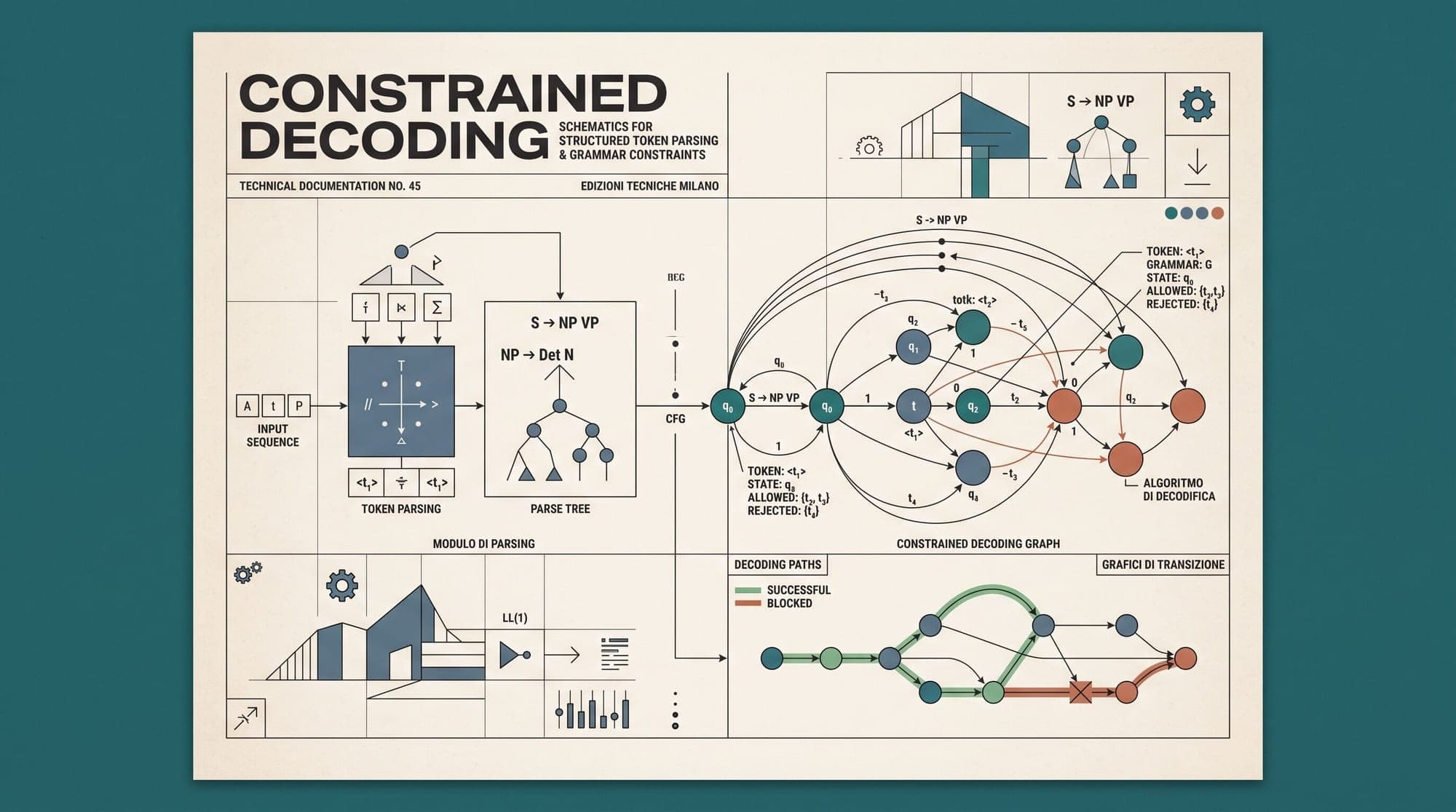
In production AI engineering, enforcing structured data formats such as JSON, YAML, SQL, or domain-specific languages from Large Language Models (LLMs) is a fundamental requirement. Early production pipelines attempted to achieve structural compliance through prompt engineering, few-shot examples, and retry loops. In high-throughput systems, this prompt-driven approach exhibits unacceptable failure rates: models periodically emit malformed syntax, unescaped characters, missing schema properties, or explanatory conversational filler that crashes downstream parsers.
Constrained decoding (also known as grammar-guided generation or structured outputs) solves this problem deterministically at the inference engine level. By intersecting the language model's output distribution with formal grammars or automata, the engine forces the model to generate strictly compliant sequences with zero syntactic error rate.
However, implementing constrained decoding in high-concurrency production serving infrastructure introduces significant engineering challenges. Engines must construct token masks across vocabulary sizes exceeding 128,000 tokens within tens of microseconds to prevent stalling GPU tensor cores.
This analysis examines the architectural mechanics, formal grammar representations, logit masking algorithms, and production performance tradeoffs of four leading constrained decoding engines: XGrammar, llguidance (Guidance), Outlines, and llama.cpp GBNF.

The Core Mechanics of Logit Masking
Autoregressive language models generate text by producing a vector of unnormalized log-probabilities (logits) over a fixed vocabulary at each generation step . Under unconstrained generation, the next token is sampled directly from the probability distribution computed via the softmax function:
Constrained decoding modifies this sampling process by applying a binary mask derived from a formal constraint evaluated against the prefix sequence :
Tokens that would violate the target grammar receive a logit value of , reducing their probability to zero during softmax normalization.
The primary architectural challenge is calculating efficiently. If an LLM serving engine takes 1 millisecond to compute the token mask for a vocabulary of 128,256 tokens (such as Llama 3 or Qwen 2.5), and the GPU generates tokens at 50 tokens per second per stream, the masking overhead alone degrades throughput by 50%. A production-grade masking engine must execute mask derivation in under 50 microseconds per token.
Formal Grammars and Automata Paradigms
Constrained decoding engines process schemas by compiling them into formal grammar automata. The choice of automaton determines both schema expressiveness and computational complexity.
1. Deterministic Finite Automata (DFA / FSM)
Regular expressions and non-recursive schemas can be compiled into Finite State Machines (FSMs). In an FSM, the valid next characters depend solely on the current state:
- State Transitions: , where is the consumed symbol.
- Advantages: state lookup time during decoding. If state transitions and valid token sets are precomputed, token masking requires minimal runtime computation.
- Limitations: Cannot handle recursive structures, balanced parentheses of arbitrary depth, or complex context-dependent validations (such as nested JSON objects or arrays).
2. Context-Free Grammars (CFG) and Pushdown Automata
Arbitrary JSON schemas, programming languages, and mathematical expressions represent context-free languages requiring a stack memory to track nesting levels:
- Parsing Algorithms: Engines use variations of the Earley parsing algorithm or Generalized LR (GLR) parsers.
- Advantages: Full support for arbitrary nesting, recursive schemas, and complex grammar constraints.
- Limitations: Dynamic state management is computationally more intensive than FSM state lookups. Without specialized token indexing, evaluating CFG validity across a large tokenizer vocabulary at each step introduces significant latency.
Deep Architectural Comparison
1. XGrammar and XGrammar-2: Context-Independent Precomputation and Trie Indexing
Developed within the MLC AI and SGLang ecosystems, XGrammar and its successor XGrammar-2 are designed specifically for high-throughput LLM serving backends.
Core Architecture:
- Vocabulary Trie: XGrammar constructs a prefix trie representing the model's entire tokenizer vocabulary once at server initialization.
- Context-Independent Masking: XGrammar classifies grammar rules into context-independent segments (syntax tokens like brackets, quotes, and commas whose validity is static within specific grammar rules) and context-dependent segments (variable string and number values). Context-independent bitmasks are precomputed, allowing instant bitwise operations during generation.
- JIT Compilation and Cross-Grammar Caching: XGrammar-2 compiles JSON schemas dynamically using Just-In-Time optimization and maintains an adaptive cache across repeated requests, reducing schema compilation latency to under 1 millisecond for over 99% of production schemas.
- Hardware Acceleration: Native C++ and CUDA implementations enable mask operations to execute asynchronously alongside GPU kernel dispatches.
2. llguidance: Rust-Native Earley Parsing on Regex Derivatives
llguidance, developed as the core execution engine for Microsoft's Guidance framework, is a high-performance library written in Rust.
Core Architecture:
- Earley Parser on Regex Derivatives: Implements a context-free grammar engine utilizing Earley's algorithm running over derivatives of regular expressions. This allows llguidance to enforce mixed grammar constraints, such as standard JSON structural syntax combined with arbitrary regex pattern constraints on string values.
- Token Trie Matcher: Traverses a compact tokenizer trie to identify all tokens whose byte representations form valid continuations from the current Earley parser state.
- Zero Compilation Overhead: Unlike FSM-based approaches that require precomputing state tables for all possible schema transitions, llguidance evaluates constraints dynamically on the fly. This eliminates initial compilation delays and makes it ideal for dynamic, per-request schemas.
- Execution Speed: Achieves per-token mask calculation times of approximately 40 to 60 microseconds for 128k tokenizers, with seamless C ABI bindings for vLLM and SGLang.
3. Outlines: Precompiled FSM Indexing
Outlines, developed by .txt, pioneered the widespread adoption of structured generation via finite state machine indexing.
Core Architecture:
- Schema-to-Regex Compilation: Converts JSON schemas and Pydantic models into comprehensive regular expressions using
interegular. - Precomputed State-to-Token Index: Iterates over every state in the compiled DFA and pre-computes the exact set of valid vocabulary token IDs. During runtime generation, determining the valid token mask requires only an index lookup into the precomputed matrix:
valid_tokens = mask_table[current_state]. - Runtime Performance: Provides nearly zero runtime masking latency (<10 microseconds) because all parsing logic is resolved ahead of time.
- Compilation Bottleneck: Precomputing the full DFA-to-vocabulary matrix requires substantial time and CPU memory. On complex schemas featuring large string unions or nested properties, compilation can take anywhere from several seconds to over a minute, creating a severe Time-To-First-Token (TTFT) bottleneck unless schemas are statically cached.
4. llama.cpp GBNF: Direct Pushdown Automaton Parsing
llama.cpp integrates constrained decoding through its native GBNF (Grammar-Based Backus-Naur Form) engine.
Core Architecture:
- In-Loop PDA Execution: Directly interprets GBNF grammar rules using a pushdown automaton within the C++ sampling loop.
- Dynamic Vocabulary Scan: Evaluates tokens against active grammar states during the sampling phase.
- Simplicity and Portability: Requires zero external dependencies, no precompilation step, and minimal memory footprint, making it ideal for edge devices and local desktop runtimes (such as Ollama).
- Scalability Tradeoffs: Because it evaluates candidate tokens dynamically without pre-indexed multi-byte prefix tries, per-token overhead increases on large vocabulary models (128k+ tokens) compared to specialized engines like XGrammar or llguidance.
Jump-Forward Speculative Token Insertion
A major efficiency breakthrough in modern constrained decoding engines is Jump-Forward (also known as Fast-Forwarding or Token Skipping).
When an LLM generates structured output, large portions of the sequence are syntactically deterministic. For example, in the JSON snippet:
{"status": "success", "results": [Once the model generates "status", the subsequent tokens ": "success", "results": [ may be uniquely determined by the schema and previous selections.
Instead of dispatching multiple autoregressive forward passes through the multi-billion parameter neural network to generate static syntax:
- The constrained decoding engine inspects the automaton state.
- If only one valid token or deterministic string continuation exists, the engine fast-forwards the parser state.
- The deterministic tokens are appended directly to the input context and KV cache.
- The engine invokes the model only when it reaches a branch point (such as an unconstrained field value or a choice between enum variants).
In production benchmarks published by the MLC AI team and SGLang team, jump-forward decoding increases end-to-end token generation throughput by 1.5x to 4x on highly structured workloads, transforming constrained decoding from a latency overhead into an inference accelerator.
Empirical Performance: JSONSchemaBench Evaluation
The comprehensive JSONSchemaBench study (arXiv:2501.10868) evaluated state-of-the-art constrained decoding frameworks across 10,000 real-world JSON schemas. The findings highlight sharp differences in production viability:
- Schema Compilation Latency:
- Outlines: Exhibits high compilation variance. While simple flat schemas compile in 50ms to 200ms, complex schemas take between 1,000ms and 60,000ms.
- llguidance: Compiles virtually instantaneously (0.05ms to 2ms) across the entire benchmark suite.
- XGrammar / XGrammar-2: Compiles over 99% of real-world schemas in under 1ms due to optimized grammar simplification and JIT parsing.
- Per-Token Mask Generation Overhead:
- Outlines: ~5µs to 10µs per token (precomputed table lookup).
- XGrammar: ~30µs to 50µs per token on 128k vocabularies.
- llguidance: ~40µs to 60µs per token on 128k vocabularies.
- llama.cpp GBNF: ~150µs to 400µs per token on large vocabularies without trie acceleration.
- Schema Feature Coverage:
- Outlines converts schemas to regular expressions, which struggles with complex recursive schemas (
$refloops) and certain numeric range constraints. - llguidance and XGrammar provide broad support for full JSON Schema draft-07/2020-12 specifications, including nested objects, type unions (
anyOf,oneOf), array min/max bounds, and field-level regex patterns.
Production Failure Modes and Architectural Mitigations
Deploying constrained decoding in mission-critical environments requires addressing several non-obvious failure modes:
1. Syntactic Validity vs. Semantic Correctness
Constrained decoding guarantees that an output strictly parses against a target schema. It does not guarantee that the factual content inside those fields is correct. If a schema constraint is overly restrictive, a model may be forced to emit fabricated data or hallucinated enum choices simply because the grammatically valid path was constrained.
2. Degenerate Token Traps and Chain-of-Thought Interference
Forcing an LLM to emit raw JSON immediately can degrade reasoning quality. LLMs rely on autoregressive token generation to perform step-by-step reasoning. If an engine forces immediate JSON syntax, the model loses the ability to perform chain-of-thought scratchpad processing.
Mitigation Pattern: Use hybrid grammars that permit an unconstrained <thought> ... </thought> or analysis block before enforcing the strict JSON schema boundary, or utilize two-phase generation (reasoning pass followed by structured extraction).
3. Tokenizer Byte Alignment and Multi-Byte Characters
Modern tokenizers split Unicode characters and byte sequences across multiple tokens depending on preceding context. If an engine evaluates grammar rules naively at the character level rather than operating on byte-level trie frontiers, multi-byte UTF-8 sequences (such as non-Latin scripts or emojis) can cause parser deadlocks where valid continuations are falsely masked out. Both llguidance and XGrammar resolve this by implementing byte-level grammar matching.
Architecture Selection Matrix
Choosing the right constrained decoding framework depends on serving topology and schema dynamism:
- High-Throughput Distributed Serving (vLLM, SGLang):
- Recommendation: XGrammar or llguidance.
- Rationale: Sub-millisecond compilation, sub-50µs mask calculation, jump-forward speculative acceleration, and native integration into continuous batching schedulers.
- Static Schema APIs with Fixed Endpoints:
- Recommendation: Outlines or XGrammar with cached grammars.
- Rationale: If schemas are known at deploy time, Outlines precomputes FSM transition tables, yielding minimal per-token masking overhead.
- Edge Runtimes and Local LLM Deployments (llama.cpp, Ollama):
- Recommendation: llama.cpp GBNF.
- Rationale: Zero external dependencies, pure C++ implementation, minimal memory overhead, and native cross-platform execution.
- Dynamic Agent Workflows with Dynamic Tool Definitions:
- Recommendation: llguidance or XGrammar-2.
- Rationale: Agents frequently modify tool definitions, schemas, and parameter constraints per prompt. Zero-overhead dynamic compilation prevents TTFT degradation on novel schemas.
Sources
- JSONSchemaBench: A Rigorous Benchmark of Structured Outputs for Language Models (arXiv:2501.10868)
- XGrammar-2: Dynamic and Efficient Structured Generation Engine for Agentic LLMs (arXiv:2601.04426)
- MLC AI: Achieving Efficient, Flexible, and Portable Structured Generation with XGrammar
- Guidance AI: llguidance High-Performance Structured Output Engine
- Outlines: Efficient Guided Generation for Large Language Models (arXiv:2307.09702)
- SGLang Documentation: Structured Outputs and Speculative Constrained Decoding
- llama.cpp: GBNF Grammar Specification and Constrained Sampling



