
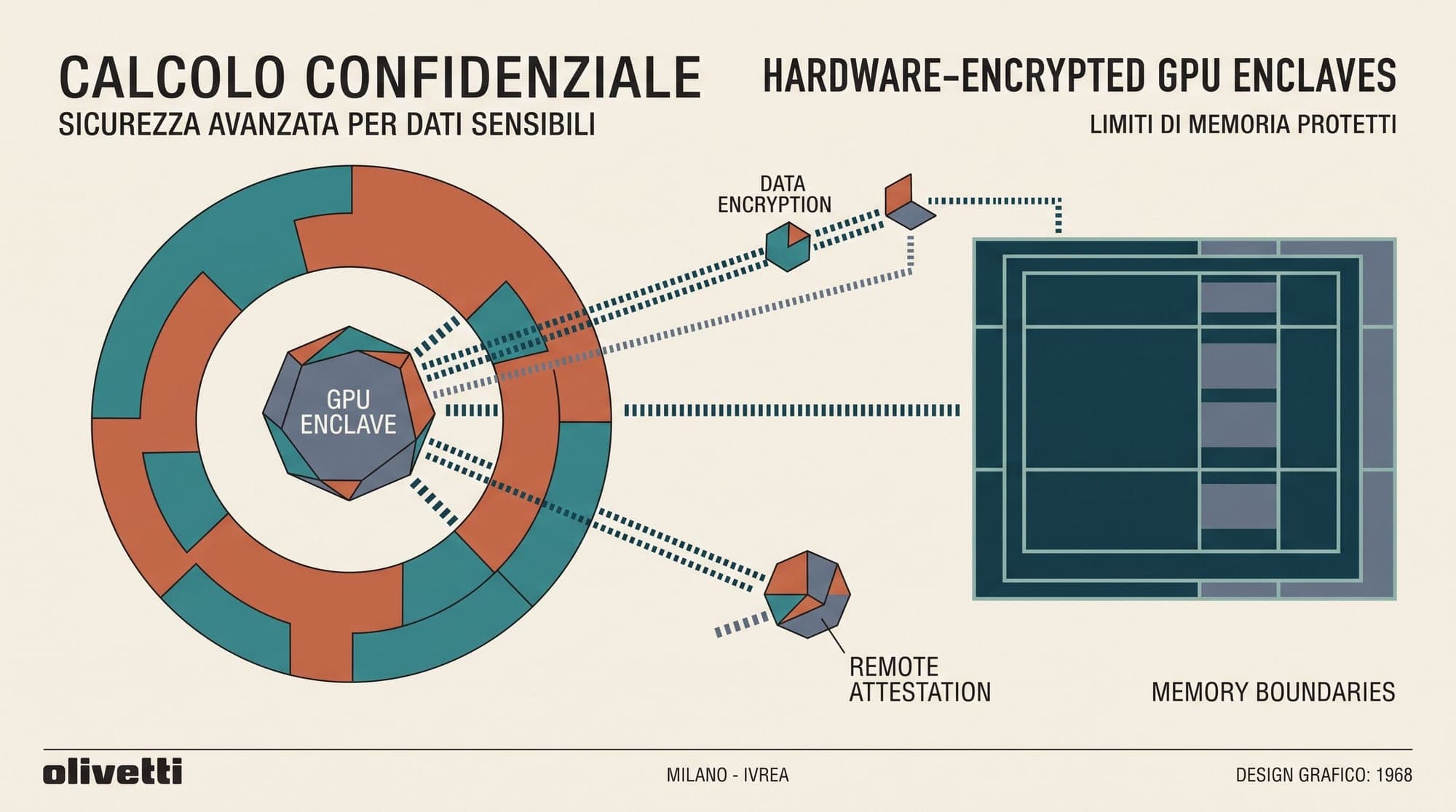
Deploying foundation models on regulated, proprietary, or multi-tenant workloads introduces severe data exposure risks. Traditional cloud deployments require trusting the cloud provider, the virtualization hypervisor, host operating system kernels, and infrastructure administrators with direct physical and memory access. In standard inference setups, model weights, input prompts, system instructions, and generated tokens reside in cleartext across host RAM, PCIe buses, and GPU High Bandwidth Memory (HBM).
Confidential computing addresses this exposure surface by establishing hardware-enforced Trusted Execution Environments (TEEs). While CPU-based enclaves such as AMD Secure Encrypted Virtualization-Secure Nested Paging (SEV-SNP) and Intel Trust Domain Extensions (TDX) have matured in general compute, GPU-accelerated LLM inference requires extending the confidential boundary directly into accelerator hardware.
The introduction of Confidential Computing (CC) mode in architectures like NVIDIA Hopper (H100/H200) and Blackwell (B200) allows engineering teams to execute sensitive transformer workloads inside cryptographically isolated enclaves. Implementing confidential LLM inference in production requires understanding the hardware root of trust, cryptographic interconnects, remote attestation lifecycles, and empirical latency penalties.

Hardware Isolation and the GPU Trust Boundary
Confidential LLM inference operates under an adversarial threat model where host hypervisors, peripheral devices, baseboard management controllers (BMCs), and rogue privileged processes are treated as untrusted.
To secure the execution environment without rewriting model architectures, modern systems pair a confidential virtual machine (CVM) with a confidential GPU (cGPU):
- Host CPU Enclave: The host virtual machine runs within an AMD SEV-SNP or Intel TDX partition. The CPU hardware enforces memory encryption using AES-128/256 engines embedded directly in the memory controllers, preventing hypervisors or DMA-capable PCIe peripherals from snooping guest memory pages.
- GPU Hardware Root of Trust: The GPU operates with an on-die Root of Trust (RoT), secure boot ROM, and internal cryptographic microcontrollers. In NVIDIA Hopper CC mode, hardware firewalls partition the GPU memory address space, blocking external JTAG debuggers, sideband I2C/SMBus controllers, and unauthorized host PCIe BAR accesses.
- Encrypted High Bandwidth Memory (HBM): Inside the GPU package, data stored in HBM3/HBM3e is encrypted at rest and in transit across the memory bus using dedicated AES-256-GCM hardware engines integrated into the memory controllers. Encryption and decryption occur at line rate alongside the HBM controller, isolating physical probing attacks without passing through CUDA Streaming Multiprocessors (SMs).
- Secure Interconnects: Communication between the host CPU TEE and the GPU traverses untrusted PCIe traces. PCI-SIG Integrity and Data Encryption (IDE) protocols or driver-level authenticated encryption (AES-256-GCM) secure all PCIe data packets, eliminating bus snooping and man-in-the-middle tampering.
Remote Attestation and the Key Broker Service (KBS)
A confidential enclave is only as secure as the verification protocol that proves its authenticity before secrets are loaded. Remote attestation establishes a cryptographic proof chain from the physical silicon up to the running container application.
+-------------------------------------------------------------------------------+
|                           Remote Attestation Flow                             |
+-------------------------------------------------------------------------------+

 [Client / Data Owner]            [Host CVM + GPU TEE]              [Attestation / KBS]
          |                                |                                 |
          |  1. Request Model Deployment   |                                 |
          |------------------------------->|                                 |
          |                                |  2. Generate Evidence Report    |
          |                                |     (SPDM + CPU SNP/TDX Quote)  |
          |                                |-------------------------------->|
          |                                |                                 |  3. Validate Silicon Signatures
          |                                |                                 |     against Reference Manifests
          |                                |  4. Release Decryption Keys     |     (RIM / VCEK / Root PKI)
          |                                |<--------------------------------|
          |                                |                                 |
          |                                |  5. Decrypt Model into Encrypted|
          |                                |     HBM & Initialize Serving    |
          |  6. Attested Inference Query   |                                 |
          |------------------------------->|                                 |
          |  7. Encrypted Output Stream    |                                 |
          |<-------------------------------|                                 |
The attestation and deployment lifecycle proceeds through structured phases:
- Evidence Generation: Upon boot, the guest operating system queries the GPU Security Protocol and Data Model (SPDM) interface. The GPU signs a measurement report containing the cryptographic hashes of its VBIOS, firmware, microcode, driver state, and hardware configuration using an internal device private key anchored in hardware fuses. Simultaneously, the CPU TEE generates an attestation quote reflecting the CVM bootloader, kernel, and initial ramdisk measurements.
- Evidence Verification: The combined evidence is transmitted to a trusted Attestation Service or Key Broker Service (such as Confidential Containers CoCo-KBS). The verification service validates the CPU quote against hardware vendor PKIs (AMD Versioned Chip Endorsement Key / Intel Root CA) and the GPU report against NVIDIA Reference Integrity Manifests (RIM).
- Policy Evaluation and Key Release: The KBS evaluates the measurements against user-defined security policies (verifying that no debug flags are enabled, firmware versions are patched, and the container image hash matches the authorized build). Upon validation, the KBS releases wrapped cryptographic keys to decrypt proprietary model weights and establish mutual TLS (mTLS) termination endpoints inside the enclave.
- Direct Secret Provisioning: Decryption keys never touch host storage or cleartext host RAM. Decryption occurs strictly inside the CVM and cGPU memory spaces.
Data Path Mechanics and Serving Overheads
Enabling confidential computing introduces specific architectural overheads that impact Large Language Model serving metrics, specifically Time-to-First-Token (TTFT) and Inter-Token Latency (ITL).
+-------------------------------------------------------------------------------+
|                       Host-to-GPU Secure Data Path                            |
+-------------------------------------------------------------------------------+

 [ CVM Guest Memory ]  -->  [ Encrypted Bounce Buffer ]  --> [ Untrusted PCIe Bus ]
   (AMD SEV / TDX)            (Staged DMA Transfer)            (PCIe IDE / AES-GCM)
                                                                       |
                                                                       v
 [ GPU Compute SMs ]  <--  [ In-Controller AES Engine ] <-- [ GPU Ingress Buffer ]
   (Cleartext Core)           (Line-Rate AES-256-GCM)          (Hardware Firewall)
1. PCIe Bounce Buffers and DMA Encryption
In standard serving runtimes (such as vLLM or SGLang), input token embeddings and tensor buffers are transferred directly from host user memory to GPU VRAM via direct memory access (DMA). In confidential mode, direct DMA from arbitrary guest memory to untrusted PCIe controllers is prohibited. Data must be staged into pre-allocated, physically contiguous bounce buffers, where AES-GCM tags and authentication headers are appended before transmission over PCIe.
2. Prefill Phase Bottlenecks (TTFT Impact)
During the prompt prefill phase, large token batches and prompt weight matrices are pushed across the host-device boundary. Because prompt processing is compute-heavy on the GPU but transfer-heavy during initial ingestion, bounce buffer copying and PCIe cryptographic framing introduce measurable latency. Empirical benchmarks published by Zhu et al. (2024) demonstrate that for standard context lengths (512 to 2,048 tokens), prefill throughput suffers a 5% to 8% overhead on PCIe-connected H100 cards.
3. Autoregressive Decode Phase (ITL Impact)
During the autoregressive decoding phase, the model generates tokens one by one. In this regime, execution is strictly memory-bandwidth bound within the GPU High Bandwidth Memory rather than host PCIe bound. Because the AES-256-GCM engines inside the HBM memory controllers operate at hardware line rate in parallel with memory requests, the overhead on token generation is negligible (typically between 1.5% and 3.5%).
4. Multi-GPU Interconnects: Hopper vs. Blackwell
On multi-GPU clusters running Tensor Parallelism (TP) or Pipeline Parallelism (PP), inter-GPU communication across NVLink becomes a primary scaling factor:
- Hopper Architecture (H100/H200): Confidential computing mode disables direct cleartext inter-GPU NVLink transfers. Multi-GPU confidential inference on Hopper requires routing cross-GPU collective communications (NCCL AllReduce) through CPU-mediated encrypted channels or restricted links, which incurs substantial throughput degradation for large tensor-parallel splits ().
- Blackwell Architecture (B200): Blackwell introduces native, line-rate NVLink encryption directly between GPUs. Dedicated hardware cryptographic engines on each NVLink port encrypt cross-GPU tensor communication without CPU intervention, bringing multi-GPU confidential inference overheads down to parity with single-node performance ().
Architectural Comparison: Inference Execution Environments
| Dimension | Standard Cloud Inference | CPU TEE (SEV-SNP / TDX) | Hopper cGPU (H100 CC) | Blackwell cGPU (B200 CC) | | :--- | :--- | :--- | :--- | :--- | | Protected Boundary | Application process only | Host CPU RAM & Registers | Host CPU + Single GPU VRAM | Host CPU + Multi-GPU NVLink Fabric | | Hypervisor Trust | Trusted (Full Access) | Untrusted (Isolated) | Untrusted (Isolated) | Untrusted (Isolated) | | Model Weight Protection | Cleartext in RAM/VRAM | Encrypted in Host RAM | Encrypted in VRAM (HBM) | Encrypted in VRAM + NVLink Fabric | | Serving Throughput | 100% (Baseline) | 20% - 40% (CPU Matrix Limit) | 93% - 97% of Baseline | 96% - 98% of Baseline | | Multi-GPU Scaling | Full NVLink Speed | N/A (CPU-Only) | Bottlenecked (Host-Routed) | Line-Rate Encrypted NVLink | | Attestation Standard | None | AMD/Intel TPM Quotes | SPDM + CVM Dual Attestation | SPDM + CVM + NVLink Fabric Attestation |
Production Implementation Patterns
Building a production confidential inference stack requires coordinating container orchestration, driver runtimes, and attestation proxies:
1. Infrastructure Provisioning
Deploying confidential inference instances (such as Azure DCasv5/ECasv5 or GCP Confidential A3 VM instances) requires configuring the underlying hypervisor with SEV-SNP/TDX enabled and binding the cGPU in CC mode via NVIDIA Open Kernel Modules:
# Verify NVIDIA Hopper CC mode status via NVML
nvidia-smi --query-gpu=gpu_name,confidential_compute.state --format=csv
2. Confidential Container (CoCo) Integration
Using standard Docker engines on untrusted hosts risks metadata leakage. Production architectures wrap serving engines (e.g., Triton Inference Server, vLLM, or TGI) within Kata Containers utilizing direct hardware virtualization:
- Guest kernels are minimal, measured, and signed.
- Root filesystems are encrypted with dm-crypt and authenticated via dm-verity.
- Attestation sidecars (such as
attestation-agent) query hardware quotes prior to mounting storage volumes.
3. Key Caching and Prompt Session Management
While attestation introduces an initial startup delay of 1 to 3 seconds during pod provisioning, runtime queries should avoid re-attesting on every HTTP request. Production gateways establish an ephemeral, authenticated mTLS channel directly into the enclave, terminating TLS inside the CVM memory space so that intermediate load balancers and reverse proxies never see plaintext prompts.
Sources
- NVIDIA Developer: Confidential Computing on Hopper H100
- EnclaveX: End-to-End Confidential AI with CPU/GPU TEEs (arXiv:2606.31408)
- Zhu et al.: Confidential Computing on NVIDIA Hopper GPUs: A Performance Benchmark Study (arXiv:2409.04381)
- PCI-SIG: Integrity and Data Encryption (IDE) Specification
- DMTF: Security Protocol and Data Model (SPDM) Standard
- Confidential Containers (CoCo) Architecture



