

Beyond Naive RAG: Production Comparison of Self-RAG, CRAG, and Adaptive-RAG for Enterprise LLMs
As retrieval-augmented generation (RAG) matures from prototype to production, teams face a critical choice: which advanced RAG variant best balances accuracy, latency, and operational complexity? Three leading approaches—Self-RAG, Corrective RAG (CRAG), and Adaptive-RAG—offer distinct trade-offs for enterprise deployment.

Architectural Overview
Self-RAG: Learning to Reflect
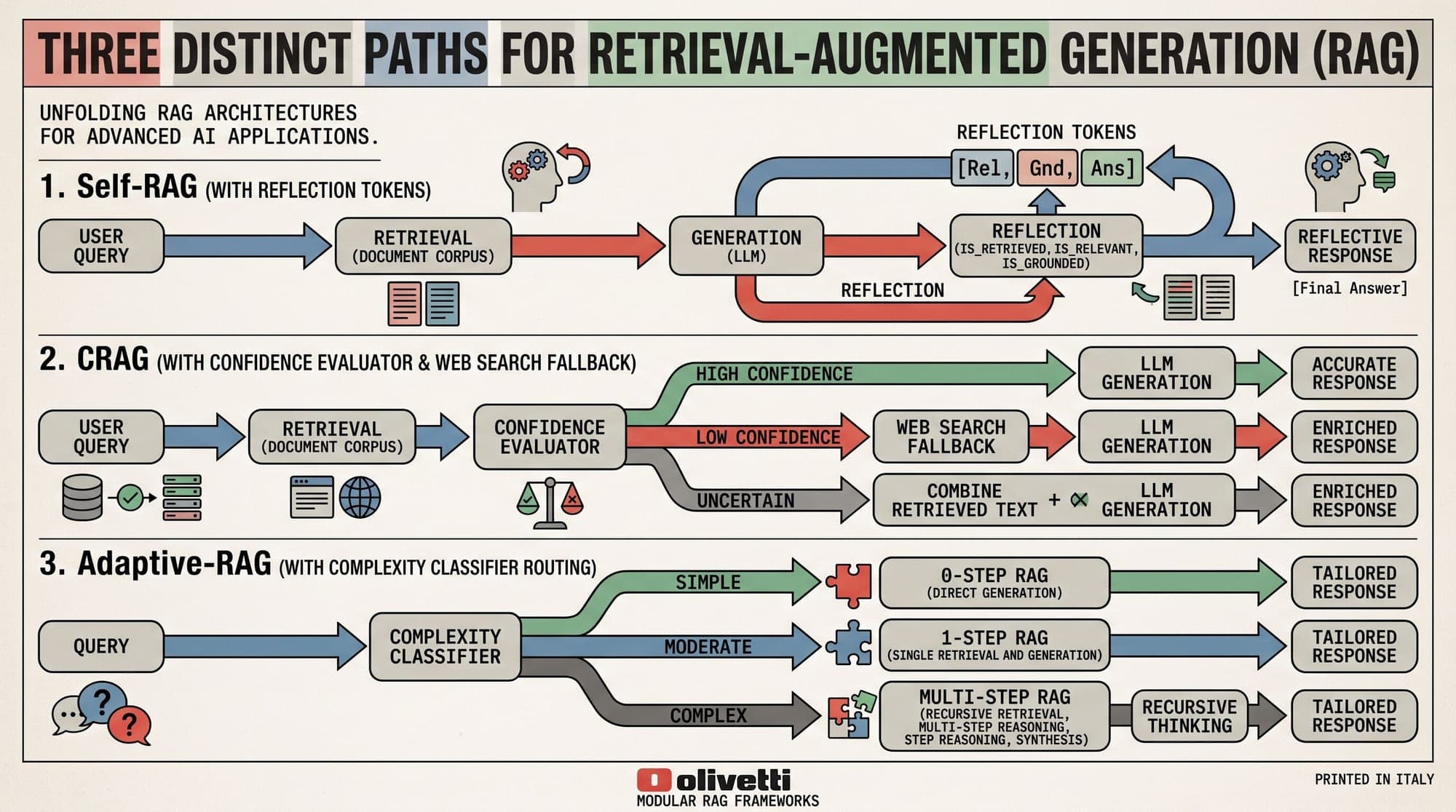
Self-RAG (Asai et al., ICLR 2024) trains a single language model to generate special reflection tokens during generation: [Retrieve], [IsRel] (is relevant), [IsSup] (is supported), and [IsUse] (is useful). Instead of blindly retrieving and generating, the model critiques its own outputs and retrieved passages, deciding dynamically whether to retrieve additional context or regenerate.
Key mechanism: Segment-wise beam search optimizes for utility across generation steps, allowing the model to weigh retrieval costs against factuality gains.
Corrective RAG (CRAG): Confidence-Gated Correction
CRAG (Yan et al., 2024) introduces a lightweight retrieval evaluator that assesses retrieved document quality before generation. Rather than accepting all retrieved context blindly, CRAG scores relevance and triggers one of three actions based on confidence thresholds:
- Correct (>0.7): Keep and refine documents via decompose-then-recompose
- Incorrect (<0.3): Discard and fall back to web search
- Ambiguous (0.3–0.7): Combine refined internal knowledge with web search
The evaluator (T5-large) adds minimal overhead while enabling robust handling of noisy or irrelevant retrieval results.
Adaptive-RAG: Query-Complexity Routing
Adaptive-RAG (Jeong et al., NAACL 2024) trains a lightweight classifier to predict query complexity and route each question to the optimal retrieval strategy:
- Simple queries: No retrieval (direct LLM answer)
- Moderate queries: Single-step retrieval
- Complex queries: Multi-step iterative retrieval
This approach avoids the "one-size-fits-all" penalty of standard RAG, where simple queries waste resources on unnecessary retrieval and complex queries suffer from insufficient reasoning depth.
Production Benchmark Analysis
Latency and accuracy measurements from controlled experiments reveal clear trade-offs:
| Approach | Execution Time (s/instance) | Latency vs RAG | Accuracy Gain (PopQA) | Key Trade-off | |----------|-----------------------------|----------------|------------------------|---------------| | Standard RAG | 0.363 | baseline | baseline | High retrieval noise sensitivity | | CRAG | 0.512 | +41% | +7.0% | Modest overhead for robustness | | Self-RAG | 0.741 | +104% | +20-40%* | Higher latency for strong factuality | | Self-CRAG | 0.908 | +150% | +27.9%* | Highest accuracy, highest cost |
*Self-RAG accuracy gains vary by task: +25-40% on long-form QA benchmarks per independent analysis.
Adaptive-RAG latency characteristics are workload-dependent: simple queries bypass retrieval entirely (near-zero latency), moderate queries match standard RAG latency, and complex queries incur multi-step overhead. Across mixed enterprise workloads, this routing optimizes average latency while preserving accuracy on hard queries.
Architecture-Specific Production Considerations
Self-RAG Deployment
- Compute profile: Variable inference time due to adaptive reflection steps (26.5–132.4 TFLOPs/token range)
- Tuning requirement: Instruction tuning needed to inject reflection token capability; base LLMs lack this behavior
- Strength: Highest factuality gains, particularly effective against hallucinations in long-form generation
- Best suited for: Knowledge-intensive applications where accuracy is paramount and slight latency increases are acceptable (e.g., research assistants, technical documentation)
CRAG Deployment
- Compute profile: Predictable overhead (27.2 TFLOPs/token, +41% latency)
- Dependencies: Requires external retrieval evaluator (T5-large) and web search API for incorrect/ambiguous cases
- Strength: Plug-and-play compatibility—works with standard RAG, Self-RAG, or any RAG variant via simple wrapper
- Best suited for: Production systems requiring robustness against retrieval failures, especially in dynamic knowledge domains where static corpora quickly become stale
Adaptive-RAG Deployment
- Compute profile: Highly workload-adaptive; simple queries consume minimal resources
- Dependencies: Requires complexity labeling pipeline to train the router classifier
- Strength: Optimizes resource allocation across heterogeneous query mixes; emerging as the "best practice" for enterprise RAG
- Best suited for: User-facing applications with mixed query complexity (e.g., customer support chatbots, enterprise search) where both latency and accuracy matter
Hybrid Approaches and Emerging Patterns
Production systems increasingly combine these techniques:
- Self-CRAG: Applying CRAG's evaluator to Self-RAG's retrieved contexts shows synergistic gains (61.8% PopQA accuracy vs 54.9% for CRAG alone)
- Adaptive Self-RAG: Using complexity routing to gate Self-RAG's expensive reflection steps only on complex queries
- CRAG-enhanced Adaptive: Using CRAG's evaluator within each Adaptive-RAG retrieval step to handle noisy intermediate results
Recommendations for Enterprise Teams
Choose based on your primary constraints:
- If maximizing factuality is critical: Self-RAG or Self-CRAG, accepting higher latency and tuning overhead
- If robustness against retrieval noise is priority: CRAG for its plug-and-play nature and predictable overhead
- If optimizing mixed workload efficiency: Adaptive-RAG for its intelligent resource allocation across query complexities
All three approaches move beyond naive retrieve-and-generate, addressing core limitations that hinder production RAG deployment. The choice ultimately depends on whether your system prioritizes peak accuracy, failure resistance, or workload-adaptive efficiency—and what latency and complexity costs you're willing to incur for those gains.
Sources
- Asai et al. "Self-RAG: Learning to Retrieve, Generate, and Critique through Self-Reflection" (arXiv:2310.11511, ICLR 2024)
- Yan et al. "Corrective Retrieval Augmented Generation" (arXiv:2401.15884)
- Jeong et al. "Adaptive-RAG: Learning to Adapt Retrieval-Augmented Large Language Models through Question Complexity" (arXiv:2403.14403, NAACL 2024)
- Experimental latency/accuracy data from arXiv:2506.00054v1 (Table 6: Computational overhead assessment)
- Independent benchmark analyses: Luketina.org RAG architecture review, Atlantean advanced RAG techniques survey
Sources
- https://arxiv.org/abs/2310.11511
- https://arxiv.org/abs/2401.15884
- https://arxiv.org/abs/2403.14403
- https://arxiv.org/abs/2506.00054v1



