Apple Music Mandates AI Transparency Tags Across Tracks, Compositions, and Artwork

Apple Music has notified record labels and distribution partners that it is introducing mandatory AI transparency tags across its ingestion pipeline, establishing visible indicators for synthetic audio and visual assets later this year. Under the updated ingestion specifications, content providers must declare when artificial intelligence tools have been used to generate a material portion of a release. Four-Tier Metadata Taxonomy The framework establishes distinct metadata flags across four

1 min
Apple Music Mandates AI Transparency Tags Across Tracks, Compositions, and Artwork

Apple Music has notified record labels and distribution partners that it is introducing mandatory AI transparency tags across its ingestion pipeline, establishing visible indicators for synthetic audio and visual assets later this year.

Under the updated ingestion specifications, content providers must declare when artificial intelligence tools have been used to generate a material portion of a release.

Four-Tier Metadata Taxonomy

The framework establishes distinct metadata flags across four creative layers of catalog delivery:

  1. Track: Identifies synthetic generation within the master sound recording at the individual track level.
  2. Composition: Flags machine-generated lyrical content, melodic structures, or compositional scoring.
  3. Artwork: Applies at the album release level for AI-generated static packaging or animated motion art.
  4. Music Video: Categorizes standalone or bundled video assets produced using generative visual models.
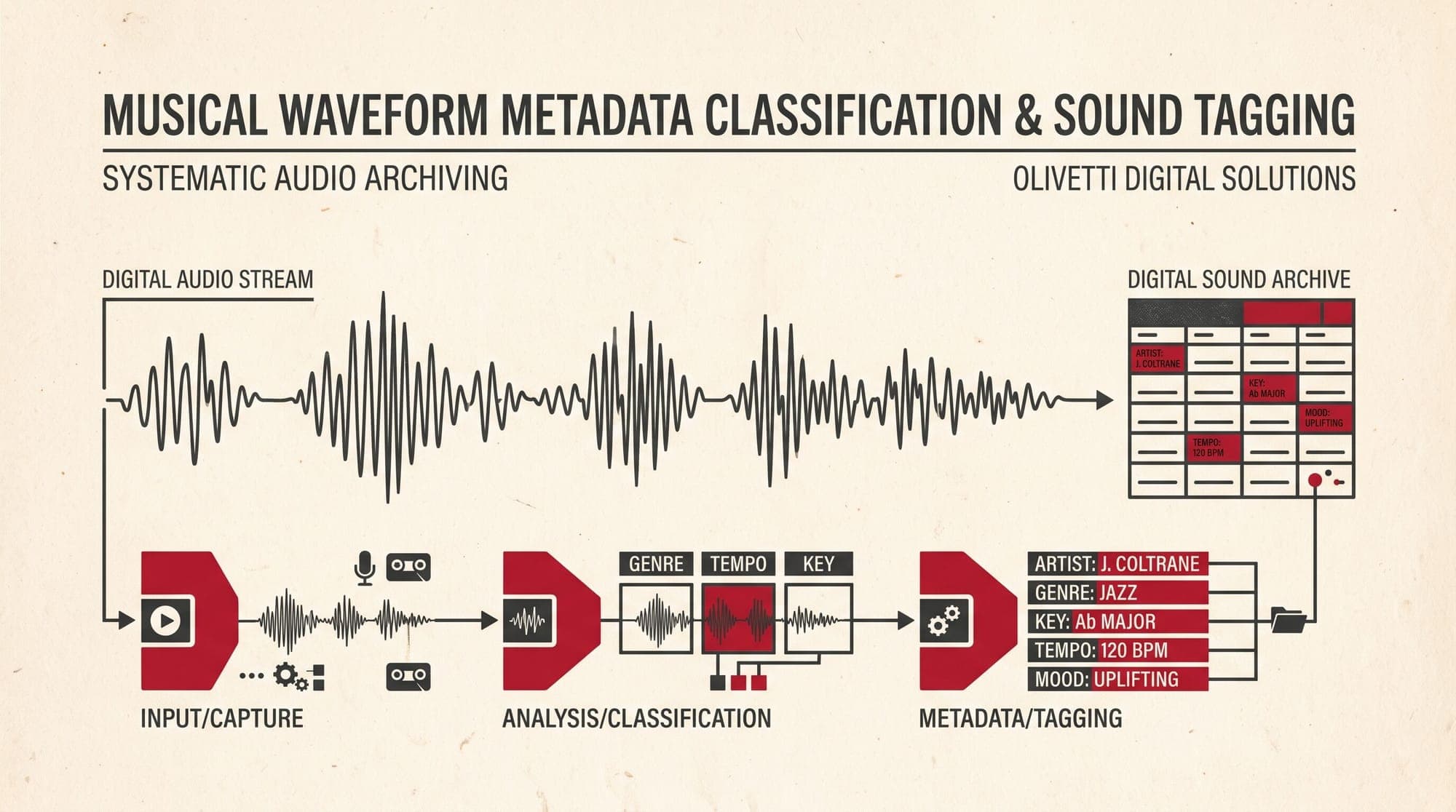
Four-category AI metadata taxonomy for streaming media distribution

Distributors and record labels are permitted to apply multiple tags concurrently across a single release package.

Upstream Verification and Catalog Scale

In communication with partners, Apple stated that it will rely on upstream content distributors to apply the tags during catalog delivery, treating AI disclosures similarly to conventional metadata fields such as genres, songwriter credits, and explicit content flags.

The labeling system addresses an influx of synthetic tracks across commercial streaming networks. Apple Music executive Oliver Schusser previously disclosed that fully synthetic audio accounted for more than a third of monthly content submissions to the platform.

Once the consumer-facing interface rolls out, qualifying releases will display public transparency indicators directly within the Apple Music application.


Sources

Written by

More to read

  • TVA Board Approves Dedicated Data Center Rate Class to Shield Households from AI Compute Costs

    The Board of Directors of the Tennessee Valley Authority (TVA) voted on August 20, 2026, to establish a dedicated wholesale rate class for large data centers. The tariff restructuring is designed to insulate residential consumers and small commercial businesses from the escalating capital expenditures required to expand the power grid for artificial intelligence workloads. Approved during the board's quarterly meeting in Memphis, Tennessee, the package introduces targeted tariffs for facilities

    1 min
  • Fast Model Weight Loading in Production: Safetensors, Tensorizer, and Direct GPU Deserialization

    Fast Model Weight Loading in Production: Safetensors, Tensorizer, and Direct GPU Deserialization In modern large language model inference clusters, cold start latency is rarely bounded by GPU compute allocation. Instead, the operational bottleneck centers on storage I/O and weight deserialization. As foundation models scale from 70 billion to 405 billion parameters, raw weight footprints range from 140 GB to over 800 GB in standard 16-bit precision. On naive serving stacks, deserializing these

    1 min
  • Maximal Update Parametrization (muP): How Tensor Programs Enable Zero-Shot Hyperparameter Transfer in LLM Pre-Training

    Pre-training a frontier large language model requires hundreds of thousands of GPU hours and millions of dollars in compute. At that scale, traditional hyperparameter tuning is financially and operationally impossible: teams cannot sweep learning rates, weight initializations, or optimizer betas across multiple 70B parameter runs to find the loss minimum. Historically, practitioners relied on ad-hoc heuristic extrapolation or manual guesses from small runs, often leading to sub-optimal loss curv

    1 min

