
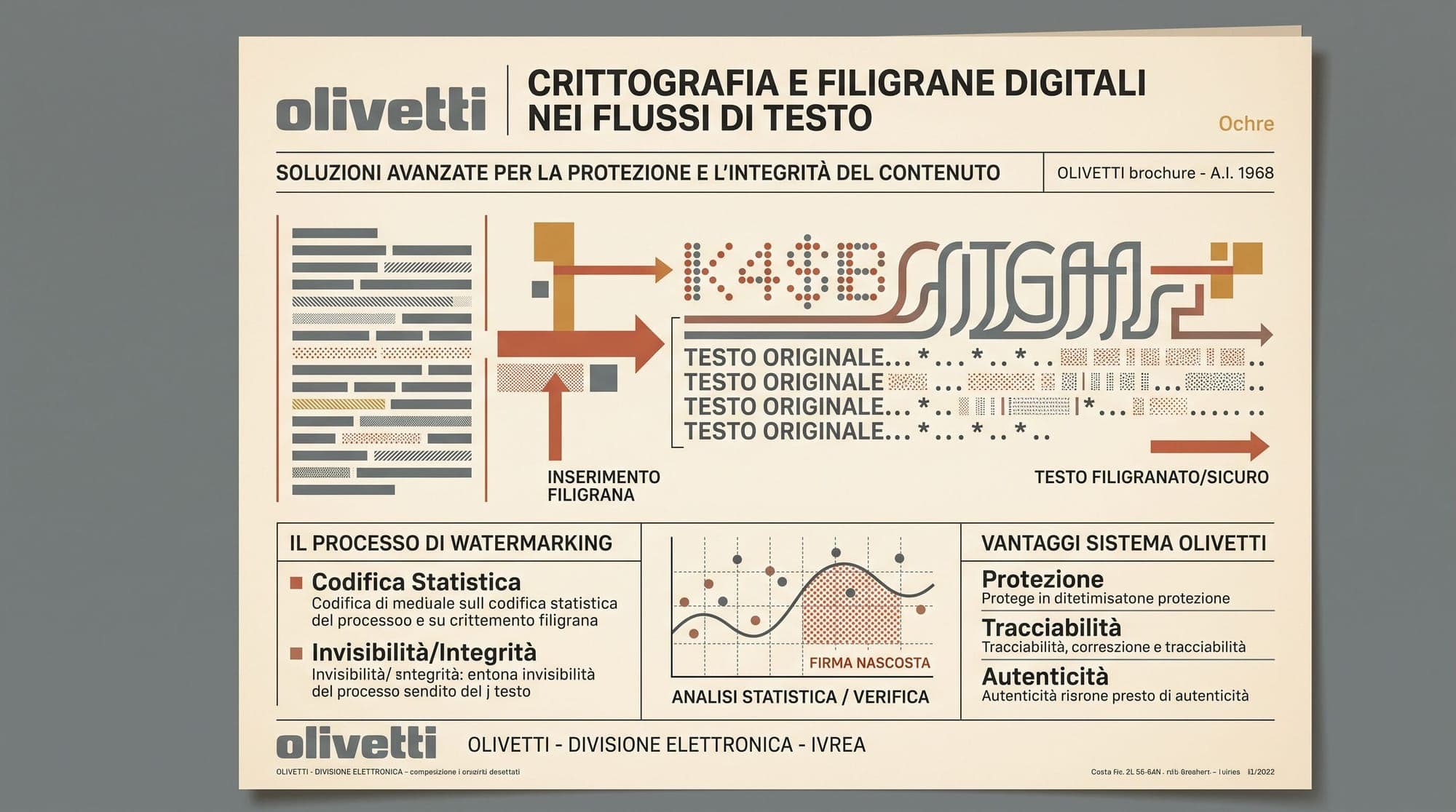
Anthropic has started deploying model-level text watermarking across Claude to meet the regulatory requirements of the European Union AI Act. The company confirmed that because it currently lacks infrastructure to reliably partition model inference behavior by geographic jurisdiction, watermarking is being applied globally across all Claude web products and API endpoints.
The update follows the formalization of the EU Code of Practice on Transparency of AI-Generated Content, signed in July 2026 by Anthropic and approximately 190 industry participants. Under the EU AI Act framework taking effect in August 2026, general-purpose AI providers offering models in the European single market must implement technical mechanisms to mark synthetic text and multimodal outputs.
Mechanism and Sampling Architecture
Rather than injecting invisible Unicode markers or modifying output token lengths, Anthropic's watermarking operates at the generation layer during token sampling. The system implements an adaptation of Google DeepMind's SynthID-Text framework, which builds on statistical pseudo-random sampling principles established by Scott Aaronson in 2022.
During autoregressive generation, a large language model calculates probability distributions across candidate tokens for each sequential position. When candidate tokens have similar probabilities, standard inference engines select candidates using a pseudo-random number generator. Anthropic's watermarking algorithm replaces the generic random number source with a deterministic pseudo-random function seeded by a proprietary cryptographic key combined with the preceding token sequence (n-gram context).

This deterministic seeding creates a subtle statistical pattern across extended text sequences. While individual word choices appear natural to human readers, the full sequence can be evaluated against the cryptographic key to compute the probability that Claude participated in text generation.
Dynamic Suppression for Exact Completions and Code
A core design requirement for production inference is preventing statistical watermarking from degrading factual precision or code execution. In constrained contexts where only a single token is objectively correct, altering candidate selection would introduce functional syntax errors or factual inaccuracies.
Anthropic confirmed that watermarking is dynamically suppressed in scenarios with low entropy:
- Deterministic completions: Calculations, factual historical names, and structured data with single valid answers bypass candidate shifting entirely.
- Source code generation: Programming language syntax and functional statements remain unwatermarked to preserve operational validity, though non-functional segments like comments can carry subtle seed modifications.
- Editing and proofreading: When Claude processes human-provided drafts for minor grammar and spelling corrections, only newly generated replacement tokens carry watermarking, leaving detection signals sparse.
- Open-ended generation and translation: Creative prose, long-form explanations, and language translations feature wide token selection entropy, allowing full watermark embedding.
Multimodal Credentials and Detection Roadmap
For non-text media produced by Claude, including PNG, JPG, and SVG assets, Anthropic is deploying Coalition for Content Provenance and Authenticity (C2PA) metadata standards rather than steganographic text alterations. These files receive cryptographically signed metadata records certifying AI generation without altering visual pixels.
Anthropic announced plans to release a dedicated Watermark Detection API, allowing enterprises and verification systems to query text passages against its cryptographic verification service. Existing model checkpoints released prior to August 2, 2026 operate under temporary regulatory transition windows and will receive watermarking integration in upcoming update cycles.



