
AI Agent Sandboxes and Safe Code Execution Runtimes in Production: Comparing E2B, Modal, Daytona, and Docker/gVisor Architecture, Isolation Boundaries, Startup Latency, and Serving Economics
Autonomous AI agents, evaluation harnesses, and code generation pipelines increasingly execute untrusted code generated directly by Large Language Models. When an agent runs dynamic Python scripts, executes terminal shell commands, installs arbitrary packages via package managers, or browses the web, it introduces severe security and operational risks. These risks include host privilege escalation, kernel exploitation, container breakout vulnerabilities such as CVE-2024-21626, credential theft via cloud Instance Metadata Services (IMDS), and denial-of-service via resource starvation.
To mitigate these risks while maintaining low end-to-end latency in iterative agentic loops, engineering teams rely on specialized sandboxing platforms. The production landscape is characterized by three distinct virtualization models: hardware-level microVMs (such as E2B), user-space syscall-intercepting kernels (such as Modal on gVisor), and standardized container-based workspace runtimes (such as Daytona).
This analysis evaluates the underlying isolation mechanisms, startup latency dynamics, memory snapshotting architectures, networking boundaries, and serving economics across these production sandbox platforms.
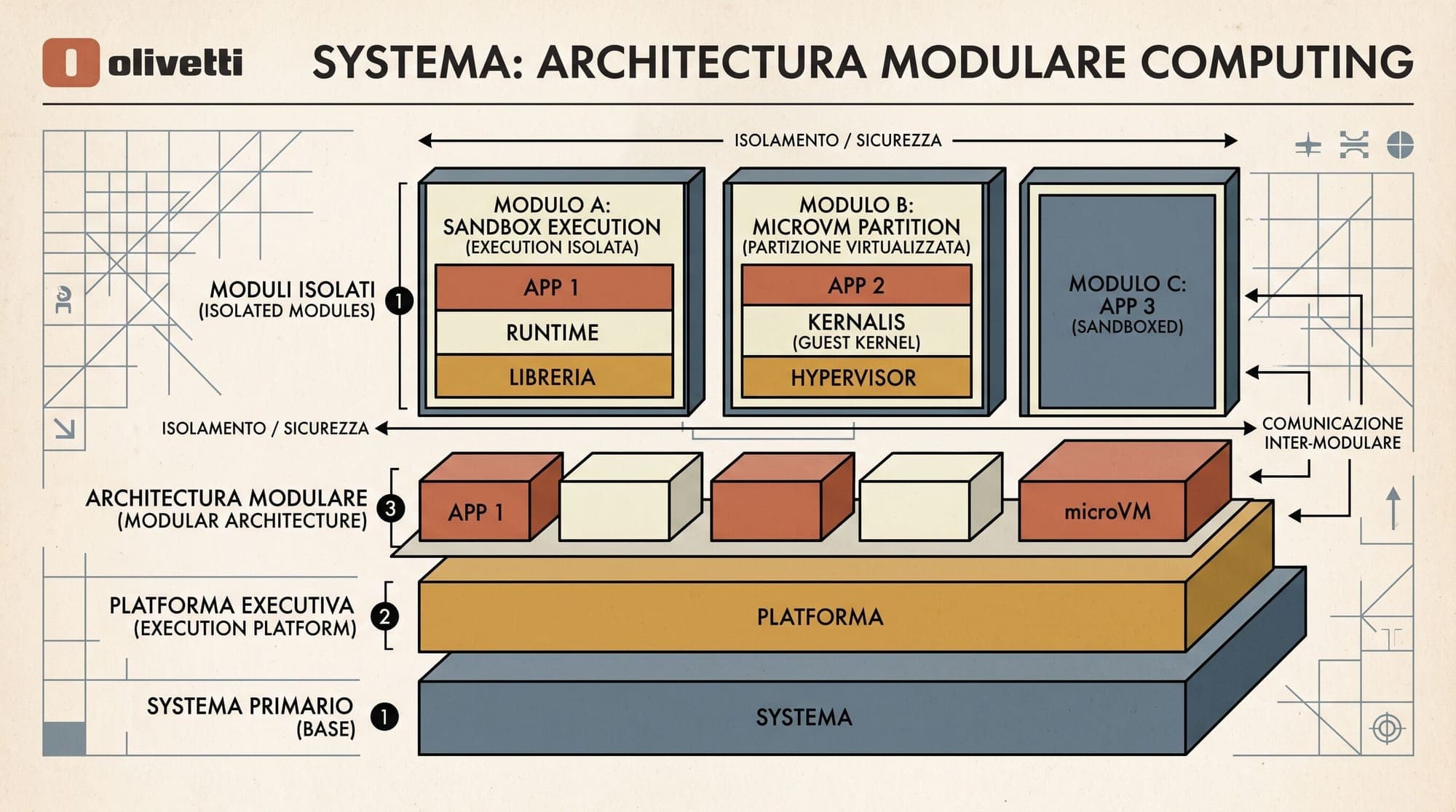
The Isolation Spectrum: MicroVMs vs. User-Space Kernels vs. OCI Containers
The fundamental architectural differentiator among sandbox platforms is the isolation primitive that defines the security boundary between the untrusted agent workload and the underlying host infrastructure.
+-----------------------------------------------------------------------------+
|                          ISOLATION PRIMITIVE SPECTRUM                       |
+-----------------------------------------------------------------------------+
| 1. HARDWARE MicroVMs (E2B / Firecracker / libkrun)                          |
|    [ Untrusted Code ] -> [ Guest Linux Kernel ] -> [ KVM / VMM Hypervisor ] |
|    -> Hardware Virtualization Boundary -> [ Host OS Kernel ]               |
|                                                                             |
| 2. USER-SPACE INTERCEPTING KERNELS (Modal / gVisor runsc)                   |
|    [ Untrusted Code ] -> [ Sentry Interceptor (Go) ] -> [ Host Virtual FS ] |
|    -> Filtered Syscalls (Seccomp) -> [ Host OS Kernel ]                     |
|                                                                             |
| 3. OCI CONTAINERS (Daytona / Docker / containerd)                           |
|    [ Untrusted Code ] -> [ Shared Linux Namespaces / cgroups v2 ]           |
|    -> Direct System Calls -> [ Host OS Kernel ]                             |
+-----------------------------------------------------------------------------+
1. Hardware-Level MicroVMs (Firecracker / KVM)
MicroVM architectures, implemented by systems like AWS Firecracker and utilized by E2B, provide hardware-enforced isolation. Each sandbox runs an independent guest Linux kernel inside a lightweight virtual machine monitor (VMM) managed via the Linux Kernel-based Virtual Machine (KVM) interface.
The security boundary is the hypervisor rather than the host kernel. Firecracker strips non-essential device drivers, legacy BIOS code, and complex ACPI tables, maintaining a minimal codebase of roughly 50,000 lines of Rust. A vulnerability in the guest kernel remains contained inside the microVM; compromising the underlying host requires an exploit in the hypervisor device model.
2. User-Space Kernels (gVisor / runsc)
Platforms such as Modal use gVisor, an application kernel written in Go that implements substantial portions of the Linux kernel surface in user space.
Instead of routing system calls directly to the host kernel, gVisor intercepts syscalls via a core component termed the Sentry. File system operations are brokered through an isolated daemon called the Gofer. The host kernel is protected via restrictive seccomp-bpf filters, meaning untrusted code cannot execute arbitrary host syscalls. While gVisor shares the host kernel at the outer layer, it eliminates direct host kernel exposure without incurring the memory footprint of full hardware virtualization.
3. Namespaces and Control Groups (OCI Containers)
Standard Linux containers (managed via runc, Docker, or containerd) isolate processes using Linux namespaces (PID, Mount, Network, IPC, UTS, User) and control groups (cgroups v2).
Platforms like Daytona utilize container-based environments configured via the standard devcontainer.json specification. Containers share the host OS kernel directly. While namespaces prevent unauthorized process visibility and cgroups enforce strict CPU/RAM limits, any unpatched kernel vulnerability (such as privilege escalation or use-after-free bugs) exposes the entire host node to compromise in multi-tenant environments.

Architectural Deep Dive: Production Sandbox Runtimes
E2B: Disposable Firecracker MicroVMs for Agentic Loops
E2B is designed specifically for running LLM-generated code, bash sessions, web browsers, and desktop automation inside ephemeral, hardware-isolated microVMs.
- Virtualization Core: E2B runs each sandbox inside an individual Firecracker microVM with a dedicated guest Linux kernel and memory space.
- Snapshot and Resume Architecture: To bypass standard kernel boot delays (which take several seconds), E2B pre-warms microVM templates and utilizes memory snapshotting. The state of a running Linux environment is captured directly from RAM and persistent block devices; new sandboxes are restored from these snapshots in approximately 150 milliseconds.
- State Model: Sandboxes are stateless and ephemeral by default, though users can programmatically fork sandboxes using copy-on-write memory branches (
sandbox.fork()) to explore parallel agent decision trees. - SDK Surface: E2B exposes clean Python and TypeScript SDKs featuring dedicated interfaces for filesystem manipulation, background process management, interactive terminal streaming (PTY), and headless Chromium browser execution.
Modal: High-Concurrency Serverless Sandboxes with Native GPU Access
Modal provides serverless container infrastructure optimized for data-intensive, batch, and AI agent workloads.
- Virtualization Core: Modal uses gVisor containerization (
runsc) to deliver strong compute isolation across multi-tenant clusters while scaling to tens of thousands of concurrent containers. - Filesystem and Cold-Start Optimization: Modal implements a custom user-space network filesystem and memory snapshotting system. Large container images (including multi-gigabyte Python dependencies and PyTorch libraries) are mounted dynamically without pulling complete disk layers before execution, enabling sub-second cold starts.
- Hardware Acceleration: Unlike CPU-restricted microVM providers, Modal provides first-class, dynamic access to NVIDIA GPUs (including L4, A100, H100, and B200 accelerators), allowing agents to execute local model inference, fine-tuning scripts, and CUDA kernels inside secure sandboxes.
- Concurrency: Modal is architected for large-scale production elasticity, capable of running over 50,000 to 100,000 active concurrent sandbox sessions with scale-to-zero economics.
Daytona: Standardized DevContainer Workspaces for Coding Agents
Daytona focuses on providing standardized, developer-grade workspace environments designed for long-running software development agents.
- Virtualization Core: Daytona instantiates environments based on standard Docker/OCI container images and
.devcontainerconfigurations, maintaining full compatibility with human developer setups. - Warm Pool Instantiation: By managing warm pools of pre-built container runtimes, Daytona achieves sub-90 millisecond container startup times.
- Persistence and Lifecycle: Unlike ephemeral execution wrappers, Daytona supports persistent workspaces, Docker-in-Docker (DinD) capabilities, multi-repository mounts, and long-running state preservation across complex coding tasks.
- Deployment Flexibility: Daytona provides both managed cloud infrastructure and self-hosted deployments (Bring Your Own Cloud / BYOC) for enterprise environments with strict data sovereignty mandates.
Latency Analysis: The Compounding Cost of Sequential Agent Tool Calls
In autonomous agent architectures (such as coding assistants, data analysts, or multi-step reasoning systems), an agent does not execute code in a single batch. Instead, it executes an iterative loop: read file, run command, observe stdout/stderr, modify code, run test suite.
Agent Task Execution: Iterative Tool Call Loop (N = 15 steps)
--------------------------------------------------------------------------------
Docker Cold Start (2.5s avg):  |==============================================| (37.5s overhead)
E2B Snapshot Restore (150ms):  |===| (2.25s overhead)
Daytona Warm Pool (90ms):      |=| (1.35s overhead)
--------------------------------------------------------------------------------
When an agent performs multiple sequential operations where each operation requires an isolated environment, total startup overhead scales linearly with loop count:
Total Startup Overhead = N * T_startup
If an unoptimized Docker daemon is used, provisioning and tearing down a fresh container takes between 2.0 and 5.0 seconds. For a typical software engineering task requiring 15 tool executions:
- Standard Docker Cold Start (2.5s average): 15 * 2.5s = 37.5 seconds of pure runtime overhead.
- E2B Firecracker Snapshot Restore (150ms): 15 * 0.15s = 2.25 seconds of overhead.
- Daytona Warm Pool (90ms): 15 * 0.09s = 1.35 seconds of overhead.
Sub-second sandbox instantiation is not merely an optimization; it is a fundamental requirement to keep interactive agent wall-clock execution times within acceptable production thresholds.
Network Isolation and Cloud Metadata Protection
A critical vulnerability in agent sandboxes is unconstrained outbound network access. An agent executing untrusted code or prompt-injected instructions can initiate Server-Side Request Forgery (SSRF) attacks, connect to malicious command-and-control servers, or scrape credentials from cloud infrastructure.
1. Instance Metadata Service (IMDS) Exfiltration
In cloud environments (AWS, GCP, Azure), virtual machines can access internal metadata endpoints (such as http://169.254.169.254/latest/meta-data/) to retrieve IAM role credentials, instance identity tokens, and networking topology. If an agent executes curl http://169.254.169.254/latest/meta-data/iam/security-credentials/, it can compromise the parent host's cloud permissions.
Production sandboxes implement strict packet-level filtering:
- E2B and Modal: Block routing to
169.254.169.254and private VPC subnet ranges by default at the virtual network interface (veth) and iptables layer. - IMDSv2 Enforcement: Requiring session tokens via
PUTheaders withX-aws-ec2-metadata-token-ttl-secondsprevents naive SSRF, but total firewall isolation of metadata CIDR blocks is the only reliable defense.
2. Default-Deny and Domain Allowlisting
Production architectures should enforce a default-deny egress policy. Sandboxes intended solely for code computation should disable outbound networking entirely. For sandboxes that require package installations (such as pip install or npm install), egress gateways must restrict traffic to verified package registries and package hash verification proxies.
3. Credential Proxying
Rather than injecting raw API keys, database credentials, or third-party secrets directly into the sandbox environment variables (where an LLM or script can inspect env or /proc/self/environ), production platforms use outbound proxy sidecars. The agent sends requests to an internal proxy, which injects authentication headers downstream without exposing secret values to the untrusted sandbox memory space.
Production Sandbox Feature & Operational Comparison
+-----------------------------------------------------------------------------+
| RUNTIME FEATURE & OPERATIONAL COMPARISON MATRIX                             |
+-----------------------------------------------------------------------------+
| Feature             | E2B            | Modal          | Daytona             |
|---------------------+----------------+----------------+---------------------|
| Isolation Primitive | MicroVM        | gVisor (runsc) | OCI Container       |
| Guest Linux Kernel  | Dedicated      | Translated     | Shared Host Kernel  |
| Security Boundary   | Hypervisor/KVM | User-space FS  | Namespaces/cgroups  |
| Cold-Start Latency  | ~150 ms        | ~300ms - 1.0s  | ~90 ms              |
| Hardware GPUs       | CPU only       | Full (NVIDIA)  | Custom / BYOC       |
| State Model         | Ephemeral/Fork | Ephemeral/Snap | Persistent Workspace|
| Config Standard     | Templatefile   | Python app     | devcontainer.json   |
| Multi-Tenant Safety | High           | High           | Medium              |
| Base Pricing Model  | $0.000014/vCPU | $0.000039/core | $0.000014/vCPU      |
+-----------------------------------------------------------------------------+
Detailed Provider Profiles
- E2B: Best-in-class for multi-tenant, untrusted execution where strong isolation is paramount. Powered by Firecracker microVMs with dedicated guest kernels, snapshot-restore latency of 150ms, and built-in support for desktop and headless browser automation.
- Modal: Optimal for workloads requiring massive elastic concurrency (50,000+ sessions), fast user-space container storage, and high-performance GPU acceleration across NVIDIA T4 through B200 clusters with scale-to-zero economics.
- Daytona: Optimal for autonomous coding agents requiring persistent software workspaces, full
devcontainer.jsonenvironment definitions, Docker-in-Docker support, and enterprise Bring-Your-Own-Cloud deployment options. - Self-Hosted Docker / gVisor: Viable for internal-only trusted workflows, but introduces 2-5 second cold starts and high orchestration maintenance unless coupled with custom snapshotting and network egress proxies.
Architectural Decision Framework: Choosing the Right Sandbox
When architecting production agent infrastructure, the selection between E2B, Modal, Daytona, or a custom stack depends on three operational parameters:
+-----------------------------------------------------------------------------+
|                     SANDBOX SELECTION DECISION TREE                         |
+-----------------------------------------------------------------------------+
|                                                                             |
|  Does your agent require local GPU execution or fine-tuning?                 |
|  ├── YES  ===> Choose MODAL (gVisor isolation with native NVIDIA GPU pools) |
|  └── NO                                                                     |
|       │                                                                     |
|       Is the workload executing arbitrary, multi-tenant, untrusted code?   |
|       ├── YES  ===> Choose E2B (Hardware Firecracker microVMs, snapshotting)|
|       └── NO (Controlled developer workspaces, internal team automation)   |
|            │                                                                |
|            Do you require full DevContainer compatibility and persistence?  |
|            ├── YES  ===> Choose DAYTONA (devcontainer.json, sub-90ms start) |
|            └── NO   ===> Choose SELF-HOSTED gVisor / Docker on Nomad/K8s    |
+-----------------------------------------------------------------------------+- Choose E2B when: You are building public-facing, multi-tenant AI agents (such as code interpreters, autonomous browser agents, or data analysis assistants) where untrusted users can prompt the model to generate arbitrary code. The Firecracker hardware virtualization boundary prevents cross-tenant data leakage and host compromise, while snapshotting ensures responsive sub-second execution.
- Choose Modal when: Your agentic workflows require GPU acceleration, model fine-tuning inside the sandbox, high-throughput distributed batch processing, or when you need massive serverless elasticity scaling up to 100,000 parallel workers.
- Choose Daytona when: You are building complex coding agents that require standard development environments, persistent workspaces, multi-language IDE toolchains, Docker-in-Docker support, or standard
.devcontainerconfiguration files in an enterprise setting.
Sources
- E2B Documentation and Architecture
- Modal Sandbox Documentation and gVisor Architecture
- Daytona Infrastructure Overview
- AWS Firecracker MicroVM Architecture
- Google gVisor Container Runtime Security
- NIST CVE-2024-21626 Container Breakout Vulnerability Report
- LogRocket: Comparing AI Agent Sandbox Platforms
- Superagent: AI Code Sandbox Benchmark 2026



