
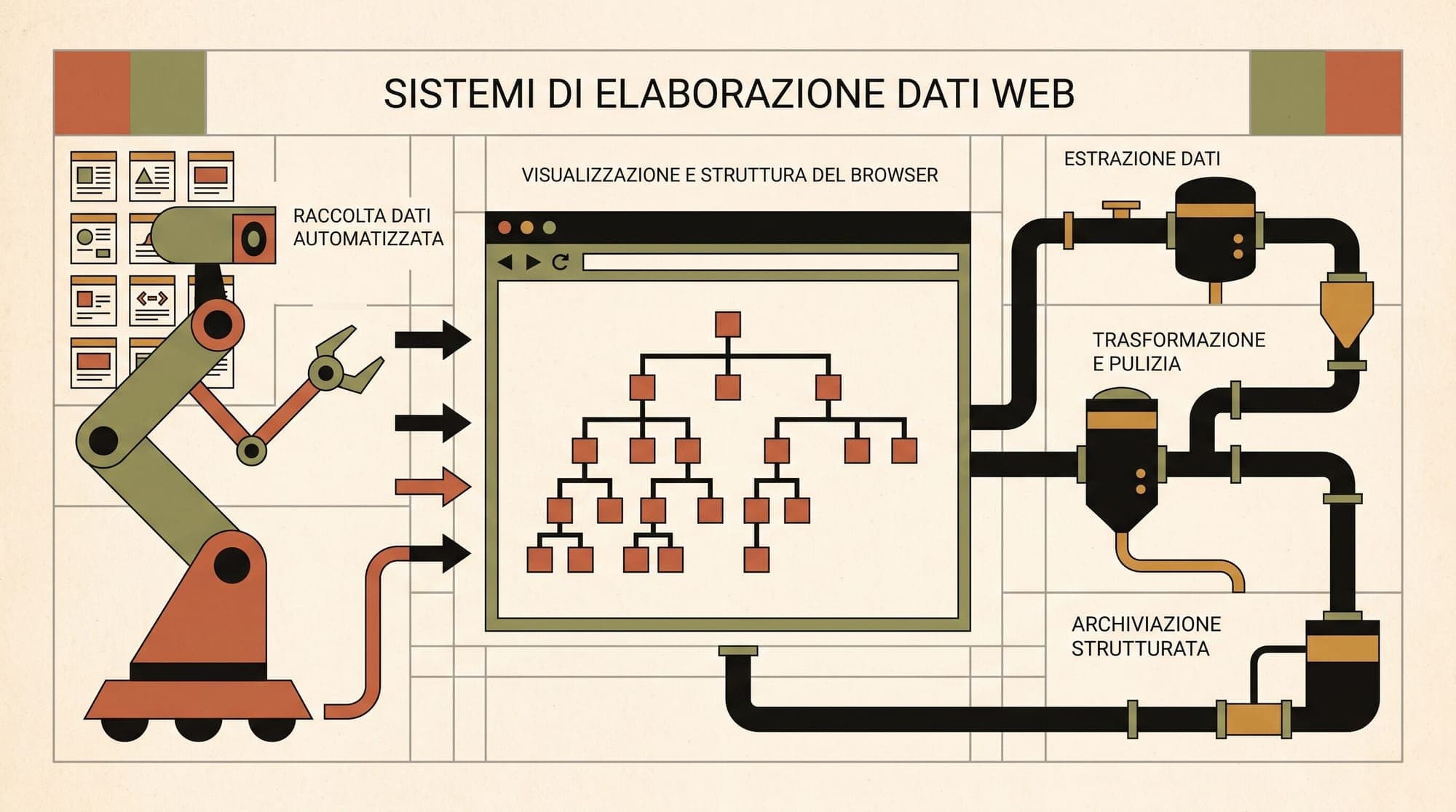
Agentic Web Scraping and Headless Browser Automation in Production: Comparing Crawl4AI, Browser-Use, Stagehand, and ScrapeGraphAI
Web scraping has undergone a fundamental architectural transition. For decades, automated data extraction relied on deterministic parsers such as Beautiful Soup, Scrapy, and raw headless browser drivers like Playwright or Puppeteer. These tools depended on hand-crafted CSS selectors, XPath expressions, and rigid execution trees. While computationally lightweight, selector-based scraping suffers from severe fragility: minor frontend layout refactors, dynamic DOM class obfuscation (such as Tailwind CSS or CSS-in-JS compilation), shadow DOM encapsulation, and client-side single-page application (SPA) hydration frequently break production extraction pipelines.
The emergence of large language models (LLMs) and vision-language models (VLMs) introduced two distinct paradigms to web automation: semantic content parsing and autonomous agentic navigation. In semantic parsing, models interpret unstructured, messy DOM structures without explicit selectors. In agentic navigation, models observe the runtime browser state, reason about intermediate user interfaces, and execute goal-directed multi-turn actions (such as clicking, scrolling, typing, and tab switching).
However, deploying LLM-driven scraping in production introduces significant engineering tradeoffs across token overhead, inference latency, compute infrastructure, and deterministic reliability. Four prominent frameworks have emerged to tackle these challenges across different architectural layers: Crawl4AI, Browser-Use, Stagehand, and ScrapeGraphAI.
This analysis evaluates the underlying architectures, perception pipelines, execution engines, token economics, and operational tradeoffs of each framework.

Architectural Profiles: The Four Paradigms
Each framework approaches web automation with fundamentally different architectural assumptions regarding statefulness, autonomy, and the role of the LLM.
1. Crawl4AI: High-Throughput Semantic Ingestion and Preprocessing
Developed as an open-source, asynchronous crawling framework, Crawl4AI is designed for high-throughput batch extraction and RAG (Retrieval-Augmented Generation) document ingestion pipelines. Rather than treating the LLM as an autonomous agent that navigates the web step-by-step, Crawl4AI treats the browser as a deterministic data collector and uses LLMs selectively for content transformation and schema extraction.
Key architectural characteristics:
- Playwright Asynchronous Core: Uses an asynchronous Playwright engine (
AsyncWebCrawler) capable of executing user actions (such as scrolls, waits, and clicks) via deterministic hooks before extracting content. - Semantic HTML-to-Markdown Pruning: Implements heuristics to strip script tags, styles, navigation bars, footers, SVGs, and base64 images, converting bloated HTML payloads into dense, clean Markdown and "fit-HTML" suitable for context windows.
- Content Chunking and Cosine Filtering: Includes built-in chunking strategies (such as overlapping sliding windows, regex-based chunking, and topic-based segmentation). It can calculate cosine similarity between extracted text chunks and a target user query, discarding irrelevant sections before passing data to an extraction model.
- LLM Schema Extraction Layer: Supports both free, selector-based extraction (
DefaultTableExtraction) and LLM-driven structured extraction (LLMExtractionStrategyandLLMTableExtraction) using Pydantic schemas or JSON schemas with automatic retries and chunk stitching.
Crawl4AI prioritizes throughput, low compute cost, and minimal token consumption. It does not attempt to solve open-ended visual navigation tasks, making it ideal for large-scale crawling where URLs are known or discoverable via sitemaps.
2. Browser-Use: Multimodal ReAct Loops over Chrome DevTools Protocol
Browser-Use is an open-source Python framework designed for full agentic autonomy. It models browser interaction as a closed-loop ReAct (Reasoning + Acting) cycle, allowing an LLM to navigate arbitrarily complex, multi-page websites to achieve a high-level goal (for example: "Find the lowest price for flight X on site Y, enter passenger details, and reach the payment screen").
Key architectural characteristics:
- Dual-Stream Perception (DOM + Vision): At every interaction step, Browser-Use queries the browser via the Chrome DevTools Protocol (CDP) to extract two parallel streams of state:
- A flattened and filtered Chrome Accessibility Tree (AXTree) representing interactive DOM elements, their ARIA attributes, labels, and hierarchy.
- A high-resolution viewport screenshot highlighting interactive elements with bounding boxes and numeric index overlays (set-of-marks prompting).
- Indexed Action Space: The agent maps interactive DOM elements to integer indices. The planner model emits structured JSON tool calls referencing these indices (such as
click_element(index=14),input_text(index=3, text="user@example.com"),scroll_page(down=True), orswitch_tab(tab_id=2)). - Autonomous Error Recovery: If an action fails (such as an overlay blocking a button or an unexpected modal pop-up), the agent observes the new state in the subsequent turn, inspects the updated DOM snapshot, and dynamically adjusts its strategy.
- BrowserSession Abstraction: Manages multi-tab contexts, persistent browser profiles, cookie storage, and proxy routing within isolated execution environments.
Browser-Use provides maximum adaptability for exploratory tasks and complex workflow automation, but incurs high inference latency and substantial token costs due to repetitive multimodal state evaluations on every step.
3. Stagehand: Hybrid Deterministic-Agentic SDK
Created by Browserbase, Stagehand is an automation SDK (available in TypeScript and Python) designed to bridge the gap between brittle legacy scripts and unpredictable fully autonomous agents. Stagehand avoids infinite agentic planning loops by providing modular, atomic AI primitives that can be integrated directly into deterministic Playwright code.
Key architectural characteristics:
- Atomic AI Primitives: Provides four discrete functional methods:
act(instruction): Executes a single natural-language action (such as "click the submit button" or "select California from the dropdown") by resolving the target element and executing the native event.extract(instruction, schema): Extracts structured data from the current page state, enforcing validation using Zod (TypeScript) or Pydantic (Python).observe(instruction): Discovers actionable elements matching a description without executing an action, returning candidate selectors and methods for programmatic verification.agent(goal): An optional orchestrator for multi-step autonomous execution when strict step-by-step control is unnecessary.- Self-Healing Selector Resolution: Rather than passing entire raw HTML payloads to the model, Stagehand extracts a compressed accessibility tree, maps the target element using an LLM, and generates resilient locators. If a site changes its layout, Stagehand automatically rediscovers the intended target without breaking the test or script.
- Cloud Infrastructure Integration: Native compatibility with Browserbase cloud browser infrastructure, session replay, CAPTCHA bypass, and WebMCP (Model Context Protocol) integration.
Stagehand is engineered for production reliability, CI/CD pipelines, and end-to-end automation where predictability, execution speed, and deterministic guarantees are paramount.
4. ScrapeGraphAI: Modular Directed Acyclic Graph Pipelines
ScrapeGraphAI is an open-source Python library that conceptualizes web scraping as a Directed Acyclic Graph (DAG) of discrete processing nodes. Instead of maintaining long-lived interactive browser sessions, ScrapeGraphAI constructs structured pipelines where each node handles a specific stage of data ingestion, transformation, retrieval, or schema generation.
Key architectural characteristics:
- Node-Based DAG Architecture: Pipelines are composed of modular nodes, including:
FetchNode: Retrieves raw content via HTTP clients or headless browser engines (Playwright, Chromium).ParseNode: Converts raw markup (HTML, XML, JSON) into clean text blocks.RAGNode: Splits parsed content into text chunks, embeds them, and executes vector similarity search against the extraction prompt to isolate relevant text segments.GenerateAnswerNode: Feeds the retrieved context and user prompt into an LLM to generate the final structured output.- Pre-Built Graph Topologies: Includes standard graphs for common scraping patterns:
SmartScraperGraph: Single-page prompt-to-JSON extraction.SearchGraph: Multi-page extraction that queries search engines and extracts structured data across the top N search results.ScriptCreatorGraph: Generates standalone, selector-based Python/Scrapy scripts from a natural language prompt, eliminating ongoing LLM inference costs for static websites.- Local and Remote Model Flexibility: Supports both proprietary API endpoints (OpenAI, Anthropic, Google) and local model inference (Ollama, vLLM, HuggingFace).
ScrapeGraphAI is optimized for structured extraction tasks where users need direct answers or JSON payloads without writing parsing rules or managing complex interactive agent loops.
Architectural Comparison Matrix
| Dimension | Crawl4AI | Browser-Use | Stagehand | ScrapeGraphAI | | :--- | :--- | :--- | :--- | :--- | | Primary Paradigm | High-throughput async crawler & markdown preprocessor | Autonomous multimodal ReAct agent | Hybrid deterministic / AI primitive SDK | Modular Directed Acyclic Graph (DAG) pipeline | | Core Languages | Python | Python | TypeScript, Python | Python | | Perception Mechanism | Pruned HTML, Markdown, fit-HTML, cosine chunking | Chrome AXTree (CDP) + Viewport Screenshots (VLM) | Filtered Accessibility Tree + Element Locators | HTML/XML parsing + In-memory Vector RAG | | Execution Engine | Async Playwright hooks & deterministic actions | CDP-driven indexed action loop (click, type, tab) | Native Playwright locators + act() / observe() | Graph-orchestrated nodes (Fetch, Parse, RAG) | | Schema Validation | Pydantic / JSON schema with chunk aggregation | Tool-call parameter schemas / Agent final output | Zod (TypeScript) / Pydantic (Python) | Pydantic / JSON schema via generative node | | Autonomy Level | Low (script-driven crawling & extraction) | High (fully autonomous goal-driven navigation) | Flexible (developer-controlled hybrid steps) | Medium (fixed graph pipeline execution) | | Average Latency / Step | Sub-second (crawling) to 2-4s (LLM extraction) | 3-8s per interaction step (multimodal inference) | 1-3s per AI primitive; sub-second for Playwright | 5-15s per graph run (RAG + inference) | | Token Consumption | Very Low to Medium (heavily pruned / chunked) | Very High (repetitive multimodal context per step) | Low to Medium (localized AXTree targeting) | Medium (embedding + filtered context windows) |
Technical Deep-Dive: Perception Layers and State Representation
The performance, cost, and reliability of an AI scraping framework depend primarily on its perception layer: how the framework captures, filters, and formats webpage state before presenting it to the language model.
Raw Webpage (Dynamic DOM, Styles, Scripts, Canvas, Iframes)
  │
  ├── Crawl4AI ─────────► Heuristic Pruning ──► Clean Markdown / Fit-HTML ──► Cosine Chunking ──► LLM Schema Extractor
  │
  ├── Browser-Use ──────► CDP AXTree Export + Viewport Screenshot ──────────► Set-of-Marks VLM ─► ReAct Action Loop
  │
  ├── Stagehand ────────► Filtered AXTree Nodes + Natural Instruction ──────► Targeted Locator ──► Deterministic Playwright
  │
  └── ScrapeGraphAI ────► Fetch & Parse Nodes ─► In-Memory Vector Store ─────► Context RAG Node ──► Generative JSON Node
1. Raw HTML vs. Filtered Markdown (Crawl4AI)
Modern web pages frequently contain between 50,000 and 500,000 characters of raw HTML markup, the majority of which consists of styling classes, tracking scripts, metadata, and deeply nested <div> wrappers. Passing raw HTML directly to an LLM wastes context window capacity and degrades retrieval precision.
Crawl4AI addresses this by using structural HTML sanitization. It removes non-content elements and converts the remaining DOM tree into semantic Markdown. By preserving header hierarchies, lists, and markdown tables while stripping layout noise, Crawl4AI reduces token consumption by 70% to 90% compared to raw markup. For pages exceeding model context limits, Crawl4AI executes overlapping sliding window chunking and cosine similarity filtering, ensuring the extraction model only evaluates semantically relevant sections.
2. Accessibility Tree (AXTree) vs. Pure Vision (Browser-Use & Stagehand)
For interactive agents, raw HTML and plain Markdown lose critical interaction state (such as whether an element is disabled, focused, expanded, or hidden behind an overlay). Conversely, relying purely on raw viewport screenshots and pixel coordinates makes agents vulnerable to scaling issues, coordinate hallucinations, and rendering mismatches across different device pixel ratios.
Modern frameworks have converged on the Chrome Accessibility Tree (AXTree) as the optimal state representation:
- Semantic Grounding: The AXTree provides the exact roles (
button,combobox,dialog), accessible names, current values, and ARIA attributes exposed to screen readers. - Token Efficiency: An AXTree snapshot is typically 80% to 95% smaller than the corresponding raw DOM tree, containing only actionable, interactive, or readable nodes.
- Deterministic Targeting: Instead of predicting fragile screen pixel coordinates , the model references discrete backend node IDs or assigned indices. The framework translates these IDs into native browser input dispatches via CDP.
Browser-Use combines the AXTree with visual bounding-box overlays (set-of-marks prompting), enabling the model to cross-reference visual layout cues (such as spatial proximity or non-standard visual canvas elements) with structural DOM identifiers. Stagehand relies primarily on AXTree parsing for its observe() and act() primitives, minimizing visual model latency.
3. In-Memory Vector RAG over DOM Structures (ScrapeGraphAI)
ScrapeGraphAI uses a document retrieval approach. Rather than compressing the entire page into a single prompt, its ParseNode splits the webpage content into structured text chunks and embeds them into a transient vector index. When extracting specific fields (such as product specifications or executive names), the RAGNode retrieves the top- most similar content chunks before invoking the generative model. This design allows ScrapeGraphAI to handle extensive multi-page documents and complex catalogs without exceeding model token limits or paying for unnecessary context processing.
Serving Economics, Latency, and Infrastructure
Operating browser automation and LLM scraping in production requires balancing infrastructure compute costs against model API pricing.
1. Compute and Memory Footprint
- Headless Browser Overhead: Running Chromium instances requires significant memory (typically 500MB to 1.5GB RAM per active browser context). Multi-step interactive agents like Browser-Use must keep browser instances alive throughout the entire navigation trajectory, creating connection pooling and container orchestration bottlenecks.
- Lightweight Ingestion: Crawl4AI and ScrapeGraphAI can decouple fetching from processing. In high-concurrency environments, page fetching can be executed across distributed worker pools, with extracted content processed asynchronously in batch inference queues.
2. Token Consumption and Model Costs
- Interactive Agents (Browser-Use): A typical 10-step multi-turn navigation run sending both AXTree text and high-resolution screenshots can consume 50,000 to 200,000 tokens per workflow. At proprietary vision-model pricing, single-task execution costs can range from $0.05 to $0.50 per run.
- Hybrid Workflows (Stagehand): By using deterministic Playwright locators for known paths and invoking AI primitives (
act/extract) only when encountering dynamic elements or schema parsing, Stagehand limits LLM calls to 1-3 invocations per task, keeping per-run costs below $0.01. - Batch Semantic Scrapers (Crawl4AI & ScrapeGraphAI): By utilizing aggressive markdown pruning, in-memory RAG filtering, or local small models (such as Llama-3.2 or Qwen-2.5 via Ollama/vLLM), batch ingestion costs remain minimal, making large-scale data harvesting commercially viable.
3. Anti-Bot Detection and Session Persistence
Dynamic bot detection platforms (such as Cloudflare Turnstile, Akamai, and DataDome) actively monitor browser fingerprint attributes (Canvas rendering, WebGL fingerprints, CDP runtime flags, and mouse movement trajectories).
- Frameworks like Stagehand mitigate this through native cloud browser infrastructure (Browserbase), which provides automated proxy rotation, CAPTCHA solving, and fingerprint masking.
- Crawl4AI and Browser-Use support stealth configurations, custom browser profiles, and proxy pooling, though managing long-lived sessions across authenticated boundaries requires dedicated proxy and session-storage backends.
Production Decision Matrix
Selecting the appropriate framework depends on the operational objective, site complexity, and deterministic reliability requirements:
- Choose Crawl4AI if:
- You are building ingestion pipelines for RAG knowledge bases, LLM pre-training, or search indexes.
- Target URLs are known or discoverable via crawling, and multi-step complex interaction (like multi-page checkout flows) is not required.
- Maximizing throughput (hundreds of pages per minute) and minimizing token expenditure are primary constraints.
- Choose Stagehand if:
- You are automating enterprise web workflows, integration tests, or data pipelines that require high reliability.
- You want to mix standard Playwright automation with self-healing AI capabilities for dynamic UI elements.
- You operate in a TypeScript or Python production environment and need predictable execution with schema validation (Zod/Pydantic).
- Choose Browser-Use if:
- You are building autonomous AI agents capable of open-ended web exploration and interactive goal fulfillment.
- Workflows require complex, multi-turn reasoning, handling unpredictable modal overlays, and visual spatial understanding.
- Execution time (10-60 seconds per task) and token cost are secondary to navigation flexibility.
- Choose ScrapeGraphAI if:
- You need direct prompt-to-JSON structured extraction across diverse websites without manually defining scraping logic.
- You want modular graph pipelines that combine multi-source search results with in-memory RAG extraction.
- You want the option to automatically generate standalone, selector-based scraping scripts to eliminate recurring LLM inference costs.
Sources
- Crawl4AI GitHub Repository
- Crawl4AI Official Documentation
- Browser-Use GitHub Repository
- A Production Architecture for Browser-Use
- Stagehand Official Documentation
- Stagehand GitHub Repository
- ScrapeGraphAI GitHub Repository
- Building Browser Agents: Architecture, Security, and Benchmarks (arXiv:2511.19477)
- Proxidize: Best Web Scraping Tools for AI Agents in 2026



