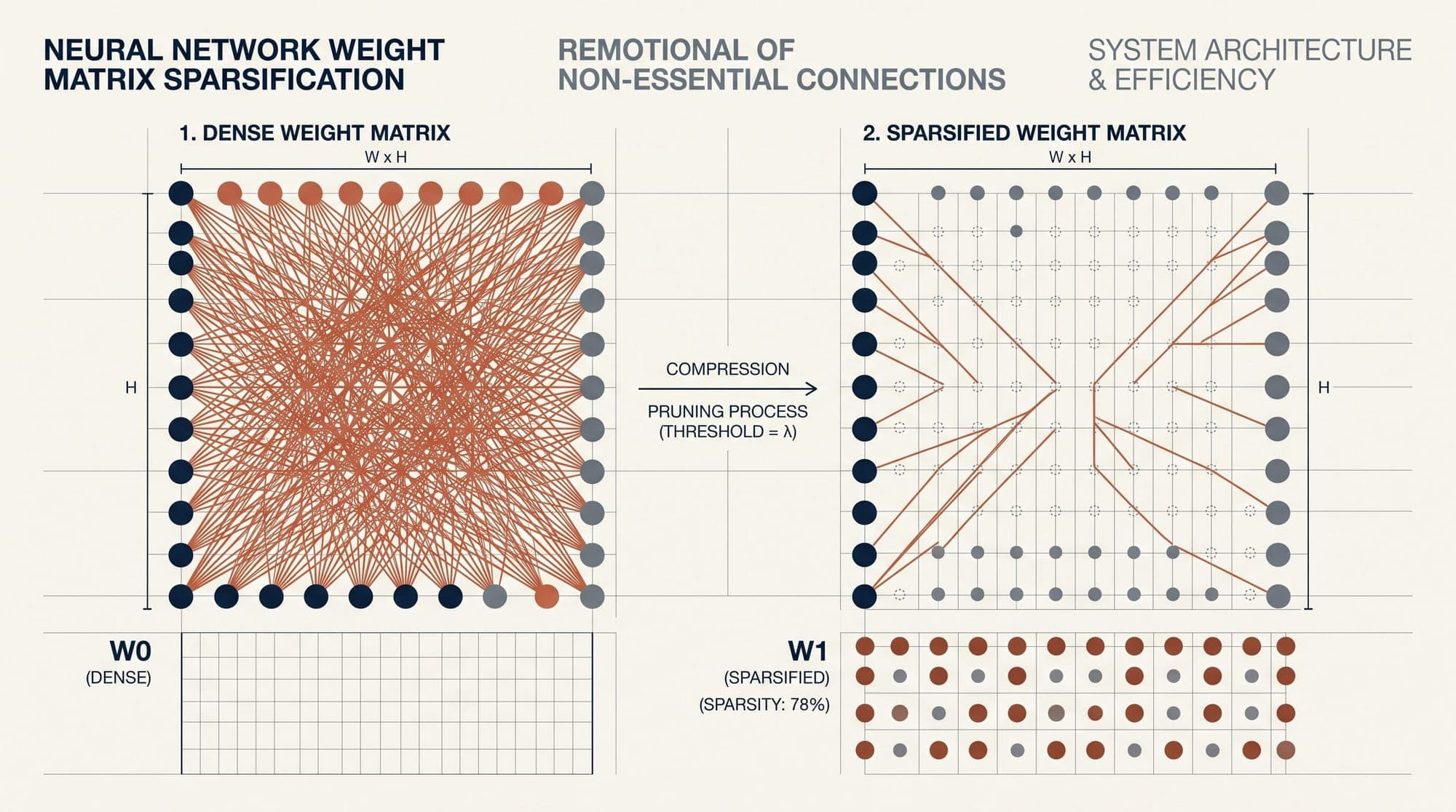
Weight Pruning in Large Language Models: How SparseGPT, Wanda, and Semi-Structured 2:4 Sparsity Compress Neural Networks Without Retraining
Modern large language models require tens to hundreds of gigabytes of high-bandwidth memory to store billions of parameters. While post-training quantization compresses model footprints by reducing numerical precision from 16-bit floating point to 8-bit or 4-bit integers, weight pruning attacks model size along an orthogonal axis: setting redundant parameter values exactly to zero. Historically, pruning deep neural networks required iterative cycles of magnitude thresholding and compute-heavy r
1 min