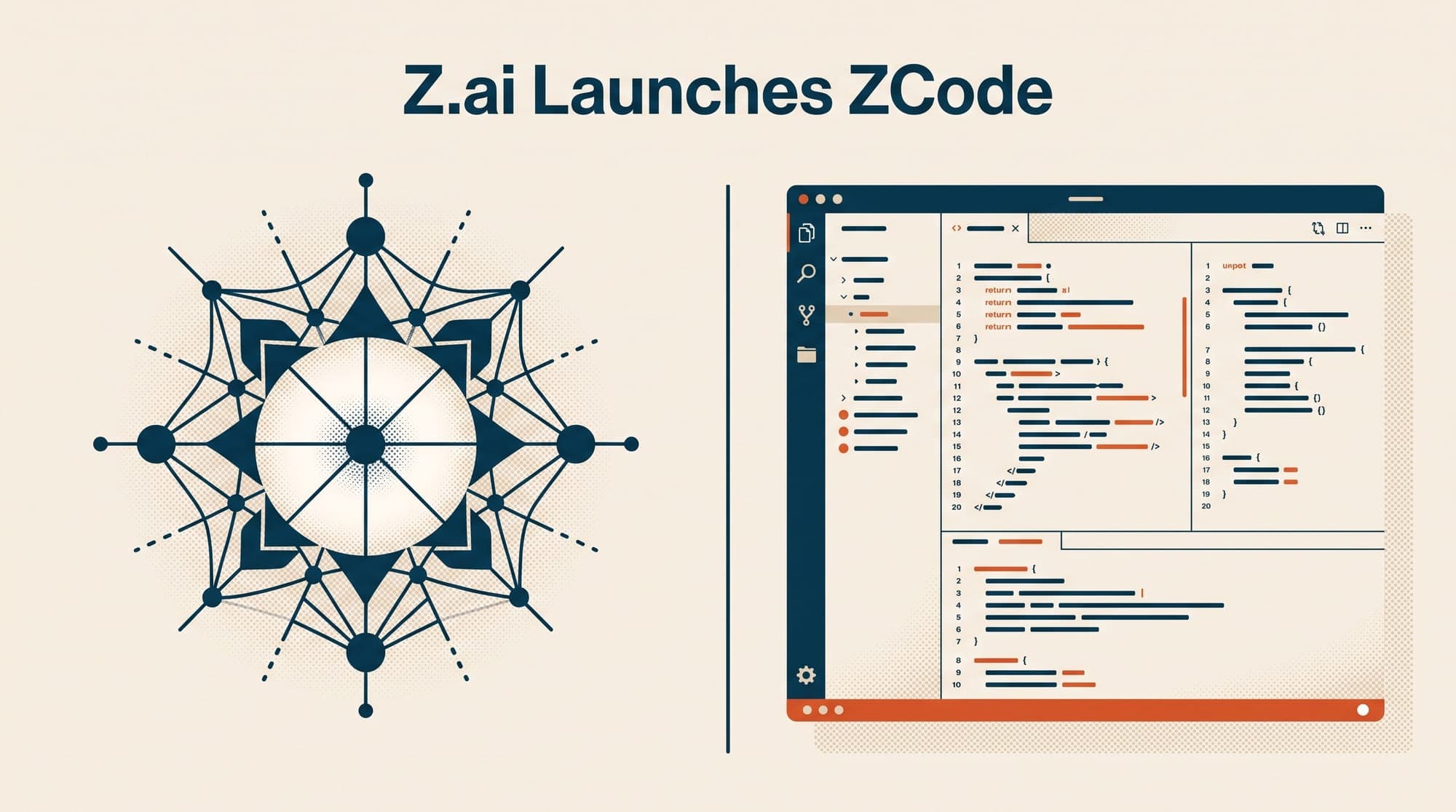
On July 2, Beijing-based Z.ai (formerly Zhipu AI) released ZCode, a free desktop application it calls an "Agentic Development Environment" built around its GLM-5.2 model. The launch puts it in direct competition with Cursor, Claude Code, and GitHub Copilot at price points the American tools cannot match. It also arrives with a structural constraint every team should evaluate before switching: China's National Intelligence Law applies to every API call routed through Z.ai's servers.
ZCode is not a sidebar chatbot grafted onto a code editor. It is agent-first by design. A developer describes a goal and the ZCode Agent reads the codebase, drafts a plan, edits files, runs terminal commands, reviews output, and iterates until the task is complete. The workspace bundles a file manager, terminal, Git panel, and live browser preview into a single application across macOS, Windows, and Linux (beta).
The economics of GLM-5.2
ZCode's pricing advantage follows from GLM-5.2's architecture rather than labor costs or subsidies. The model uses a Mixture-of-Experts design with 744 billion total parameters, of which roughly 40 billion activate per token. A gating network routes each input to the most relevant subnet, keeping inference cost closer to that of a 40B dense model.
A second architectural choice, called IndexShare, computes one attention indexer and reuses it across every four transformer layers instead of recalculating at each layer. Z.ai reports this cuts per-token floating-point operations by 2.9x at the full one-million-token context window.
The result: $1.40 per million input tokens and $4.40 per million output tokens, compared to Claude Opus 4.8 at roughly $5 and $25. That gap flows through to subscription pricing: ZCode Lite at $16.20 per month, Pro at $64.80, and Max at $144. Cursor Pro runs $20 and Ultra $200. Claude Code sits at comparable price points.
What the benchmarks show
GLM-5.2 scores 62.1 on SWE-bench Pro, ahead of GPT-5.5 at 58.6 and within four points of Claude Opus 4.8 at 66.0. On Terminal-Bench 2.1 it scores 81.0, trailing Opus 4.8 by four points. Early community testing reports higher-than-expected token consumption on complex tasks and heavy rate limits on lower-tier plans. On sustained multi-step agentic work, reviewers place GLM-5.2 behind Claude Opus 4.8.
One documented gap: GLM-5.2 ships without a visual encoder. It cannot process images, screenshots, or design files, limiting its utility for frontend work. A developer poll from Z.ai co-founder Tang Jie, drawing 466,000 views, returned vision input as the top request for the next model generation.
The data jurisdiction question
Z.ai operates under Chinese law. Three statutes -- the National Intelligence Law (2017), Data Security Law (2021), and Cybersecurity Law (2017) -- create a framework in which any code processed through Z.ai's cloud API could be subject to government access requests the company is legally required to fulfill. The U.S. Department of Homeland Security has warned that the National Intelligence Law compels Chinese companies to hand over data from U.S. persons on government demand, regardless of server location or privacy agreements.
Z.ai has publicly denied cooperating with any government data requests. No independent security audit of ZCode or its API infrastructure has been published. The full mitigation is self-hosting: GLM-5.2 is MIT-licensed and teams can run it on their own hardware. But full-precision inference requires roughly 1.5 terabytes of GPU memory, approximately eight NVIDIA H200 GPUs. Quantized builds compress the model to about 239 GB, with quality tradeoffs.
Launch timing
ZCode launched three weeks after the U.S. government suspended Anthropic's Fable 5 model, forcing thousands of developer teams to reconsider their AI vendor choices. The timing was not coincidental. ZCode's combination of open weights and competitive pricing offers a hedge -- a model that, once downloaded, no future policy directive can revoke. But the hedge only applies to self-hosted deployments. Teams using Z.ai's cloud API have replaced one regulatory risk with another.
ZCode is a credible product for cost-constrained developers working on non-sensitive codebases. It is less suited for regulated industries, teams dependent on Cursor's VS Code extension ecosystem or Copilot's native GitHub integration, and anyone routing proprietary code through Chinese-jurisdiction cloud infrastructure without a legal review.
Sources
Tech Times, "AI Coding Assistant ZCode Launches Free: China Data Law Applies to Every GLM-5.2 API Call," July 4, 2026: https://www.techtimes.com/articles/319707/20260704/ai-coding-assistant-zcode-launches-free-china-data-law-applies-every-glm-52-api-call.htm
Z.ai, "GLM-5.2: Built for Long-Horizon Tasks," June 16, 2026: https://z.ai/blog/glm-5.2
Developers Digest, "ZCode Developer Guide 2026," July 7, 2026: https://www.developersdigest.tech/blog/zcode-developer-guide-2026