
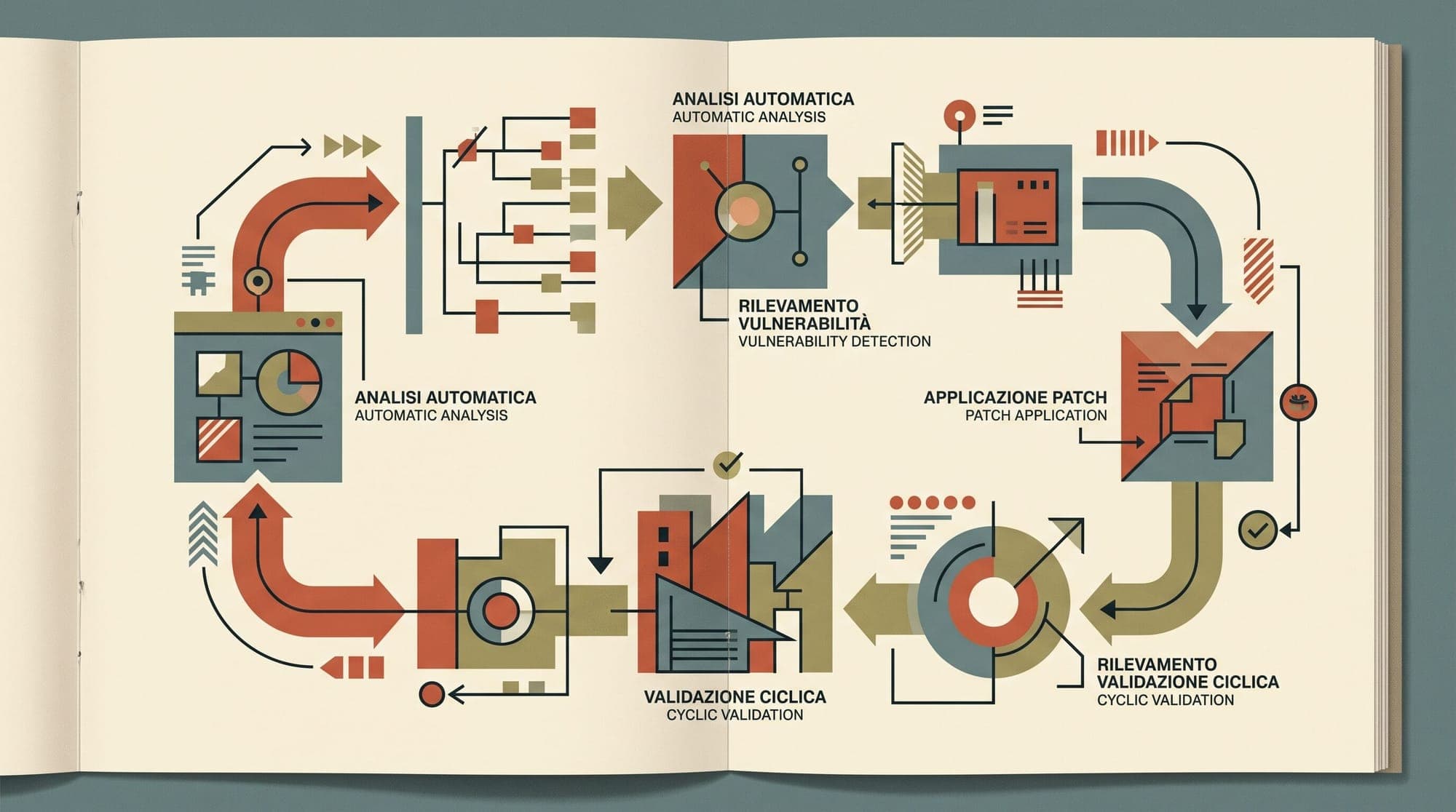
Visa has released a major update to its open-source Visa Vulnerability Agentic Harness (VVAH), extending the framework from a vulnerability discovery engine into an end-to-end 11-stage pipeline that generates code fixes and evaluates them against adversarial validation models.
The release shifts the default operating posture of the harness. Rather than terminating at SARIF report generation, a standard execution now traverses all 11 stages: identifying exploitable security flaws, authoring candidate remediation patches directly in a local working copy of the target repository at Stage 10, and running an automated adversarial review panel at Stage 11 to test whether the patch negates the exploit.

Automated Remediation and Adversarial Validation Loops
VVAH originated from Visa's internal security research during Anthropic's Project Glasswing, where the payment network evaluated Claude Mythos against transaction infrastructure. According to Rajat Taneja, Visa's president of technology, the speed at which frontier models discover vulnerability chains created a bottleneck in manual patch creation and verification.
Under the updated architecture, VVAH scans target codebases by constructing an abstract syntax tree (AST) call graph to trace function invocations and reachability paths. When an exploitable condition is verified, Stage 10 writes candidate source modifications to the local filesystem. Stage 11 then invokes an adversarial validation panel to simulate attack payloads against the patched code state. The validation panel returns one of three formal verdicts:
- Validated: The patch successfully prevents exploit execution without introducing syntax or functional regressions detected by the harness.
- Validation Failed: The patch fails to neutralize the exploit path, triggering an automated feedback loop that preserves diagnostic context for successive remediation attempts.
- Needs Review: Ambiguous execution paths or complex control flows require direct human analysis.
Stage 11 runs read-only and does not trigger deployment pipelines or compile binaries directly.
Governance and Human Approval Gates
The decision to enable automated code modifications by default has prompted discussion across the enterprise security sector, particularly following recent demonstrations of agentic exploitation such as GhostJacking at DEF CON 34. Security researchers have argued for external authorization gates prior to code alteration.
In response, Visa clarified that VVAH operates as an analysis harness rather than a continuous integration merge tool. Modifications are restricted to local working copies, maintaining three distinct human control gates:
- Invocation Scope: Operators configure repository boundaries, execution depth, and privilege bounds before runtime. Operators can restrict execution to detection-only using
--stop-after s9. - Patch Inspection: Security and software engineering teams review candidate diffs and adversarial validation logs.
- Pull Request and Merge: Code changes must pass standard CI/CD builds, integration tests, and pull request approvals prior to merging into production branches.
Multi-Model Orchestration and Industry Initiatives
While early iterations of VVAH depended primarily on Anthropic models for semantic reasoning and patch generation, the updated release introduces modular per-stage model routing. Teams can configure distinct models across individual pipeline stages, pairing high-recall frontier reasoning models for exploit discovery with lower-latency or open-weight models for initial syntax graph parsing and routine patch drafting.
Visa confirmed that VVAH is currently deployed internally against production systems as "client zero." In parallel with the open-source release, Visa is contributing VVAH to Nvidia's Open Secure AI Alliance and collaborating with IBM and Red Hat on the $5 billion Project Lightwell initiative. Additionally, Visa Consulting & Analytics has introduced enterprise advisory services, including NIST-aligned maturity assessments and risk prioritization workshops.



