
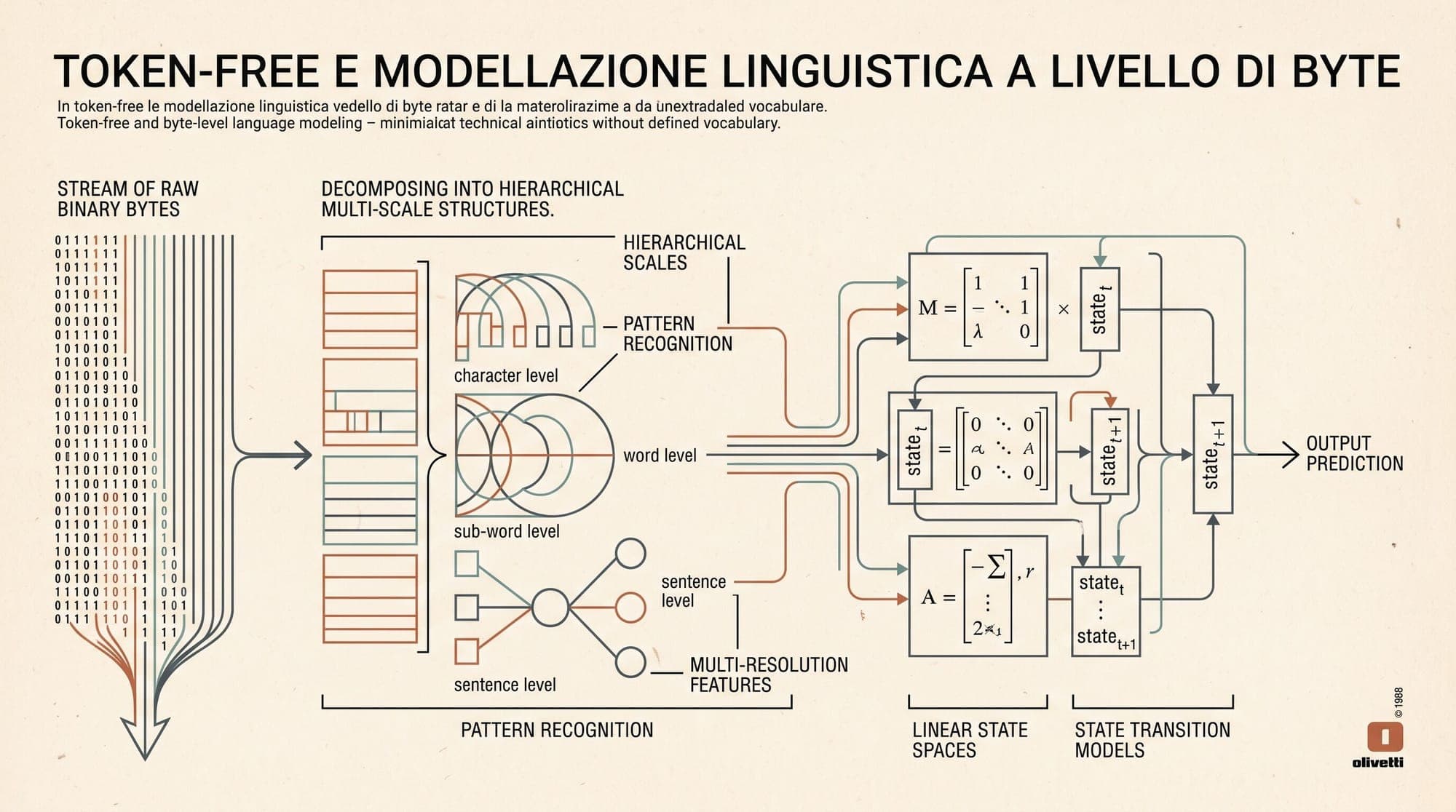
Modern large language models universally rely on subword tokenizers such as Byte-Pair Encoding (BPE), WordPiece, and Unigram algorithms. These tokenizers compress text into discrete integer IDs from a fixed vocabulary, typically spanning 32,000 to 256,000 entries. By collapsing three to five characters into a single token, tokenizers reduce sequence length (), making quadratic self-attention computationally tractable.
However, subword tokenization introduces systemic architectural liabilities: multilingual cost disparities, arithmetic fragility, out-of-vocabulary anomalies, and vulnerability to adversarial string manipulation. To overcome these limitations, researchers have developed token-free and byte-level architectures. Systems such as MegaByte (Yu et al., 2023), SpaceByte (Tuck et al., 2024), and MambaByte (Wang et al., 2024) demonstrate that modern models can process raw UTF-8 byte streams directly, bypassing subword tokenizers while managing computational scaling.
The Pathologies of Subword Tokenizers
Subword tokenization is a preprocessing heuristic designed to circumvent the memory and compute limits of standard Transformers. While effective for sequence compression, it creates fundamental failure modes:
- The Tokenizer Tax on Non-Latin Scripts: Subword vocabularies are predominantly trained on English and Latin-script corpora. Consequently, languages using non-Latin scripts (such as Arabic, Hindi, Cyrillic, Thai, or Japanese) suffer from severe tokenization fragmentation. Expressing identical semantic concepts in these languages often requires two to five times more tokens than in English, proportionally inflating inference latency and API costs.
- Morphological and Arithmetic Blindness: Tokenizers segment numeric values and words based on statistical frequency rather than mathematical or grammatical structure. A five-digit number like
48192may be arbitrarily split into tokens like48and192, forcing the model to reconstruct place-value mechanics before performing calculation. Similarly, character-level tasks such as spelling, anagram resolution, and string reversal fail because the model never directly observes individual characters. - Vocabulary Matrix Overhead: Embedding tables scale linearly with vocabulary size (). A model with a 128,000-token vocabulary and a hidden dimension of 4,096 allocates over 524 million parameters solely to input embeddings and the unembedding head, consuming valuable parameter budgets before any computation occurs.
- Glitch Tokens and Adversarial Fragility: Statistical tokenization creates ungrounded or anomalous tokens (such as undertrained strings or whitespace sequences) that trigger out-of-distribution behavior and hallucination when prompted. Minor typographic variations or character insertions alter token boundaries entirely, undermining model robustness.
The Byte-Level Challenge: The Quadratic Wall
Operating directly on raw UTF-8 bytes eliminates tokenization entirely. The input vocabulary shrinks to a fixed size of 256 byte values (0x00 to 0xFF), plus any specialized control tokens. Under this regime, any document, code repository, binary executable, or multilingual text can be represented without out-of-vocabulary exceptions.
The primary obstacle to byte-level modeling is sequence length expansion. A prompt of 2,000 English words corresponds to roughly 2,500 subword tokens, but expands to approximately 10,000 raw bytes.
In a standard autoregressive Transformer, this 4x expansion creates two severe bottlenecks:
- Quadratic Attention Computation: The self-attention mechanism scales with the square of the sequence length (). Increasing sequence length by a factor of 4 increases self-attention FLOPs by a factor of 16 ().
- Key-Value Cache Footprint: The memory required to store the KV cache for autoregressive decoding scales linearly with sequence length (). Serving 10,000 byte positions requires four times more GPU high-bandwidth memory (HBM) per sequence than serving 2,500 subword tokens.
- Autoregressive Decoding Steps: Generating 1,000 words requires 4,000 sequential autoregressive forward passes instead of 1,200 token passes, increasing time-to-first-token and overall generation latency.
Overcoming these constraints requires novel architectures that decouple byte-level processing from quadratic global attention costs.

Hierarchical Multi-Scale Modeling: MegaByte
Introduced by Meta AI researchers in MEGABYTE: Predicting Million-byte Sequences with Multiscale Transformers (Yu et al., 2023), MegaByte tackles the quadratic wall through a multi-scale, hierarchical decomposition.
Instead of processing every raw byte through a single monolithic Transformer stack, MegaByte splits the architecture into three functional modules:
1. Patch Embedder
The input byte sequence of length is partitioned into non-overlapping, fixed-size patches of size (e.g., or ). Each patch of bytes is mapped into a single -dimensional embedding vector:
h_k = Linear(Flatten([e(b_1), ..., e(b_P)]))
where e(b) represents the byte embedding lookup and k represents the patch index ().
2. Global Transformer
The sequence of patch embeddings is processed by a large, deep autoregressive Transformer with hidden dimension . Because the global Transformer operates on patches rather than individual bytes, its effective sequence length is reduced from to .
Consequently, the self-attention compute cost in the global model scales as:
O((L / P)^2) = O(L^2 / P^2)
For a patch size of , global attention operations decrease by a factor of 64 relative to naive byte-level self-attention.
3. Local Byte Transformer
A smaller, shallow autoregressive Transformer with dimension () generates the individual bytes within each patch. The local model conditions on two inputs:
- The contextual representation output by the global Transformer for the preceding patch.
- The preceding bytes within the current patch.
Because the local model only attends across the bytes within its assigned patch, its intra-patch attention cost is bounded by per patch, totaling across the entire sequence. Furthermore, during training and prefill, the local model processes all patches simultaneously in parallel.
MegaByte demonstrated that a multi-scale byte Transformer can scale to sequences of over one million bytes, achieving lower perplexity and faster decoding speeds than standard byte-level Transformers while outperforming tokenized models on byte-level tasks.
Dynamic Boundary Patching: SpaceByte
While MegaByte uses fixed patch sizes (e.g., exactly 4 or 8 bytes per patch), natural language structure does not align neatly with rigid byte boundaries. Words, syllables, and punctuation marks vary widely in character length. Fixed-width chunking frequently splits morphemes across patch boundaries, forcing the global model to operate on arbitrary character fragments.
To address this limitation, SpaceByte (Tuck et al., 2024) introduced dynamic, linguistically aware computation:
- Linguistic Boundary Gating: SpaceByte maintains a standard, lightweight byte-level Transformer backbone. However, it inserts larger, high-capacity global Transformer blocks selectively after specific bytes that denote structural boundaries, such as whitespace characters and newline delimiters.
- Word-Level Compute Concentration: By firing global attention layers only at natural word boundaries, SpaceByte allocates heavy computational resources to complete semantic units rather than arbitrary byte slices.
- Performance Parity: Evaluated across large-scale pre-training benchmarks under fixed training compute ( to FLOPs) and inference budgets, SpaceByte outperformed fixed-patch byte architectures (such as MegaByte) and achieved performance parity with SentencePiece subword Transformers on code and technical datasets.
Linear-Time Token-Free Models: MambaByte
An alternative path to token-free language modeling abandons the attention mechanism altogether in favor of linear-time State Space Models (SSMs).
In MambaByte: Token-free Selective State Space Model (Wang et al., 2024), researchers applied the selective state space architecture (Mamba) directly to raw byte sequences.
Constant Memory Footprint
In standard Transformers, the memory required to maintain the Key-Value cache grows linearly with sequence length , creating memory exhaustion during long-context byte generation.
In contrast, MambaByte updates a recurrent hidden state at each byte step:
h_t = A_bar_t * h_{t-1} + B_bar_t * x_t
y_t = C_t * h_t + D * x_t
For an -layer MambaByte model, the recurrent state memory is strictly fixed at floats, completely independent of the sequence length .
Linear Compute Complexity
MambaByte processes sequence inputs in time using hardware-aware parallel associative scans during training, eliminating the quadratic scaling bottleneck.
In empirical evaluations across long-form language modeling datasets (including PG-19, Books, and arXiv), MambaByte delivered notable efficiency advantages:
- Compute Efficiency: MambaByte outperformed byte-level Transformers and MegaByte across all evaluated datasets under fixed compute budgets.
- Data Efficiency: MambaByte matched the cross-entropy loss of subword-tokenized Transformer models while using only 60% of the byte training budget.
- Noise Resilience: When subjected to input noise (such as character deletions, replacements, and casing permutations), MambaByte maintained stable perplexity, whereas subword tokenized models suffered rapid performance degradation due to token fragmentation.
Comparing Architectural Paradigms
Evaluating the structural differences across tokenized and token-free designs highlights distinct trade-offs:
- Subword Transformer: Employs large vocabularies (32,000 to 256,000 tokens) with baseline sequence lengths. Suffers from quadratic attention scaling and linear KV cache expansion, but minimizes autoregressive step counts (1 step per subword).
- Naive Byte Transformer: Operates on a fixed vocabulary of 256 bytes with 3x to 5x sequence expansion. Suffers from severe attention costs and 4x larger KV cache memory footprint, making it impractical for long contexts.
- MegaByte (Hierarchical Patching): Fixed vocabulary of 256 bytes. Uses multi-scale decomposition with a global Transformer operating on patches and local Transformers predicting intra-patch bytes. Reduces global attention to and restricts KV cache expansion to patch resolution.
- SpaceByte (Boundary-Aware): Fixed vocabulary of 256 bytes. Dynamically triggers deep global Transformer blocks only at whitespace and punctuation delimiters, aligning computational bursts with linguistic word boundaries.
- MambaByte (Selective SSM): Fixed vocabulary of 256 bytes. Achieves linear compute scaling with zero attention mechanisms and maintains a constant recurrent memory state regardless of sequence length.
Production Realities and the Road Ahead
Despite the architectural advantages of token-free models, subword tokenization remains the dominant paradigm in commercial frontier models due to practical hardware constraints:
- Hardware Matrix Utilization: Modern AI accelerators (such as Nvidia H100 and B200 GPUs) achieve peak tensor core compute utilization on large matrix multiplications. Subword models produce shorter token sequences with wider hidden representations, maximizing GEMM efficiency.
- Sequential Step Counts in Autoregressive Serving: In production inference APIs where latency-per-token is critical, subword models emit three to four characters per decoding iteration. A token-free model must perform three to four times more sequential forward passes to generate identical text, requiring aggressive speculative decoding or draft models to achieve competitive wall-clock generation speeds.
As architectures mature, token-free systems are finding rapid adoption in specialized domains:
- Multimodal Foundational Streams: Unifying text, audio waveforms, image patches, and sensor telemetry into a single, tokenizer-free byte stream without designing custom discrete codebooks for each modality.
- Code Generation and Reverse Engineering: Processing raw source code, abstract syntax trees, and compiled binary executables without suffering from indentation or syntax fragmentation.
- Low-Resource Multilingual Systems: Eliminating tokenization bias for underrepresented languages, ensuring equal computational and economic parity across global scripts.
Sources
- MEGABYTE: Predicting Million-byte Sequences with Multiscale Transformers (Yu et al., 2023)
- MambaByte: Token-free Selective State Space Model (Wang et al., 2024)
- SpaceByte: Towards Deleting Tokenization from Large Language Modeling (Tuck et al., 2024)
- ByT5: Towards a Token-Free Future with Pre-trained Byte-to-Byte Models (Xue et al., 2022)
- CANINE: Pre-training an Efficient Tokenization-Free Encoder for Language Representation (Clark et al., 2021)



