
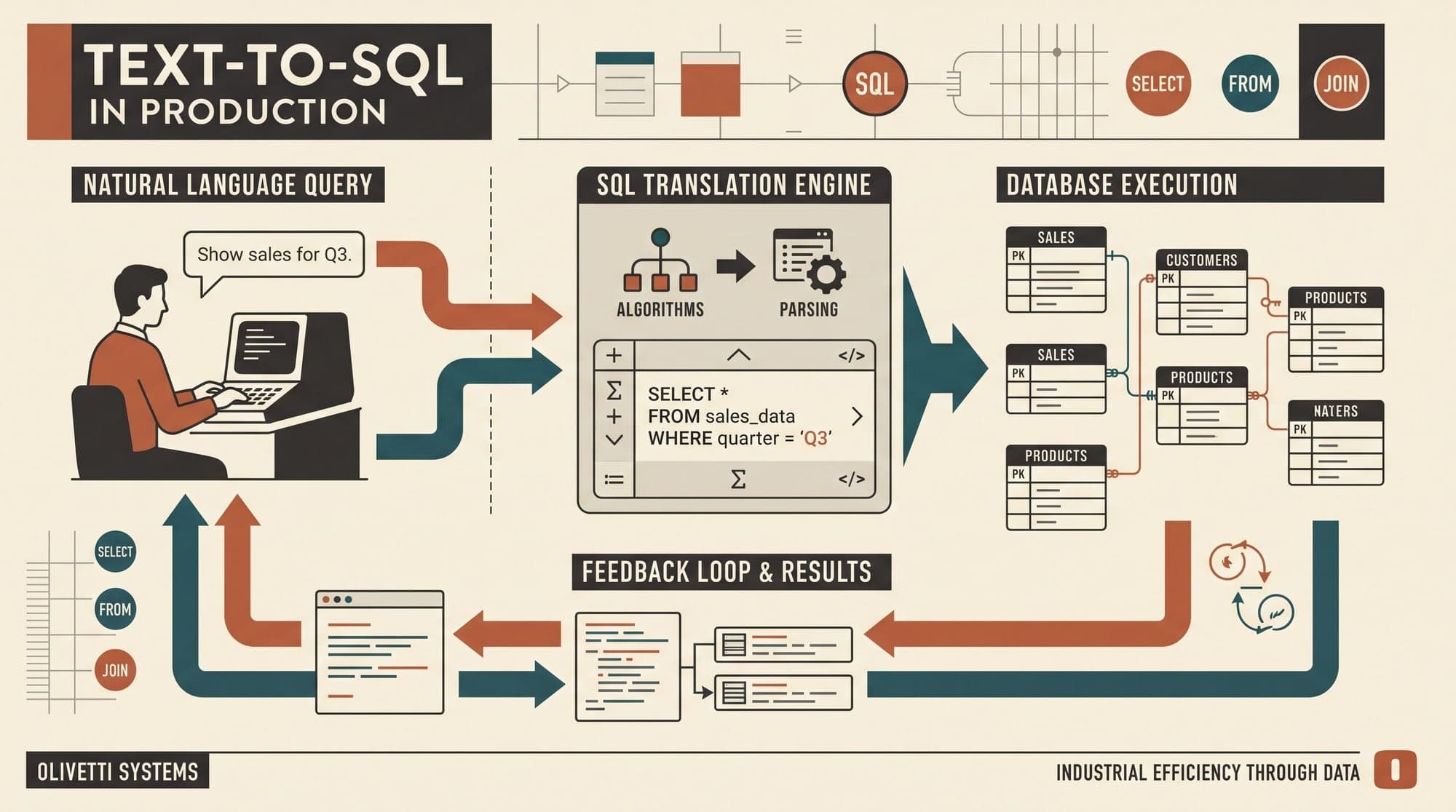
Translating natural language into executable database queries is one of the most widely deployed applications of large language models in enterprise software. It is also one of the most brittle. On synthetic academic benchmarks such as Spider 1.0, frontier models regularly exceed 90% execution accuracy. However, evaluating those same models on realistic enterprise estates yields a steep drop. On the Spider 2.0 benchmark, which evaluates real-world data warehouses spanning BigQuery and Snowflake environments with schemas often exceeding 1,000 columns, reasoning models such as OpenAI o1-preview solve only 21.3% of tasks, while GPT-4o drops to 10.1%.
Production database environments fail naive LLM prompts because real schemas contain hundreds of tables, ambiguous column namings, denormalized reporting views, and domain-specific business definitions that do not exist inside database metadata catalogs. Achieving reliable execution accuracy requires treating Text-to-SQL not as a single inference call, but as a multi-stage compilation pipeline: schema linking, cell value retrieval, modular query generation, AST validation, and closed-loop execution self-correction.

The Real-World Accuracy Gap
The performance disparity between academic benchmarks and enterprise workloads stems from structural assumptions embedded in early datasets. Benchmarks like Spider 1.0 feature small, normalized schemas averaging under ten tables with explicit foreign key definitions and self-contained questions. Real data warehouses, by contrast, exhibit five distinct points of failure:
- Schema Context Exhaustion: Production warehouses often contain 500 to 5,000 tables. Dumping raw DDL statements into a model prompt consumes hundreds of thousands of tokens, increases time-to-first-token (TTFT), degrades attention fidelity, and drives up token costs.
- Lexical Mismatch on Categorical Values: Natural language questions reference business entities (such as "churned enterprise accounts") that map to non-obvious categorical codes (such as
account_status_id = 'CHRN_ENT') rather than literal string matches. - Implicit Business Logic: Calculating standard business metrics like Annual Recurring Revenue (ARR) or Gross Retention frequently requires specific filters, exclusion tables, and currency normalization rules that reside in external documentation rather than SQL schemas.
- Complex Join Topologies: Enterprise star and snowflake schemas feature circular relationships and multiple valid join paths between fact and dimension tables, leading models to construct unintended Cartesian products.
- Dialect Nuances: Distinct SQL dialects (PostgreSQL, Snowflake SQL, Google Cloud BigQuery, DuckDB, ClickHouse) differ in window function syntax, date-truncation semantics, and string handling.
According to evaluations on the BIRD benchmark (BIg bench for laRge-scale Database grounded Text-to-SQLs), human data engineers achieve 92.96% execution accuracy, whereas top automated architectures cluster between 65% and 73%. Bridging this gap requires modularizing the translation process into specialized stages.
Stage 1: Dynamic Schema Linking and Pruning
Schema linking is the process of identifying the minimal subset of tables, columns, and foreign key relationships required to answer a specific user query. Passing an unfiltered warehouse catalog to the generation model introduces distracting distractors that increase hallucinated joins.
Modern architectures implement coarse-to-fine schema pruning:
- Coarse Table Selection: The user query is compared against table-level summaries and column metadata catalogs. Systems combine sparse keyword retrieval (BM25 over column names and descriptions) with dense embedding similarity search to score relevant candidate tables.
- Foreign Key Graph Expansion: Once candidate tables are retrieved, an in-memory graph representing the database schema traverses explicit foreign keys and logged query joins. This ensures necessary intermediary join tables (bridge tables) are pulled into context even if the user query did not mention them explicitly.
- Fine Column Pruning: Within the filtered tables, a lightweight LLM or cross-encoder selects the specific columns relevant to query projection, filtering, grouping, and ordering. Frameworks such as CHESS and DIN-SQL demonstrate that pruning irrelevant columns from prompts improves execution accuracy while reducing prompt token consumption by over 60%.
The resulting prompt receives an enriched, compact schema definition containing exact column data types, nullability, primary and foreign key constraints, and column documentation comments.
Stage 2: Cell Value Retrieval and Semantic Layer Integration
A primary source of silent execution failure is value hallucination, where the model invents string literals or state codes. For example, a user asking for "pending orders in California" might result in WHERE state = 'California' when the database actually stores WHERE state_code = 'CA' AND order_status = 2.
Production architectures resolve this through two complementary mechanisms:
Categorical Inverted Indexing and Vector Value Stores
For low-to-medium cardinality columns (such as status flags, categories, and country codes), systems maintain an offline index of distinct values. During inference, entity extraction identifies named entities in the prompt and performs fuzzy string matching (via trigram similarity or Levenshtein distance) against indexed database values. Matches are injected into the prompt as explicit value constraints (for example: state_code matches 'CA' for 'California').
Semantic Layer Integration
Rather than forcing language models to derive complex metric calculations from raw base tables, robust enterprise deployments interface with semantic layers such as dbt Semantic Layer and MetricFlow or Cube. The LLM targets predefined semantic metrics and dimensions (such as metrics: [net_revenue], group_by: [customer_region, metric_time__quarter]), which the semantic engine compiles into deterministic, optimized SQL. This decouples natural language understanding from low-level table aggregation logic.
Stage 3: Modular Query Synthesis with CTEs
When generating SQL for multi-step analytic questions, standard autoregressive generation often struggles with deeply nested subqueries. Structuring generation prompts to favor Common Table Expressions (CTEs) significantly simplifies both model reasoning and subsequent automated validation.
A modular CTE structure divides query generation into discrete, verifiable components:
WITH filtered_customers AS (
    -- Filter active enterprise customer base
    SELECT customer_id, region, signup_date
    FROM core_customers
    WHERE status = 'ACTIVE'
      AND tier = 'ENTERPRISE'
),
quarterly_revenue AS (
    -- Aggregate invoice totals per customer for Q2 2026
    SELECT
        customer_id,
        SUM(amount_usd) AS total_spent
    FROM billing_invoices
    WHERE invoice_date >= '2026-04-01'
      AND invoice_date < '2026-07-01'
      AND payment_status = 'SETTLED'
    GROUP BY customer_id
)
SELECT
    c.region,
    COUNT(DISTINCT c.customer_id) AS customer_count,
    ROUND(AVG(r.total_spent), 2) AS avg_q2_spend
FROM filtered_customers c
INNER JOIN quarterly_revenue r
    ON c.customer_id = r.customer_id
GROUP BY c.region
ORDER BY avg_q2_spend DESC;
Prompting models to emit dialect-specific syntax (such as DATE_TRUNC('month', ts) in Snowflake and PostgreSQL versus TIMESTAMP_TRUNC(ts, MONTH) in BigQuery) prevents common compilation errors across disparate backend engines.
Stage 4: Static Validation and AST Inspection
Before sending generated SQL to a database engine, the query must pass through a static validation layer. Relying exclusively on database error messages introduces unnecessary latency and security exposure.
Static validation pipelines utilize SQL parsing engines such as sqlglot to construct an Abstract Syntax Tree (AST) of the query. The validation layer enforces four automated checks:
- Syntax and Dialect Verification: Ensures the query parses strictly under the target engine's grammar rules.
- Schema Reference Validation: Traverses the AST to verify that all referenced tables, aliases, and columns exist within the pruned schema metadata.
- Safety Boundary Enforcement: Asserts that the AST consists purely of read-only
SELECTstatements, rejecting Data Definition Language (DDL) or Data Manipulation Language (DML) statements such asDROP,DELETE,UPDATE, orINSERT. - Defensive Guardrail Injection: Enforces mandatory query constraints, such as appending default
LIMITclauses and enforcing maximum date range filters to prevent unintended table scans.
import sqlglot
from sqlglot import exp

def validate_and_guard_sql(sql_query: str, dialect: str = "postgres") -> str:
    try:
        parsed = sqlglot.parse_one(sql_query, read=dialect)
    except Exception as err:
        raise ValueError(f"SQL Syntax Error: {err}")

    # Enforce read-only statement type
    if not isinstance(parsed, exp.Select):
        raise PermissionError("Prohibited non-SELECT query structure detected.")

    # Validate that no destructive operations exist in AST
    destructive_types = (exp.Drop, exp.Delete, exp.Insert, exp.Update, exp.AlterTable)
    if any(parsed.find(d_type) for d_type in destructive_types):
        raise PermissionError("Destructive operations are strictly prohibited.")

    # Automatically enforce a ceiling on row output if not specified
    if not parsed.args.get("limit"):
        parsed = parsed.limit(1000)

    return parsed.sql(dialect=dialect)
Stage 5: Execution-Guided Closed-Loop Self-Correction
Even well-formed queries can fail at runtime due to type casting incompatibilities, division-by-zero exceptions, or empty result sets caused by over-constrained filters. Systems based on multi-agent collaboration, such as MAC-SQL and CHESS, incorporate closed-loop execution feedback.
The self-correction cycle proceeds through three stages:
- Dry-Run Query Plan Analysis: The system executes an
EXPLAINquery against the database engine. If the optimizer encounters an invalid column or ambiguous join, it returns an explicit parser error without processing warehouse data. - Execution in a Sandboxed Read-Only Replica: If
EXPLAINsucceeds, the query runs on a designated read-only replica with strict execution timeouts (typically 5 to 10 seconds) and memory limits. - Structured Error Feedback: If the database engine returns an error code, a specialized Critic agent receives a minimal context bundle containing:
- The initial user question
- The failing SQL statement
- The exact database engine error message
- The relevant schema definitions for the failing tables
Rather than resending the entire multi-thousand-token warehouse context, isolating the error feedback allows the model to perform targeted surgical fixes (such as correcting a missing table alias or adding NULLIF(denominator, 0)). Empirical evaluations demonstrate that execution feedback loops recover between 15% and 28% of initial generation failures.
Security Boundaries and Production Governance
Deploying autonomous SQL synthesis into production infrastructure requires defense-in-depth security controls:
- Database Role Isolation: The agent must connect using dedicated service credentials granted
SELECT-only privileges on specific schema whitelists. Superuser, administrative, and write permissions must be hard-disabled at the database engine level. - Strict Statement Timeouts: Every connection session must set an aggressive execution timeout (for example,
SET statement_timeout = '10s') to prevent runaway analytical queries or locking bugs from consuming warehouse compute resources. - Data Privacy and RLS Enforcement: Enterprise systems must apply Row-Level Security (RLS) policies at the database layer to ensure queries generated on behalf of a specific user cannot exfiltrate unauthorized tenant data.
- Semantic Caching: Validated natural language to SQL pairs should be stored in a deterministic semantic cache. For recurrent analytic queries, returning pre-compiled and verified SQL eliminates model latency and eliminates hallucination risk entirely.
Sources
- Spider 2.0: Evaluating Language Models on Real-World Enterprise Database Workflows
- BIRD: Can LLM Already Serve as A Database Interface? A BIg Bench for Large-Scale Database Grounded Text-to-SQLs
- CHESS: Contextual Harnessing for Efficient SQL Synthesis
- DIN-SQL: Decomposed In-Context Learning of Text-to-SQL with Self-Correction
- MAC-SQL: A Multi-Agent Collaborative Framework for Text-to-SQL
- sqlglot: Pure Python SQL Parser and Transpiler
- dbt Semantic Layer & MetricFlow Documentation



