
Superposition and Polysemanticity in Neural Networks: How High-Dimensional Geometry and Sparsity Allow LLMs to Store More Features Than Dimensions
In neural network interpretability, one of the most persistent puzzles has been the phenomenon of polysemantic neurons: individual neurons in large language models that activate for seemingly unrelated concepts. A single hidden unit in an MLP layer might fire in response to Python syntax errors, academic citations, and geographic place names.
For years, researchers debated whether polysemanticity was an artifact of imperfect optimization, poor regularization, or noisy training data. In 2022, researchers at Anthropic formalized the mathematical framework of Toy Models of Superposition, demonstrating that polysemanticity is neither a bug nor an accident. Instead, it is the mathematically optimal compression strategy for neural networks operating under finite dimensional constraints.
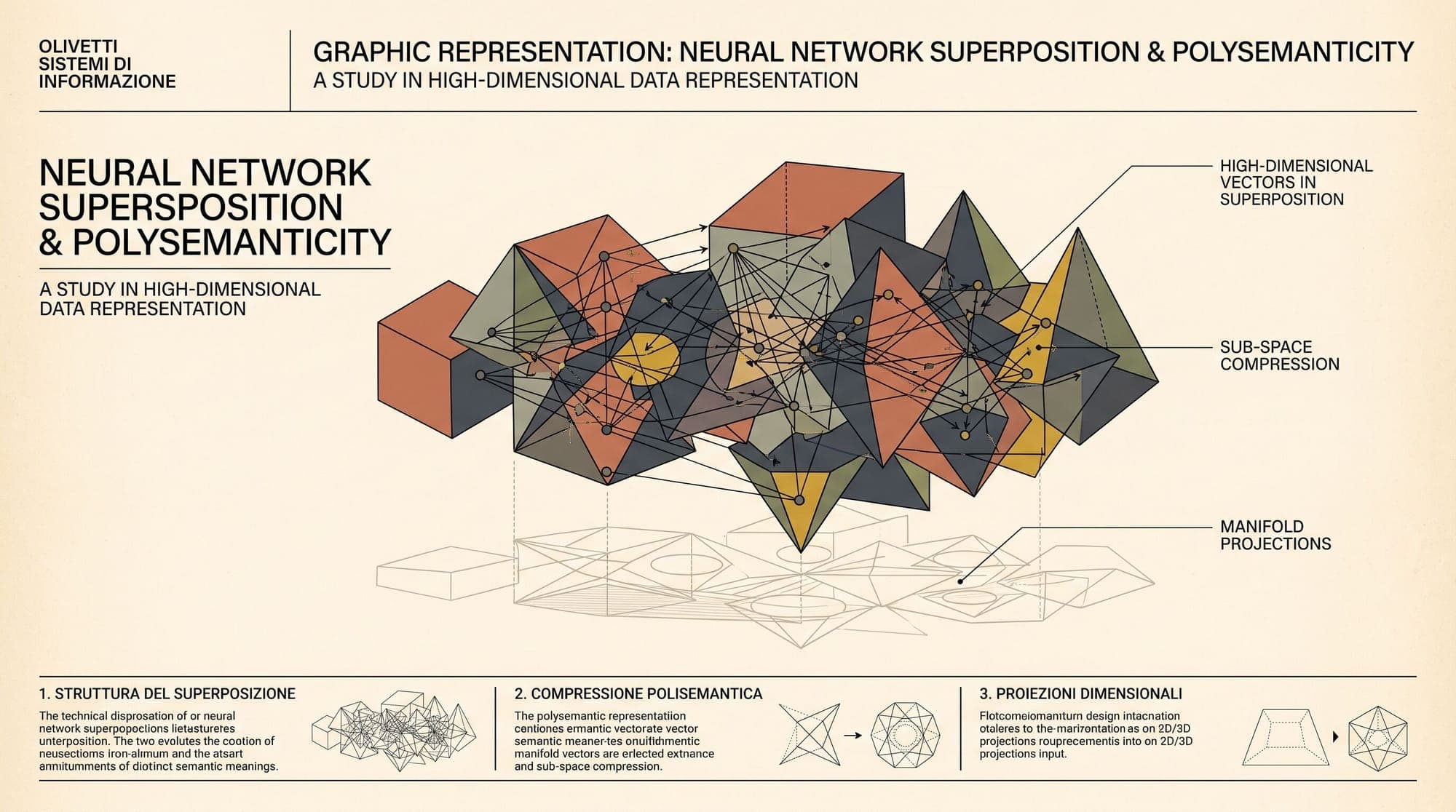
Superposition describes a fundamental geometric phenomenon: high-dimensional neural networks represent more independent features than they have dimensions by packing non-orthogonal feature vectors into shared activation spaces, relying on natural data sparsity and non-linear filtering to eliminate cross-feature interference.
The Capacity Dilemma and the Linear Representation Hypothesis
To understand superposition, one must first examine how neural networks represent information. Under the Linear Representation Hypothesis, concepts, properties, and computational variables (collectively termed "features") are represented as 1D direction vectors within the network's activation vector spaces .
When a particular feature is present in the input with magnitude , its contribution to the hidden state is given by the vector , where is a unit vector () representing that feature's direction.
This framing immediately exposes a severe linear algebra bottleneck:
- In a vector space of dimension (for example, in typical 7B-parameter models or in larger foundation models), there can be at most mutually orthogonal vectors.
- If every distinct feature required its own orthogonal dimension to avoid interfering with other features, a model with could represent at most 4,096 distinct concepts across its entire forward pass.
- Real-world language modeling requires tracking millions of distinct linguistic patterns, grammatical rules, entities, historical facts, reasoning heuristics, and stylistic markers ().
If neural networks were restricted to 1 feature per dimension, large language models could not function at their observed capability levels. Superposition resolves this capacity bottleneck.
High-Dimensional Geometry: Almost-Orthogonal Vector Packing
The geometric foundation that enables superposition is the unique property of high-dimensional vector spaces. In low-dimensional Euclidean spaces, our geometric intuition fails:
- In 2D space (), exactly two vectors can be orthogonal ( apart). If we allow an error margin such that , we can still only fit a handful of vectors.
- In 3D space (), exactly three mutually orthogonal vectors exist.
However, as the dimension scales to hundreds or thousands, the surface area and volume of a unit hypersphere concentrate sharply around the equator relative to any chosen pole. As established by the Johnson-Lindenstrauss lemma and mathematical bounds on spherical codes (such as the Welch bound and frame potential theory), the number of unit vectors that can be packed such that all pairwise inner products satisfy grows exponentially with the dimension .

In dimensions, an activation space can comfortably accommodate tens or hundreds of thousands of unit vectors whose pairwise inner products remain exceptionally small (e.g., ). While these vectors are not strictly orthogonal, they are almost orthogonal.
Feature Sparsity: The Mathematical Engine of Superposition
Almost-orthogonal packing allows storing features, but reading them out presents a challenge: cross-talk interference.
Consider a simple linear autoencoder model with an -dimensional sparse feature vector , an activation bottleneck of dimension (), an encoding matrix , and an activation state :
where each column is the unit-norm direction vector for feature .
When the network attempts to read out the value of feature using a linear projection , the resulting signal is:
Because , this simplifies to:
The readout consists of the true feature activation plus an interference noise term .
How Sparsity Suppresses Interference
Why does the interference term not destroy the model's representations? The answer lies in feature sparsity.
In natural text, features are sparse: on any single token or prompt, only a tiny fraction of all known concepts are active ().
- Zero-Mean Small Variance: When is small (e.g., ), almost all . The sum contains very few non-zero terms.
- Non-Linear Noise Gate: Because features are typically non-negative (), the network can apply a learned negative bias and a ReLU activation function:
When feature is inactive (), the small background interference is offset by the negative bias (), causing the ReLU to output exactly zero. When feature is active (), the true signal dominates the threshold, recovering with minimal distortion.
Thus, high sparsity () combined with non-linear activation functions enables the network to pack vast numbers of features into a compressed subspace with negligible reconstruction loss.
Phase Transitions and Geometric Motifs
In their 2022 empirical and theoretical investigations, Elhage et al. trained small ReLU networks on synthetic sparse data across varying dimensions, feature counts, and sparsity levels. They discovered distinct geometric phase transitions:
1. The Orthogonal Regime (Dense Features)
When features are dense (probability of activation ), the expected squared interference is severe. The network refuses to use superposition. It allocates exactly one orthogonal basis dimension to each of the most important features and completely ignores the remaining features.
2. Antipodal Pairs
When features are moderately sparse and non-negative, the network discovers a geometric trick: two independent features and can share a single 1D subspace by pointing in opposite directions ().
- A positive activation along that axis represents : .
- A negative activation along that axis represents : .
As long as and are rarely active at the exact same time, two features occupy 1 dimension with zero interference.
3. Regular Polyhedral Superposition
As sparsity increases further (), features arrange themselves into highly symmetric non-orthogonal polytopes:
- In 2D: 5 features self-organize into the vertices of a regular pentagon.
- In 3D: Features form regular octahedra (6 features in 3D) or icosahedra (12 features in 3D).
- In High Dimensions: Features form higher-dimensional cross-polytopes, simplex constellations, and spherical codes, maximizing the minimum angle between any two feature vectors.
4. Importance-Driven Geometry
When features have unequal importance weights , the network builds a hybrid architecture:
- High-importance, frequently firing features receive dedicated orthogonal dimensions.
- Low-importance, ultra-sparse features are packed into dense multi-feature superposition clusters.
Polysemanticity and the Privileged Basis
Superposition directly explains why individual neurons in large language models are polysemantic.
The distinction depends on whether an activation space has a privileged basis:
| Vector Space | Privileged Basis? | Geometric Behavior | | :--- | :--- | :--- | | Residual Stream | No | Rotation-invariant linear space. Features can point in arbitrary directions without aligning to specific coordinate axes. | | Attention Query/Key/Value | No | Rotatable subspace projections governed by head dimensions. | | MLP Intermediate Layer | Yes | Element-wise non-linearities (ReLU, GeLU, SwiGLU) establish a fixed coordinate basis tied to individual neurons. |
In the MLP intermediate layer, activations are computed as , where is an element-wise activation function. Because operates independently on each coordinate, the basis of individual neurons is privileged.
When sparse features exist in superposition across an MLP layer of width , each neuron corresponds to a standard basis vector . The activation of neuron is given by:
Because the weight matrix projects multiple non-orthogonal feature vectors across the neuron coordinates, the row has non-zero overlaps with many distinct features .
Consequently, neuron will fire whenever Feature A is present, OR whenever Feature B is present, OR whenever Feature C is present. To an outside observer inspecting single neurons, neuron appears polysemantic and incomprehensible. In reality, the neuron is merely an arbitrary 1D coordinate projection slicing through a multi-feature superposition polytope.
Implications for AI Safety and Mechanistic Interpretability
The realization that neurons are not the fundamental units of neural computation fundamentally altered AI interpretability research:
- The Failure of Single-Neuron Ablation: Early interpretability attempts tried to label neurons individually. Because neurons are polysemantic mixtures of superposed features, single-neuron inspection and ablation inevitably cause collateral damage to multiple unrelated capabilities.
- Dictionary Learning via Sparse Autoencoders (SAEs): Because features exist as directions rather than individual neurons, researchers at Anthropic (Bricken et al., 2023; Templeton et al., 2024) developed overcomplete Sparse Autoencoders. By training an SAE with an expansion factor of 8x to 64x and an L1 or TopK sparsity penalty, the autoencoder learns to disentangle the superposed activation space back into monosemantic feature directions.
- Computation in Superposition: Neural networks do not merely store features in superposition; they perform linear transformations, attention routing, and logical operations directly on superposed representations before unpacking them at downstream layers.
- Attention Superposition: Beyond MLP layers, attention mechanisms pack relational and syntactic queries into superposed subspaces within multi-head attention projections, enabling heads to track multiple distinct semantic relations simultaneously.
Sources
- Anthropic Transformer Circuits: Toy Models of Superposition (Elhage et al., 2022)
- Anthropic Transformer Circuits: A Mathematical Framework for Transformer Circuits (Elhage et al., 2021)
- Anthropic Transformer Circuits: Towards Monosemanticity: Decomposing Language Models With Dictionary Learning (Bricken et al., 2023)
- Anthropic Transformer Circuits: Scaling Monosemanticity: Extracting Interpretable Features from Claude 3 Sonnet (Templeton et al., 2024)
- arXiv: The Linear Representation Hypothesis in Large Language Models (Park et al., 2023)



