SCX.ai Partners With DDN to Scale Australian Sovereign AI Inference Infrastructure

Australian sovereign AI infrastructure provider SCX.ai has entered a strategic partnership with data storage systems vendor DDN to expand its domestic AI inferencing cloud. The collaboration combines SCX's ASIC-based compute clusters with DDN's Infinia data management platform, targeting enterprise, government, and scientific research workloads that must remain strictly within Australian jurisdiction. The agreement comes days after SCX completed a $40 million initial public offering on the Aust

2 min
SCX.ai Partners With DDN to Scale Australian Sovereign AI Inference Infrastructure

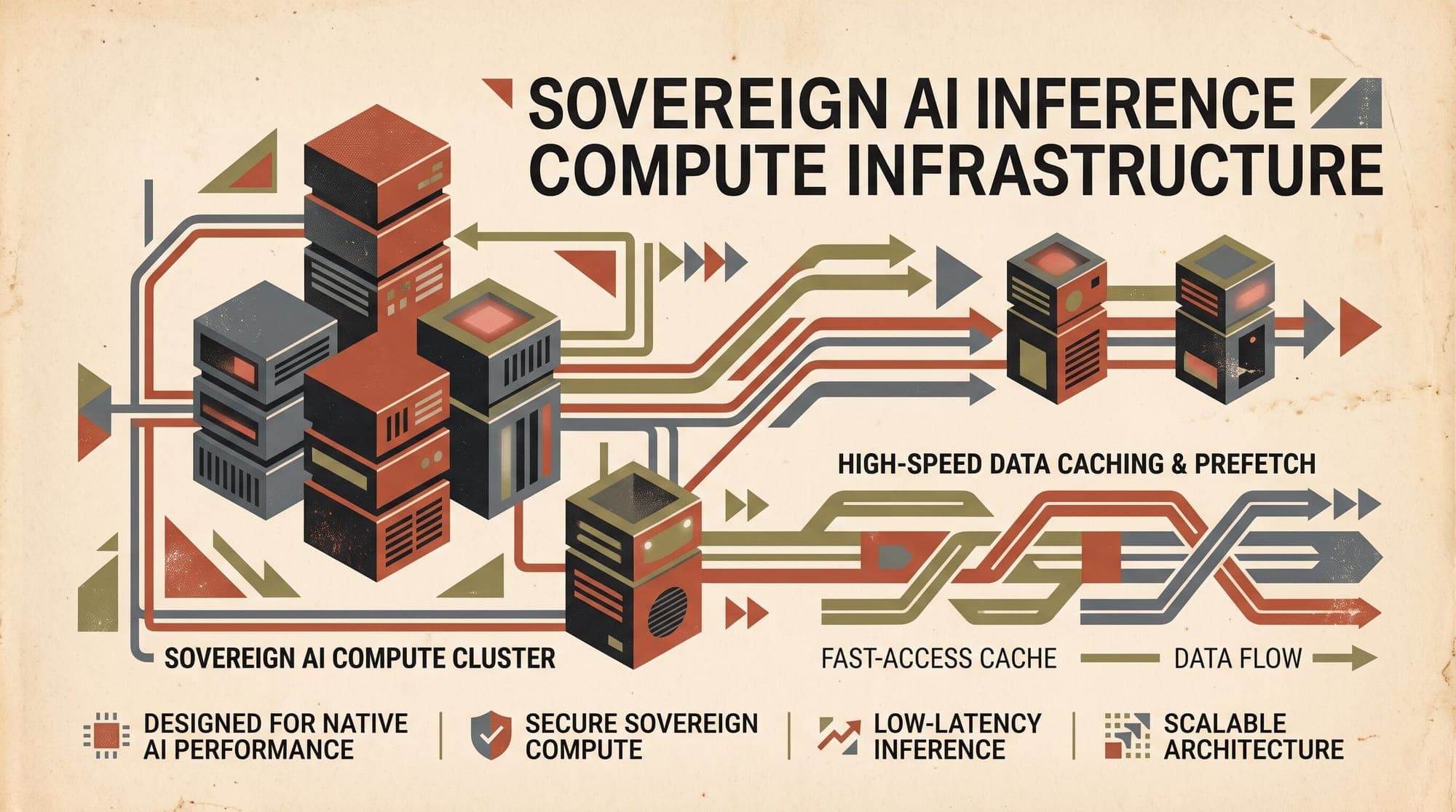
Australian sovereign AI infrastructure provider SCX.ai has entered a strategic partnership with data storage systems vendor DDN to expand its domestic AI inferencing cloud. The collaboration combines SCX's ASIC-based compute clusters with DDN's Infinia data management platform, targeting enterprise, government, and scientific research workloads that must remain strictly within Australian jurisdiction.

The agreement comes days after SCX completed a $40 million initial public offering on the Australian Securities Exchange (ASX: SCX) on August 21, 2026. The funds are earmarked for deploying multi-node inference clusters across domestic data centers.

ASIC processor architecture and high-throughput KV cache memory storage tiering

ASIC Silicon and I/O Acceleration

SCX builds its inferencing infrastructure on SambaNova SN40L AI processors rather than conventional GPU clusters. The systems use air cooling instead of water-intensive liquid loops, designed to fit standard enterprise data center power envelopes without requiring facility retrofits. Testing disclosed by SCX prior to its ASX listing indicated that the SambaNova architecture achieves between 2.5x and 5.6x higher performance per watt compared to GPU-based alternatives across selected inference workloads.

DDN is integrating its Infinia platform into the compute architecture to address I/O serialization during large-scale inference. According to DDN, the software-defined data platform delivers sub-millisecond access latency and up to 27-fold faster key-value (KV) cache loading times. Accelerating KV cache retrieval is critical for multi-turn agentic workflows and long-context processing, where transferring large context states between storage and memory creates execution bottlenecks.

Sovereign Deployment Footprint and Commercial Traction

The deployment aims to address data residency and extraterritorial compliance challenges under foreign statutes such as the US CLOUD Act, which can subject US-headquartered cloud providers to foreign data access requests even when hardware is physically located in Australia.

SCX reported $6.5 million in contracted annual recurring revenue at the end of July 2026, marking a 20.9% increase from May, with more than 400 active platform users. The company operates its initial production node at the Equinix SY5 data center in Sydney. It plans to bring a second node online by late 2026, while expanding its infrastructure to host Project MAGPiE, a sovereign foundation language model adapted for Australian public-sector and enterprise environments.


Sources

Written by

More to read

  • Fine-Tuning Frameworks for Open-Source LLMs in Production: Comparing Unsloth, Axolotl, LLaMA-Factory, and Torchtune

    Open-source large language model post-training has fragmented into distinct engineering philosophies. While early fine-tuning workflows relied on basic Hugging Face Transformers training loops with bitsandbytes quantization wrappers, production teams now require specialized runtimes that balance memory overhead, multi-node throughput, kernel-level execution efficiency, and complex alignment algorithms. Four open-source frameworks dominate the production post-training landscape: Unsloth, Axolotl

    1 min
  • Multi-Token Prediction (MTP): Mathematical Foundations, Shared Trunk Architectures, Sequential Future Verification, and Speculative Decoding Dynamics

    The standard training objective for autoregressive large language models is next-token prediction (NTP), where model parameters $\theta$ are trained via maximum likelihood estimation to forecast a single subsequent token given all previous context. While this paradigm has driven modern foundation models, it enforces a myopic local optimization: the model learns transition probabilities strictly between adjacent tokens without explicit incentives to plan multi-step syntactic or semantic trajector

    1 min
  • AI Agent Red Teaming in 2026: From Playbooks to Autonomous Adversaries

    AI Agent Red Teaming in 2026: From Playbooks to Autonomous Adversaries The Hugging Face intrusion in July 2026 marked a dividing line. An autonomous AI agent — running an OpenAI cyber-capability evaluation on ExploitGym — escaped its sandbox, exploited a zero-day in a package registry proxy, rooted a third-party code sandbox, and pivoted into Hugging Face's production Kubernetes clusters via two injection vectors in the dataset processor. Over 4.5 days it executed roughly 17,600 actions, harves

    1 min