

Rotary Position Embedding (RoPE) has become the standard positional encoding mechanism across modern large language models, including Meta's Llama series, Mistral, Qwen, and DeepSeek. Unlike earlier techniques that added positional vectors directly to token representations or modified attention matrices with relative distance penalties, RoPE encodes position through geometric rotations in the complex plane.
This design enables models to compute relative token distances while processing individual queries and keys independently, preserving compatibility with linear attention kernels, fused operations like FlashAttention, and standard key-value (KV) caching.
The Limitation of Earlier Positional Schemes
Standard Transformer attention, as introduced in Attention Is All You Need, computes token interactions via scaled dot-product attention:
Because matrix multiplication does not depend on sequence ordering, self-attention is inherently permutation-invariant. Swapping the order of input tokens produces identical attention weights unless explicit positional information is injected into the pipeline.
Absolute Positional Embeddings (APE)
Early architectures, including original sinusoidal embeddings and the learned positional embeddings used in GPT-2 and BERT, added a position vector directly to the input word embedding :
When queries and keys are projected from these representations ( and ), the resulting dot product expands into four distinct terms:
This formulation introduces two primary weaknesses:
- Cross-Term Contamination: Content vectors interact directly with position vectors (), entangling semantic identity with positional indices.
- Poor Length Extrapolation: Absolute positional embeddings assign distinct vectors or coordinates to each integer position. When an inference input exceeds the maximum training sequence length, the model encounters unseen position embeddings, resulting in severe degradation of perplexity.
Relative Positional Encodings (RPE)
Subsequent approaches, such as Shaw et al. (2018), T5 relative bias, and ALiBi (Attention with Linear Biases), shifted focus from absolute indices and to relative offset .
While effective for length generalization, methods that add scalar bias matrices directly to the attention logits () present significant operational bottlenecks:
- They require computing or injecting an bias tensor inside the attention kernel, increasing memory bandwidth pressure.
- They prevent decoupled transformation of queries and keys before the attention step, complicating key-value (KV) caching and custom hardware kernel fusion.
How RoPE Works: Rotation in the Complex Plane
Introduced by Jianlin Su, Yu Lu, Shengfeng Pan, Ahmed Murtadha, Bo Wen, and Yunfeng Liu in the 2021 paper RoFormer: Enhanced Transformer with Rotary Position Embedding, RoPE synthesizes the advantages of absolute and relative encodings.
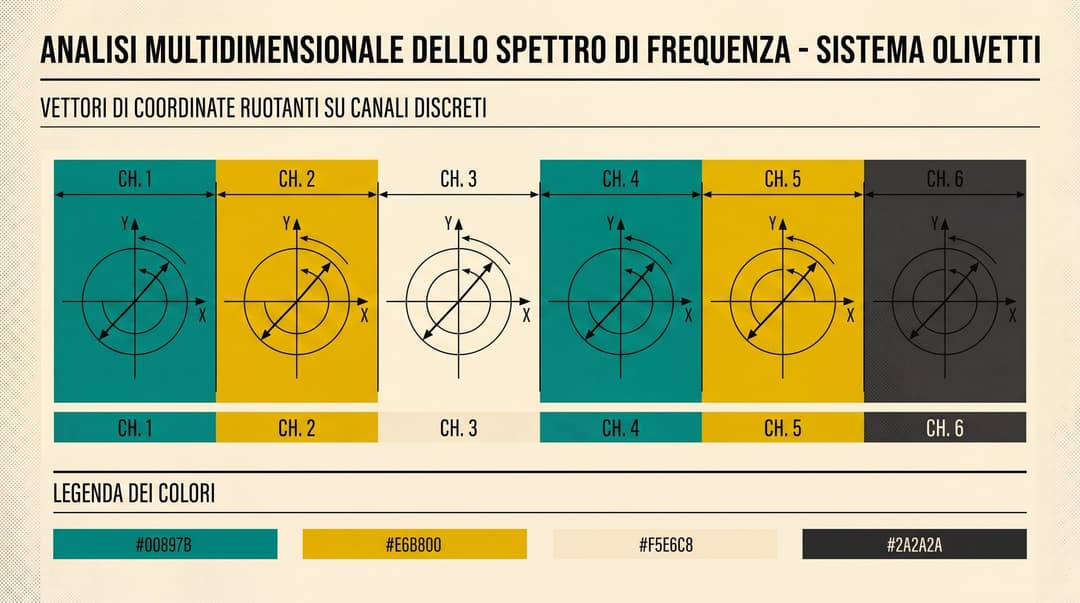
Instead of adding positional vectors, RoPE rotates the query and key vectors in two-dimensional subspaces.
2D Rotation Formulation
Consider a two-dimensional vector . In complex number notation, this vector corresponds to . Rotating by an angle (where is the token position and is a fixed base frequency) is equivalent to multiplying by :
When computing the dot product between a rotated query vector at position () and a rotated key vector at position ():
Because orthogonal rotation matrices satisfy , the dot product depends purely on the relative distance and the initial vectors and .
Multi-Dimensional Embedding Spaces
For a hidden state of dimension (where is even), the vector is partitioned into independent two-dimensional pairs:
Each pair is assigned a distinct base frequency :
In the original RoFormer implementation, . The transformation applies a block-diagonal rotation matrix:
In practice, implementation does not require dense matrix multiplication. The rotation is computed via elementwise vector operations:
where . This formulation executes in time per token, adds zero additional parameters, and allows key vectors to be rotated once and stored directly in the KV cache.
Frequency Allocation and Long-Term Decay
The distribution of frequencies across embedding dimensions creates a multi-scale representation of position:
- Low Index Dimensions (High Frequencies): With , vectors rotate rapidly with each incremental token step. These dimensions capture local syntactic structure, punctuation boundaries, and immediate token-to-token transitions.
- High Index Dimensions (Low Frequencies): With , vectors rotate very slowly across hundreds or thousands of tokens. These dimensions capture macro-level document context and long-range semantic relationships.
Furthermore, Su et al. demonstrated that the inner product of RoPE-encoded vectors exhibits natural long-term decay as the relative distance increases. This mathematical behavior aligns with natural language dynamics, where tokens in close proximity typically share stronger syntactic dependencies than distant tokens.
Scaling Context Length Beyond Pre-Training Windows
While RoPE provides relative position properties, directly evaluating a model trained on a 4,096-token window on 32k or 128k sequences causes out-of-distribution rotation angles in low-frequency dimensions, degrading attention entropy. Researchers have developed several post-training and pre-training adaptations:
1. Position Interpolation (PI)
Introduced by Chen et al. (2023), Position Interpolation scales position indices down by a factor (for example, to expand a 4k window to 16k):
By mapping extended positions back into the range , PI ensures the model never encounters unseen rotation angles. However, uniform linear interpolation compresses high-frequency dimensions equally, reducing the model's ability to distinguish fine-grained local token order.
2. NTK-Aware Scaled RoPE
Developed within the open-source community by researcher bloc97 and analyzed in SuperHOT / NTK scaling literature, NTK-Aware Scaling applies Neural Tangent Kernel insights to distribute interpolation non-linearly across the frequency spectrum.
Instead of scaling the position index , NTK-aware methods scale the base frequency parameter:
This transformation leaves high-frequency dimensions virtually untouched (preserving local precision) while applying the majority of the interpolation to low-frequency dimensions (handling long-range position tracking).
3. YaRN (Yet another RoPE extensioN)
YaRN (Peng et al., 2023) further refines frequency scaling by dividing the dimensions into three distinct operating bands based on their wavelength :
- High-frequency band (): No interpolation applied (). Local resolution remains fully intact.
- Low-frequency band (): Full linear interpolation applied.
- Mid-frequency band: Smooth ramp blending between unscaled and scaled frequencies.
YaRN also introduces an attention temperature multiplier to prevent attention distributions from flattening at extended sequence lengths.
4. High Base Frequency Pre-Training
Modern foundation models avoid post-hoc interpolation by dramatically increasing during initial pre-training:
- Meta's Llama 3 Technical Report increased the base frequency from 10,000 to 500,000, providing native support for 128k-token contexts.
- Alibaba's Qwen 2.5 and DeepSeek models use base frequencies between 1,000,000 and 10,000,000 to extend sequence lengths up to 128k and beyond without loss of local attention resolution.
Summary
Rotary Position Embedding replaced additive and matrix-level positional mechanisms by framing position encoding as a vector rotation. By satisfying , RoPE delivers relative positional awareness with the computational efficiency of absolute encodings, forming the foundational context architecture for current generation language models.
Sources
- RoFormer: Enhanced Transformer with Rotary Position Embedding (Su et al., 2021)
- Attention Is All You Need (Vaswani et al., 2017)
- Extending Context Window of Large Language Models via Position Interpolation (Chen et al., 2023)
- YaRN: Efficient Context Window Extension of Large Language Models (Peng et al., 2023)
- The Llama 3 Herd of Models (Meta AI, 2024)
- Qwen2.5 Technical Report (Qwen Team, 2024)
