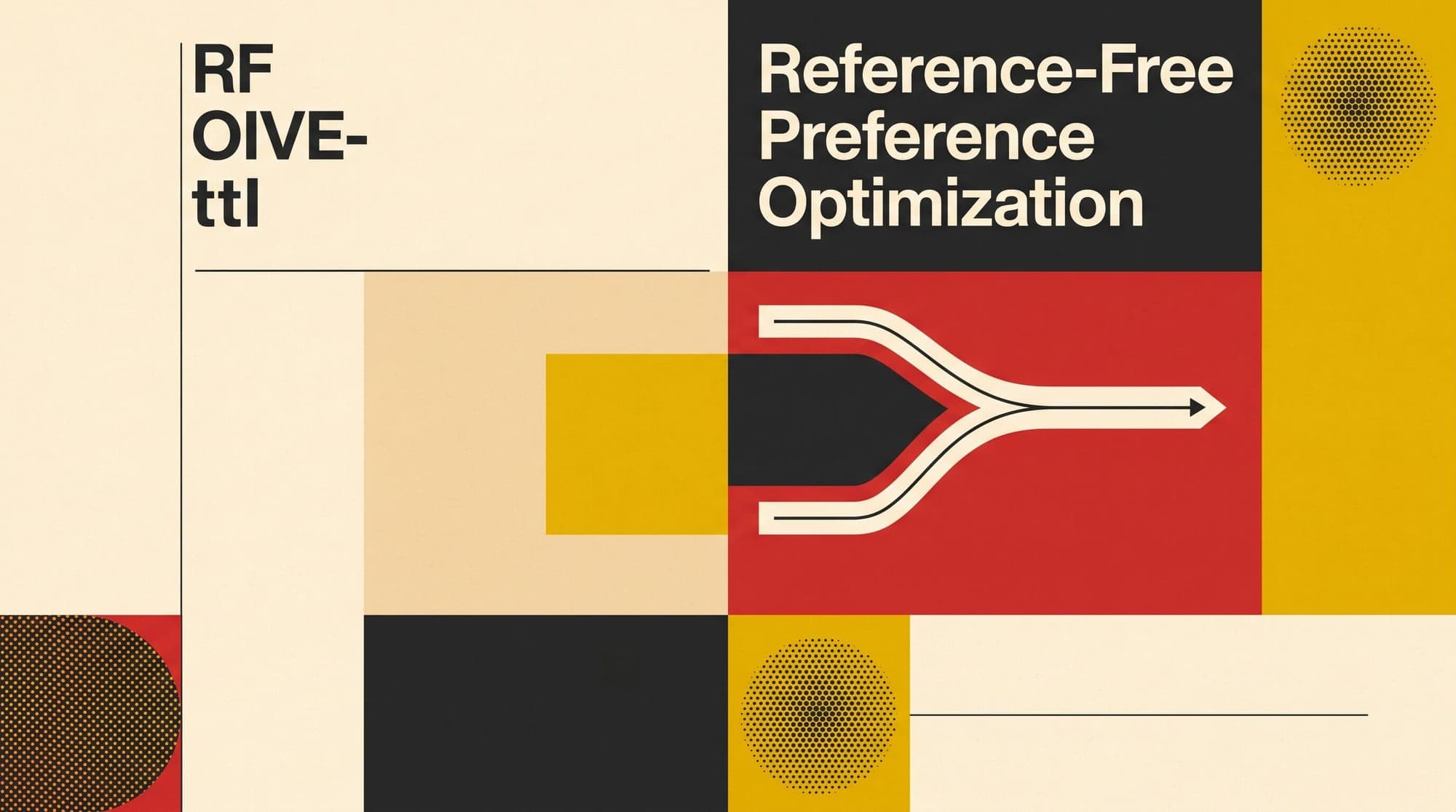
Aligning large language models with human preferences has historically relied on two distinct stages after pretraining: Supervised Fine-Tuning (SFT) to establish instruction-following behaviors, followed by reinforcement learning from human feedback (RLHF) or Direct Preference Optimization (DPO) to maximize response quality.
While DPO removed the need for explicit reward modeling and complex actor-critic policy loops (such as Proximal Policy Optimization, or PPO), it retained an architectural bottleneck: the reference model policy (). Under standard DPO, calculating preference loss requires computing output token probabilities across both the active policy () and a static, frozen copy of the base model () for every chosen and rejected prompt completion pair.
This reference model introduces substantial memory and compute overheads during distributed training, complicates online updates, and introduces verbosity exploitation artifacts. Recently developed reference-free alignment techniques, notably Odds Ratio Preference Optimization (ORPO) and Simple Preference Optimization (SimPO), eliminate entirely. By redefining loss functions through direct odds ratios and length-normalized reward margins, these methods cut alignment VRAM requirements by nearly half while matching or outperforming standard DPO on open benchmarks.

The Hidden Costs of Reference Policies in DPO
Direct Preference Optimization, introduced by Rafailov et al. (2023), reparameterized the Bradley-Terry preference model by expressing the ground-truth reward function directly in terms of the optimal policy:
The corresponding DPO objective optimizes the active model parameters across dataset pairs of prompt , winning completion , and losing completion :
The ratio enforces an implicit Kullback-Leibler (KL) divergence penalty, preventing the aligned policy from drifting too far from the base model distribution. However, this mathematical formulation creates practical engineering friction:
- VRAM and Compute Doubling: To evaluate the loss during each step of gradient descent, the training harness must run forward passes on four sequences: policy chosen, policy rejected, reference chosen, and reference rejected. In distributed setups using Fully Sharded Data Parallel (FSDP) or DeepSpeed ZeRO-3, holding a frozen copy of weights and running auxiliary forward passes doubles activation memory and increases execution time.
- Log-Probability Precomputation Invalidation: While practitioners often precalculate log-probabilities offline to save GPU memory during DPO, this optimization breaks down whenever active data curation, iterative multi-turn rollouts, or online sample generation are employed.
- Length and Verbosity Bias: Standard DPO measures raw sequence log-likelihoods without normalizing for token count. Because total log-probabilities accumulate negative mass over sequence lengths, longer responses with lower average per-token confidence can score higher under raw log-ratio differences, incentivizing conversational padding over factual accuracy.
Odds Ratio Preference Optimization (ORPO): Monolithic Alignment
Introduced by Hong et al. (2024), Odds Ratio Preference Optimization (ORPO) restructures alignment as a monolithic, single-stage process. Instead of treating instruction fine-tuning and preference optimization as sequential procedures, ORPO trains directly on preference pairs using a combined objective.
Mathematical Formulation
Given prompt and output sequence of length , the probability assigned by policy parameters is:
The odds of the model generating sequence given is defined as the probability ratio:
The odds ratio between chosen sequence and rejected sequence measures how much more likely the model generates the favored response over the disfavored response:
The ORPO loss objective combines standard Supervised Fine-Tuning cross-entropy on with a log-odds penalty:
where:
Gradient Mechanics and Training Dynamics
The parameter acts as a balancing weight (typically set between and ).
During backpropagation, provides positive gradient signals on favored tokens, preserving syntax, domain fluency, and instruction execution. Simultaneously, applies an asymmetrical penalty: if the probability of the rejected sequence rises relative to , the odds ratio collapses toward zero, and the gradient penalty spikes sharply.
Because the odds ratio is self-normalized by the model's own predictions, no frozen reference policy is required to anchor the training distribution.
Simple Preference Optimization (SimPO): Reference-Free Reward with Target Margins
Developed by Meng et al. (2024) at Princeton University, Simple Preference Optimization (SimPO) focuses directly on resolving two flaws of DPO: reference model dependency and length exploitation.
Formulating Implicit Reward as Average Log-Probability
In contrast to DPO, which uses the policy-to-reference log ratio as implicit reward, SimPO defines the reward function directly as the length-normalized sequence log-probability under the active policy:
Here, controls the scale of the implicit reward (commonly set to ).
Dividing by the response length ensures that each token contributes equally to the sequence score. This prevents the optimization objective from rewarding verbose, superficial text over dense, precise answers.
The Target Reward Margin
Without a reference policy to penalize divergence, an unconstrained Bradley-Terry objective can experience reward collapse or unstable parameter drift. SimPO introduces a fixed target reward margin directly into the pairwise loss:
The margin enforces that the model must not merely assign a higher average log-probability to than ; the difference must exceed before the loss approaches zero.
Ablation studies indicate that setting (or setting the ratio ) provides sufficient regularization, eliminating the need for a separate KL divergence anchor against .
Comparing Alignment Paradigms
The shift from standard RLHF to DPO and reference-free techniques represents a progression toward simpler loss surfaces and reduced training overhead.
Architectural Breakdown
- RLHF (PPO): Requires four distinct neural networks in memory during training (Actor policy , Critic/Value network , Reward Model , and Reference policy ). High implementation complexity and memory usage; sensitive to reinforcement learning hyperparameters.
- DPO (Direct Preference Optimization): Requires two models in memory (Active policy and Frozen Reference policy ). Relies on raw token log-probability ratios; prone to length bias without post-hoc length penalties.
- ORPO (Odds Ratio Preference Optimization): Single model in memory (). Unifies SFT and preference tuning in a single stage using cross-entropy plus log-odds ratio loss.
- SimPO (Simple Preference Optimization): Single model in memory (). Offline preference alignment using length-normalized log-probabilities with an explicit target margin .
- KTO (Kahneman-Tversky Optimization): Introduced by Ethayarajh et al. (2024). Operates on unpaired binary signals (thumbs up or down) rather than paired preferences, utilizing a prospect-theoretic utility function with reference points.
Empirical Benchmarks and Efficiency
On standard alignment benchmarks including AlpacaEval 2.0 (length-controlled win rate) and Arena-Hard, reference-free algorithms consistently match or outperform DPO:
- AlpacaEval 2.0 (LC Win Rate): SimPO applied to Llama-3-8B-Instruct achieves win rates exceeding standard DPO by 3 to 5 percentage points, primarily due to the elimination of verbosity exploitation through length normalization.
- Memory Footprint: By removing the reference policy, ORPO and SimPO decrease peak VRAM consumption by 35% to 50% compared to full two-model DPO training pipelines.
- Training Throughput: Reducing forward passes from four to two per sample increases step throughput by 1.6x to 1.9x across distributed GPU clusters.
Implementation Pattern with Hugging Face TRL
Modern alignment frameworks such as Hugging Face TRL provide native implementations for reference-free methods. Below is an example configuration implementing SimPO training:
import torch
from datasets import load_dataset
from transformers import AutoModelForCausalLM, AutoTokenizer
from trl import CPOConfig, CPOTrainer

# Load dataset containing prompt, chosen, and rejected columns
dataset = load_dataset("princeton-nlp/llama3-ultrafeedback-armorm", split="train")

model_id = "meta-llama/Meta-Llama-3-8B-Instruct"
tokenizer = AutoTokenizer.from_pretrained(model_id)
model = AutoModelForCausalLM.from_pretrained(
    model_id,
    torch_dtype=torch.bfloat16,
    device_map="auto",
)

# Configure SimPO via TRL's CPO/SimPO trainer
training_args = CPOConfig(
    output_dir="./llama3-8b-simpo",
    learning_rate=5e-7,
    per_device_train_batch_size=2,
    gradient_accumulation_steps=8,
    max_length=2048,
    max_prompt_length=1024,
    num_train_epochs=1,
    bf16=True,
    logging_steps=10,
    # SimPO-specific parameters
    loss_type="simpo",
    beta=2.0,
    simpo_gamma=1.4,
    cpo_alpha=0.0,  # 0.0 disables auxiliary BC loss for pure SimPO
)

trainer = CPOTrainer(
    model=model,
    args=training_args,
    train_dataset=dataset,
    tokenizer=tokenizer,
)

trainer.train()
trainer.save_model("./llama3-8b-simpo-final")
For ORPO, the equivalent setup uses ORPOTrainer with beta (representing the weighting factor) set between 0.1 and 0.2:
from trl import ORPOConfig, ORPOTrainer

orpo_args = ORPOConfig(
    output_dir="./mistral-7b-orpo",
    learning_rate=8e-6,
    per_device_train_batch_size=4,
    gradient_accumulation_steps=4,
    max_length=2048,
    max_prompt_length=1024,
    num_train_epochs=1,
    bf16=True,
    beta=0.1,  # Corresponds to lambda in the ORPO formulation
)

trainer = ORPOTrainer(
    model=model,
    args=orpo_args,
    train_dataset=dataset,
    tokenizer=tokenizer,
)
trainer.train()
Failure Modes and Practical Considerations
While reference-free alignment delivers substantial operational savings, several failure modes must be managed in production pipelines:
- Learning Rate Sensitivity: Because reference-free methods lack an active KL divergence anchor to a frozen reference policy, aggressive learning rates can degrade out-of-distribution language modeling capabilities faster than in standard DPO. Learning rates should typically be kept in the range of to for full parameter tuning.
- Margin Calibration: If the SimPO margin is configured too high (), gradient updates on subtle preference pairs can saturate, causing training loss to plateau prematurely. Conversely, if , the model lacks sufficient incentive to separate nuanced chosen and rejected responses.
- Distribution Shift in Monolithic Training: While ORPO eliminates the separate SFT phase, applying ORPO to a base model requires high-quality chosen responses across all necessary instruction domains. If the preference dataset lacks adequate task diversity, the model may experience instruction degradation compared to a dedicated, high-volume SFT phase followed by alignment.
Sources
- ORPO: Monolithic Preference Optimization without Reference Model (Hong et al., 2024)
- SimPO: Simple Preference Optimization with a Reference-Free Reward (Meng et al., 2024)
- Direct Preference Optimization: Your Language Model Is Secretly a Reward Model (Rafailov et al., 2023)
- KTO: Model Alignment as Prospect Theoretic Optimization (Ethayarajh et al., 2024)