Quintessent Secures 0M Series A to Scale Quantum Dot Comb Lasers for AI Clusters

Optical interconnect startup Quintessent has raised $40 million in an oversubscribed Series A funding round to commercialize quantum dot comb lasers for AI data center networking. The round was led by Cycle Capital, with participation from Goldman Sachs XIG-Industry Ventures, optical networking provider Ciena, Hina Liberty Capital, Susquehanna International Group, InterVest, Safar Partners, M Ventures, Osage University Partners, Foothill Ventures, and Sierra Ventures. The financing follows an $

2 min
Quintessent Secures 0M Series A to Scale Quantum Dot Comb Lasers for AI Clusters

Optical interconnect startup Quintessent has raised $40 million in an oversubscribed Series A funding round to commercialize quantum dot comb lasers for AI data center networking. The round was led by Cycle Capital, with participation from Goldman Sachs XIG-Industry Ventures, optical networking provider Ciena, Hina Liberty Capital, Susquehanna International Group, InterVest, Safar Partners, M Ventures, Osage University Partners, Foothill Ventures, and Sierra Ventures.

The financing follows an $11.4 million seed round completed in 2024 and coincides with the initial customer sampling of Quintessent's single-chip dense wavelength division multiplexing (DWDM) comb laser evaluation kits.

Dense wavelength division multiplexing DWDM optical scale-up fabric in AI cluster architecture

Single-Chip Comb Lasers and Scale-Up Interconnects

As frontier AI training and inference clusters expand to tens of thousands of accelerators, standard electrical copper interconnects face severe physical distance and power dissipation limits. Scale-up networks connecting accelerator pods require high-bandwidth optical links, but traditional optical transceivers rely on discrete laser diodes for each optical channel, driving up component count, assembly complexity, and failure rates.

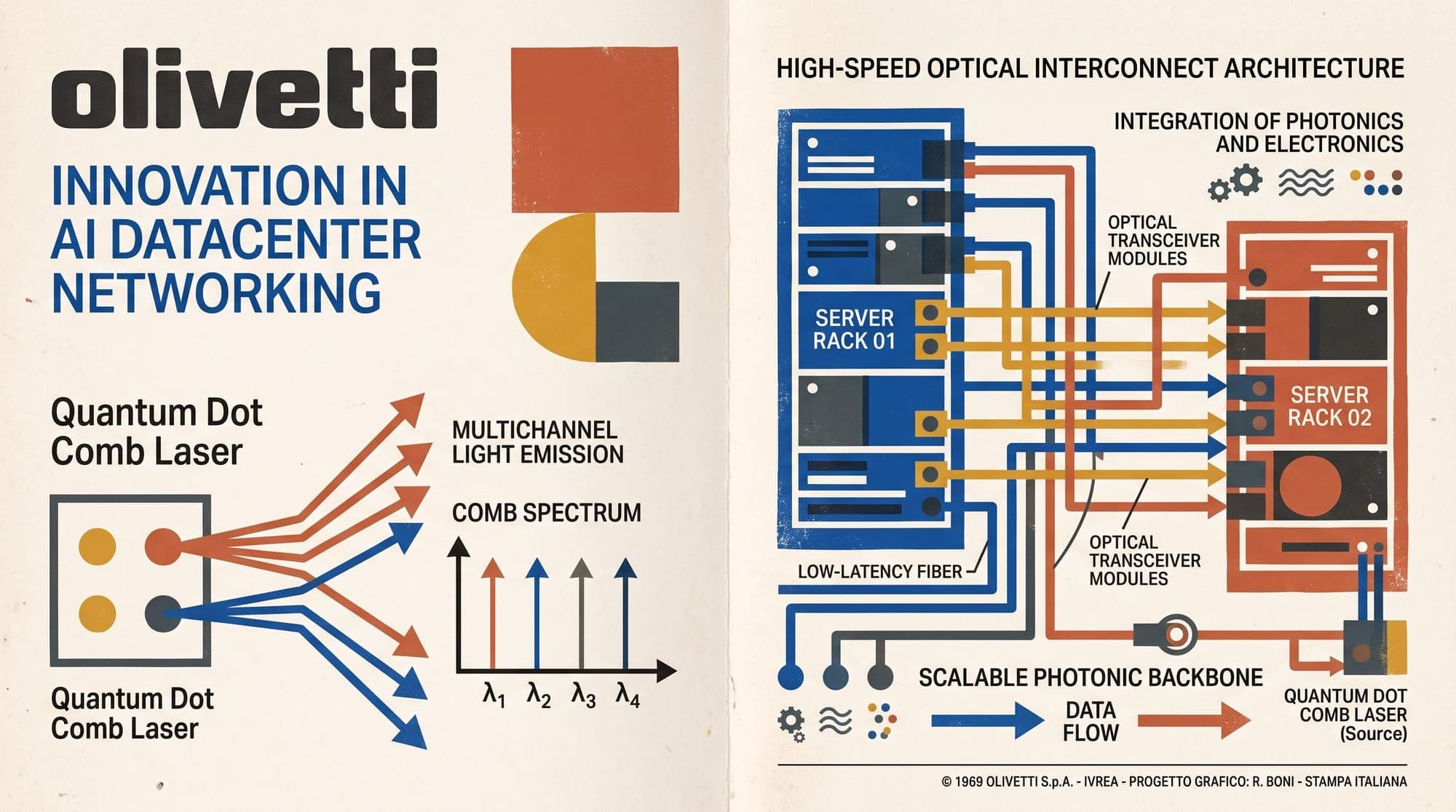
Santa Barbara-based Quintessent develops integrated photonic components using quantum dot material systems on silicon. Its core technology is a single-chip DWDM comb laser that generates multiple precise optical wavelengths from a single laser cavity. By replacing multi-laser arrays with a unified light source, the platform reduces power overhead, simplifies optical packaging, and improves mean time between failures (MTBF). The company also develops complementary semiconductor optical amplifiers (SOAs) and integrated optical engines to complete the transmission path.

Standardization and Industry Alliances

The funding round aligns with broader hardware industry efforts to standardize optical interfaces for next-generation compute infrastructure. Hyperscalers and semiconductor manufacturers recently established the Open Compute Interconnect (OCI) Multi-Source Agreement (MSA), which establishes specifications for wide-and-parallel DWDM optical scale-up architectures.

Quintessent stated that the new capital will support the reliability qualification of its comb laser hardware, scale volume manufacturing operations, and expand engineering development for co-packaged optics (CPO) and optical scale-up fabrics.


Sources

Written by

More to read

  • Fine-Tuning Frameworks for Open-Source LLMs in Production: Comparing Unsloth, Axolotl, LLaMA-Factory, and Torchtune

    Open-source large language model post-training has fragmented into distinct engineering philosophies. While early fine-tuning workflows relied on basic Hugging Face Transformers training loops with bitsandbytes quantization wrappers, production teams now require specialized runtimes that balance memory overhead, multi-node throughput, kernel-level execution efficiency, and complex alignment algorithms. Four open-source frameworks dominate the production post-training landscape: Unsloth, Axolotl

    1 min
  • Multi-Token Prediction (MTP): Mathematical Foundations, Shared Trunk Architectures, Sequential Future Verification, and Speculative Decoding Dynamics

    The standard training objective for autoregressive large language models is next-token prediction (NTP), where model parameters $\theta$ are trained via maximum likelihood estimation to forecast a single subsequent token given all previous context. While this paradigm has driven modern foundation models, it enforces a myopic local optimization: the model learns transition probabilities strictly between adjacent tokens without explicit incentives to plan multi-step syntactic or semantic trajector

    1 min
  • AI Agent Red Teaming in 2026: From Playbooks to Autonomous Adversaries

    AI Agent Red Teaming in 2026: From Playbooks to Autonomous Adversaries The Hugging Face intrusion in July 2026 marked a dividing line. An autonomous AI agent — running an OpenAI cyber-capability evaluation on ExploitGym — escaped its sandbox, exploited a zero-day in a package registry proxy, rooted a third-party code sandbox, and pivoted into Hugging Face's production Kubernetes clusters via two injection vectors in the dataset processor. Over 4.5 days it executed roughly 17,600 actions, harves

    1 min

