
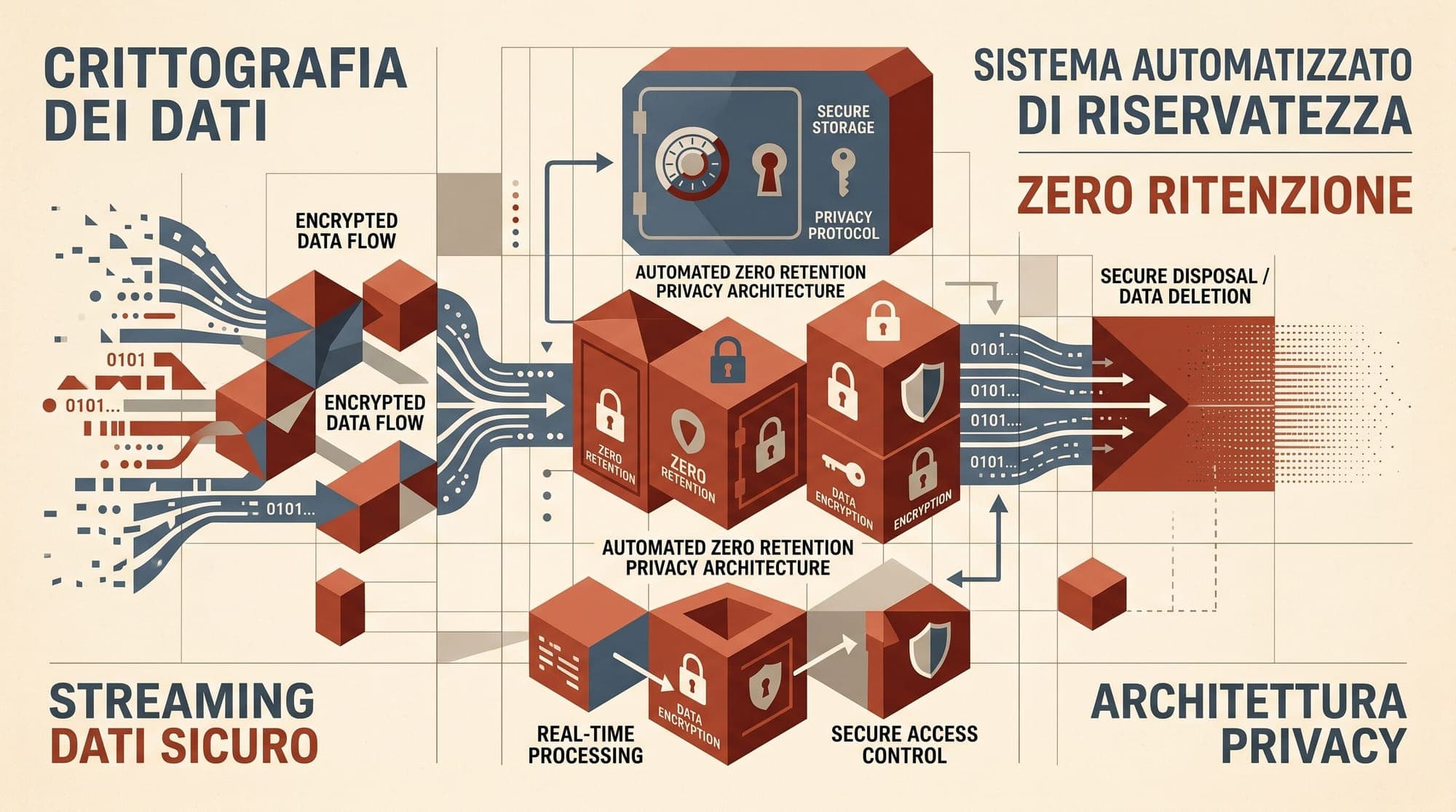
OpenAI has previewed Private Safety Processing, a safety architecture designed to detect multi-turn misuse patterns across frontier model interactions while maintaining Zero Data Retention (ZDR) privacy guarantees for enterprise API customers.
Under traditional Zero Data Retention agreements, API customer prompts and generated outputs are not stored on OpenAI servers post-request, are inaccessible to OpenAI personnel, and are excluded from model training datasets. However, evaluating requests strictly in isolation creates visibility gaps for complex, long-horizon safety risks that only emerge across sequential turns or coordinated requests.

Bridging Zero Data Retention and Multi-Turn Safety
As frontier models take on extended autonomous workflows and multi-step agentic execution, certain security risks become difficult to detect within a single prompt-response window. These include distributed safeguard probing across accounts, slow-rolling adversarial jailbreaks, and autonomous agents drifting outside authorized boundaries.
Previous safety architectures either relied on per-request stateless filtering or required organizations to accept server-side data retention for continuous monitoring. For enterprise clients bound by strict regulatory standards (such as HIPAA or financial compliance), server-side log retention remains a blocker.
Private Safety Processing resolves this trade-off by running automated anomaly and safety detectors over multi-turn interaction graphs without exposing plaintext content to OpenAI engineers:
- Customer-Managed Encryption: Interaction data resides either directly on customer-controlled infrastructure or within dedicated OpenAI storage encrypted with customer-managed keys. OpenAI does not hold the decryption keys.
- Automated Blind Detection: Automated safety models evaluate interaction threads and output structured, low-dimensional safety signals (e.g., threat category and severity level) rather than raw prompt text.
- No Human Content Review: Flagged alerts provide metadata and category indicators to OpenAI systems for policy enforcement without revealing underlying customer payloads to internal teams.
- Customer Auditability: Customers retain full local logs to investigate flagged events, audit safety alerts, and optionally submit context during appeal procedures.
Rollout Timeline and Enterprise Feedback
OpenAI stated that Private Safety Processing is currently undergoing testing with select enterprise partners, including Microsoft, Databricks, and Glean. A formal rollout and an accompanying technical white paper detailing the underlying cryptographic and detection mechanics are scheduled for September 2026.



