# OpenAI details GPT-Live: full-duplex voice AI that drops turn detection
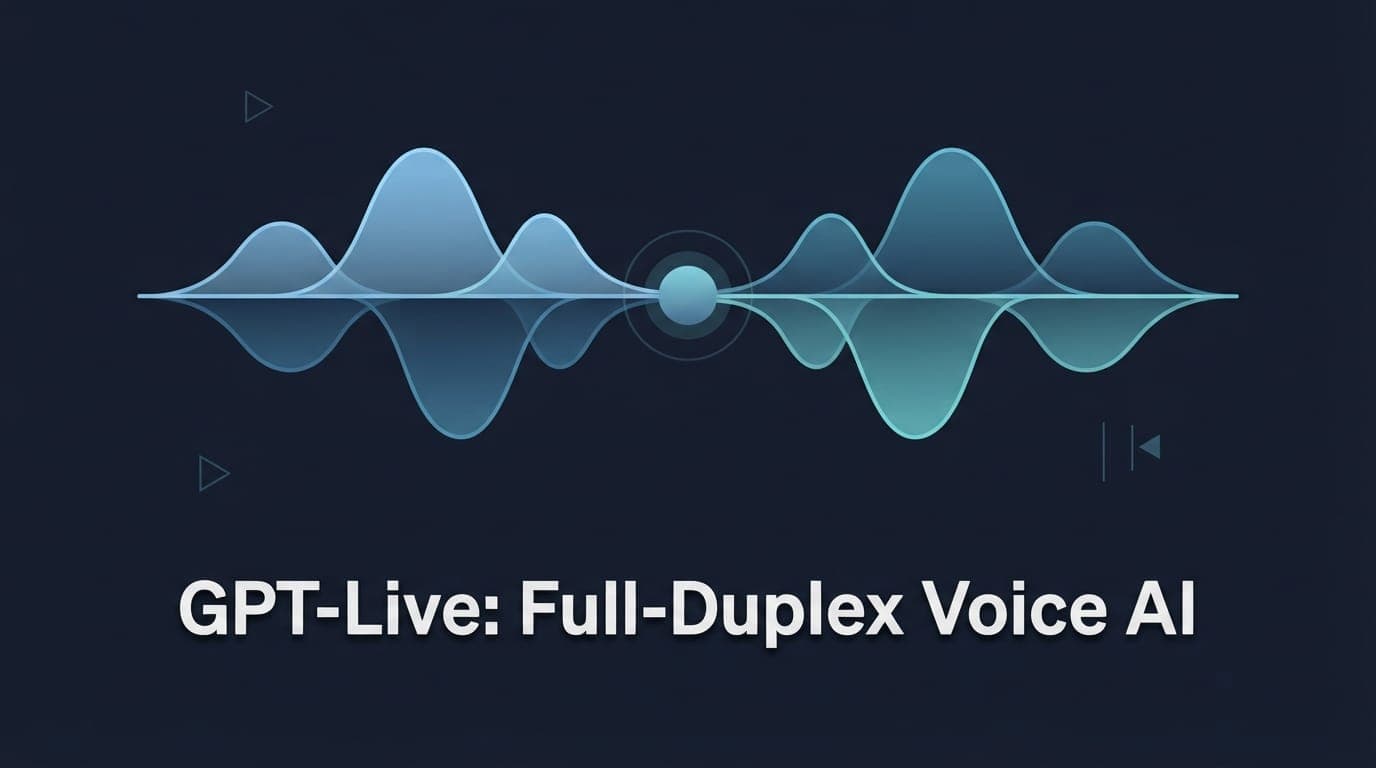
OpenAI has published a technical deep dive into GPT-Live, its third-generation voice AI system, revealing an architecture that eliminates the turn detector from the audio path entirely. The system is full-duplex, meaning it can listen and speak simultaneously, removing the bottleneck that made previous voice assistants feel either interruptive or sluggish.
The engineering post, written by Justin Uberti and Zahan Malkani, traces the evolution from cascaded speech-to-text-to-speech pipelines through speech-to-speech models, and explains why both remained fundamentally turn-based. In older systems, a small "turn detector" model had to decide when a user finished speaking before the larger model could begin inference. Guess too early and the user gets cut off. Guess too late and the response feels delayed.
GPT-Live puts a voice model directly in control of the conversation. Audio streams in and out continuously. When deeper reasoning or tool use is needed, the system delegates to frontier models like GPT-5.5 on an asynchronous path that cannot stall the media loop. The voice model keeps talking while the heavy lifting happens behind the scenes.
The media frontend and inference logic were rewritten in Go, replacing a previous Python asyncio implementation. OpenAI says the new system's p95 latency matches the old system's p50. WebRTC handles transport, with built-in mechanisms for packet loss, clock drift, and connection changes. Audio frames arrive on schedule because the system minimizes buffering and blocking throughout.
Stateful inference brings its own challenges. Voice sessions can run long, context grows continuously, and model instances spin up and down with demand. OpenAI built a handoff mechanism that warms a replacement model instance alongside the existing one, prefills it with current session context, runs both in parallel, and cuts over when the new instance is ready.
The architecture creates a clean separation between the core voice path and application logic. Tools, policies, and backend behavior can change without touching the media frontend. This foundation already powers ChatGPT Voice features including computer control and agent coordination in the desktop app.
The post does not specify pricing, availability, or API access timelines for GPT-Live.
## Sources
- [How we built a realtime system for responsive voice AI in six months](https://openai.com/index/continuous-voice-interaction-with-gpt-live) - OpenAI, August 3, 2026