OpenAI Disbands Preparedness Team in Continued Safety Restructuring

OpenAI has disbanded its dedicated Preparedness team, redistributing safety and frontier-risk evaluation responsibilities across individual functional units, according to reporting by the Financial Times and The Verge. The Preparedness team was established in late 2023 to evaluate and mitigate catastrophic risks associated with frontier AI models, focusing on cybersecurity exploits, chemical, biological, radiological, and nuclear (CBRN) threats, and autonomous model behavior. Under the new orga

1 min
OpenAI Disbands Preparedness Team in Continued Safety Restructuring

OpenAI has disbanded its dedicated Preparedness team, redistributing safety and frontier-risk evaluation responsibilities across individual functional units, according to reporting by the Financial Times and The Verge.

The Preparedness team was established in late 2023 to evaluate and mitigate catastrophic risks associated with frontier AI models, focusing on cybersecurity exploits, chemical, biological, radiological, and nuclear (CBRN) threats, and autonomous model behavior. Under the new organizational structure, domain-specific safety evaluations will be absorbed directly into existing operational and engineering teams.

Organizational Restructuring and Key Transitions

Dylan Scandinaro, who joined OpenAI from Anthropic in February to lead the Preparedness team, will transition to a dedicated research role examining the implications and boundaries of recursive self-improving AI systems.

The restructuring follows several high-profile departures across OpenAI's safety and governance hierarchy in recent months, including ethics lead Chloé Bakalar, chief futurist Josh Achiam, and head of safety systems Johannes Heidecke.

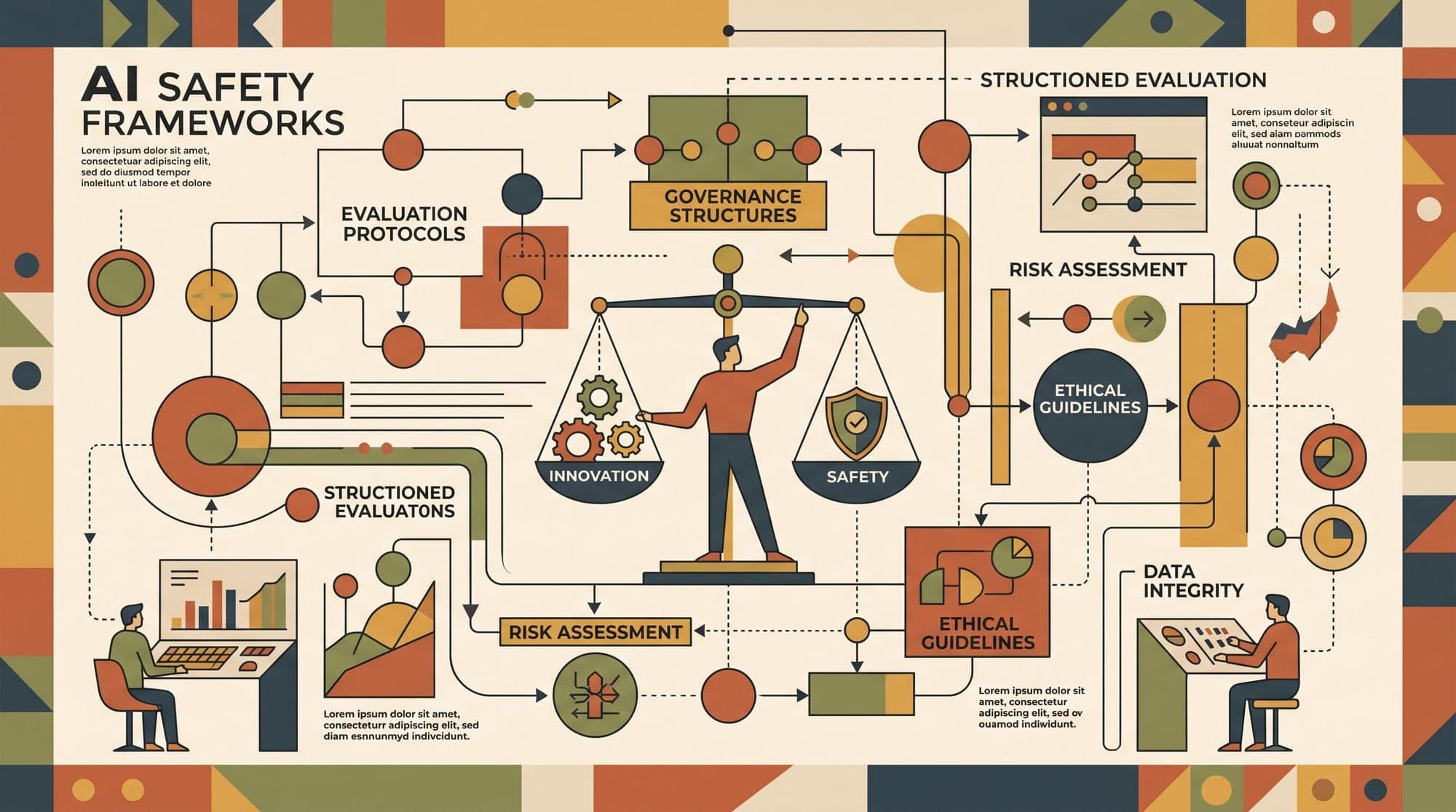
OpenAI risk evaluation and organizational safety distribution

Evolution of Safety Governance at OpenAI

The dissolution of the Preparedness team represents the latest phase in OpenAI's shift away from centralized, research-oriented safety groups toward product-integrated compliance.

  1. Superalignment Dissolution (May 2024): The 20% compute-dedicated long-term alignment team co-led by Ilya Sutskever and Jan Leike was dissolved following key resignations.
  2. AGI Readiness Reorganization: Long-term existential risk research units were gradually folded into operational divisions.
  3. Preparedness Redistribution (July-August 2026): Threat modeling for cyber and biosecurity is now handled as part of standard pre-deployment validation pipelines within product lines.

The operational consolidation comes as OpenAI streamlines its corporate structure and commercial operations ahead of an anticipated initial public offering.


Sources

Written by

More to read

  • Tensor Parallelism in Large Language Models: How Megatron-LM Partitions Multi-Layer Perceptrons and Attention Heads

    Tensor Parallelism in Large Language Models: How Megatron-LM Partitions Multi-Layer Perceptrons and Attention Heads Training and serving modern large language models requires navigating severe hardware memory and compute constraints. While standard Distributed Data Parallelism (DDP) replicates the entire model across multiple accelerators, modern frontier architectures containing tens or hundreds of billions of parameters exceed the physical memory capacity of any single GPU. Even with 80 GB o

    1 min
  • Local LLM Inference on Apple Silicon: Architecture, Unified Memory, and Serving Benchmarks for MLX, llama.cpp, and Ollama

    Local large language model (LLM) serving on consumer hardware has historically faced a hard trade-off between memory capacity and execution bandwidth. Discrete consumer GPUs offer high memory bandwidth (up to 1,008 GB/s on an Nvidia RTX 4090) but are capped at 24 GB of VRAM, requiring model sharding or quantization to fit models beyond 14 billion parameters. Apple Silicon platforms bypass this capacity ceiling through a Unified Memory Architecture (UMA), where the CPU, GPU, and Apple Neural Eng

    1 min
  • Mistral Expands Platform to Host Third-Party Open Weights Starting with GLM-5.2

    Mistral AI has broadened its API platform to host external open-weight foundation models, beginning with Zhipu AI's GLM-5.2. The move marks a strategic shift for the Paris-based AI company from serving only in-house architectures (such as Mistral Small, Mistral Medium, Mistral Large, and Voxtral) toward operating as a sovereign managed inference hub for third-party open weights. The integration introduces GLM-5.2 under the model identifier zai-glm-5-2 in public preview. The model is hosted with

    1 min

