
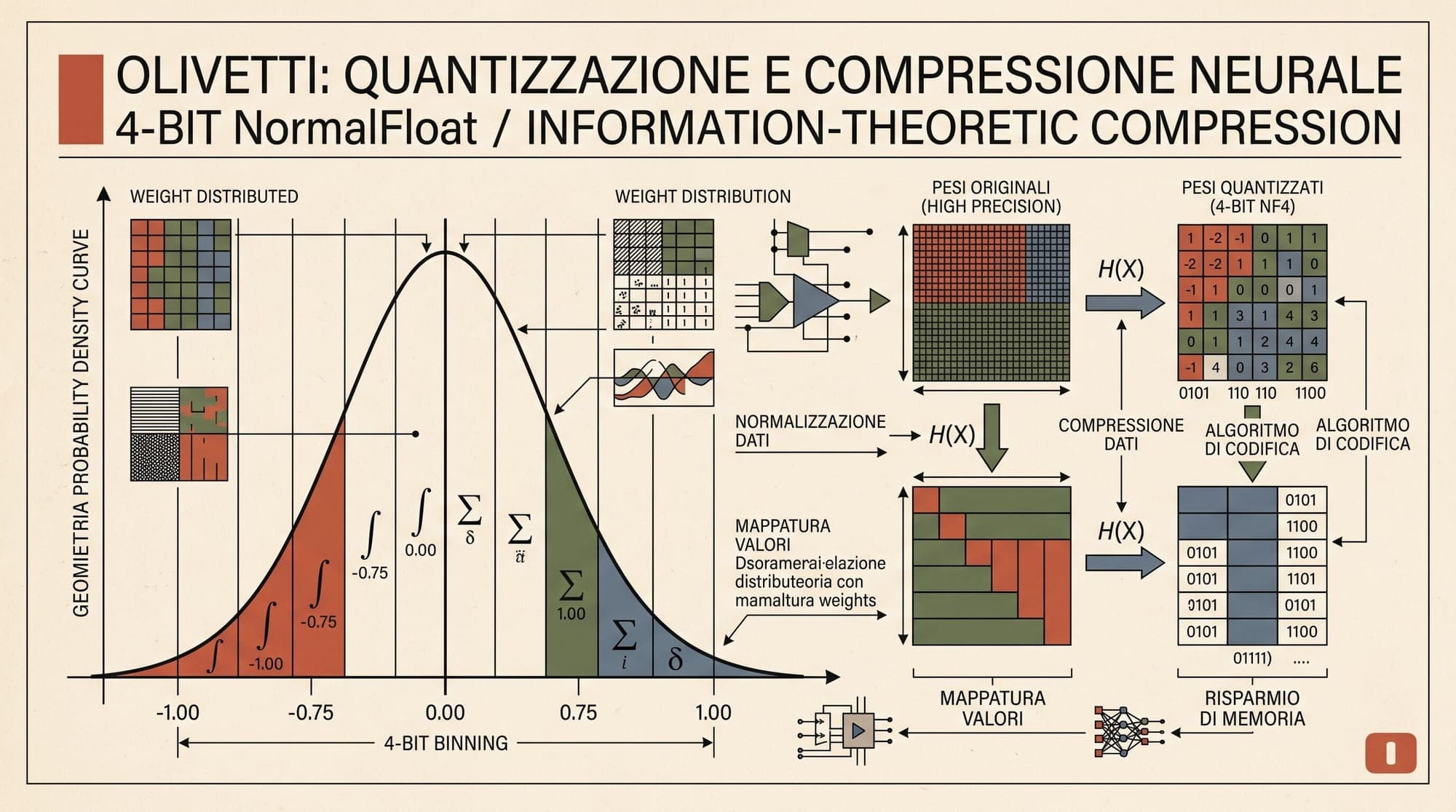
Fine-tuning large language models under full 16-bit precision is governed by strict memory scaling laws. For a standard 65-billion parameter transformer model, storing weights in 16-bit BrainFloat (BF16) or Float16 (FP16) requires 130 GB of GPU memory. During training with standard first-order adaptive optimizers such as AdamW, each parameter requires an additional 2 bytes for gradients and 8 bytes for FP32 optimizer states (4 bytes for first-moment momentum and 4 bytes for second-moment variance). When combined with activation memory and gradient checkpointing buffers, full-parameter fine-tuning of a 65B model exceeds 780 GB of high-bandwidth memory (VRAM), necessitating multi-node GPU clusters.
Parameter-Efficient Fine-Tuning (PEFT) methods, particularly Low-Rank Adaptation (Hu et al., 2021), drastically reduce optimizer and gradient footprints by freezing the base model weights and training small low-rank adapter matrices. However, standard LoRA still maintains the base model in 16-bit precision, keeping the baseline weight memory fixed at 130 GB for a 65B model and preventing single-GPU fine-tuning on standard 24 GB or 48 GB hardware.
QLoRA (Dettmers et al., 2023) introduced a framework that compresses base model weights to 4-bit precision while preserving full 16-bit task performance during backpropagation. This capability relies on three core mathematical and architectural mechanisms: 4-bit NormalFloat (NF4), Double Quantization (DQ), and Paged Optimizers.
The Information-Theoretic Foundations of NormalFloat (NF4)
Standard post-training quantization techniques typically discretize continuous parameters into uniform integer grids (such as INT4) or standard IEEE floating-point representations (such as FP4 with explicit exponent and mantissa bits). While functional for 8-bit representations, uniform and standard floating-point grids exhibit severe degradation at 4-bit precision.
Weight Distribution and the Quantile Principle
Pretrained neural network parameters do not follow a uniform distribution across their dynamic range. Statistical testing across Transformer architectures confirms that pretrained weight tensors follow zero-centered normal distributions with layer-dependent standard deviations:
Shapiro-Wilk normality tests on foundational models demonstrate that the overwhelming majority of hidden unit weight distributions fit Gaussian profiles.
In information theory, quantizing a continuous random variable into discrete bins with minimal information loss requires maximizing the entropy of the quantized representation. Shannon entropy is maximized when each discrete bin has an identical probability mass under the data distribution:
When applied to arbitrary data distributions, this principle is known as Quantile Quantization. While exact empirical quantile estimation requires computing empirical cumulative distribution functions across every weight block (an operation with high computational complexity and vulnerability to outlier distortions), the fixed Gaussian property of pretrained neural weights allows computing an analytical quantile grid offline.
Failures of Uniform INT4 and Floating-Point FP4
The limitations of alternative 4-bit representations stem directly from bin allocation:
- Uniform INT4 Quantization: Divides the bounding interval into equally spaced steps. Because the tails of a Gaussian distribution contain sparse data, uniform grids allocate excess discrete quantization levels to low-probability extremes while providing insufficient resolution in the dense region near zero, where most parameters reside.
- Floating-Point FP4 (E2M1 and E3M0): Allocates bits between sign, exponent, and mantissa. While standard floating-point formats provide non-linear spacing that concentrates points near zero, their discrete levels do not match the exact theoretical quantiles of a normal distribution. In empirical evaluations across the Pile benchmark, standard FP4 (E2M1) exhibits higher perplexity than optimal quantile-derived formats.
Analytical Derivation of the NF4 Quantile Grid
To construct the -bit NormalFloat data type for a standard normal distribution normalized to the arbitrary range , the theoretical quantiles are computed using the inverse cumulative distribution function (quantile function) :
For symmetric quantization, this formulation encounters a critical boundary condition: standard symmetric quantile division does not contain an exact representation for the value zero. In deep learning architectures, an exact discrete zero point is essential for representing zero-padded sequences, unactivated ReLU/SwiGLU units, and sparse parameters without numerical drift.
To resolve this, QLoRA constructs an asymmetric data type by estimating quantiles across two separate intervals:
- quantiles for the negative interval
- quantiles for the positive interval
The two sets are unified, and the redundant zero entry is merged, yielding exactly discrete levels for . The resulting 16 normalized values of the NF4 data type are:
- Bin 0:
-1.00000000 - Bin 1:
-0.69619280 - Bin 2:
-0.52507305 - Bin 3:
-0.39491749 - Bin 4:
-0.28444138 - Bin 5:
-0.18477343 - Bin 6:
-0.09105004 - Bin 7:
0.00000000 - Bin 8:
0.07958030 - Bin 9:
0.16093020 - Bin 10:
0.24611230 - Bin 11:
0.33791524 - Bin 12:
0.44070983 - Bin 13:
0.56261700 - Bin 14:
0.72295684 - Bin 15:
1.00000000
Every weight tensor block is quantized by computing its absolute maximum value , normalizing the tensor elements into , and mapping each normalized float to the nearest discrete index in the NF4 table.
Double Quantization (DQ): Compressing the Scale Factors
To maintain high precision during 4-bit quantization and prevent localized weight outliers from degrading entire parameter matrices, models are quantized in small discrete blocks rather than per-tensor or per-channel.

The Block Size Overhead Dilemma
A block size of parameters provides strong numerical stability. However, each block requires storing an independent 32-bit floating-point scaling constant . Storing a 32-bit constant for every 64 weights adds a substantial memory footprint:
This scaling constant overhead increases the effective bit-width of a 4-bit quantized model from 4.0 bits to 4.5 bits per parameter, adding gigabytes of memory consumption across large model architectures.
Two-Level Hierarchical Quantization
Double Quantization treats the first-level scaling constants as input tensors for a secondary quantization step:
- First Quantization Level: Base weights are partitioned into blocks of size . For each block, an FP32 absolute maximum scale is computed.
- Mean-Centering: Because absolute maximum values are strictly non-negative (), their empirical distribution has a positive non-zero mean. The mean is subtracted prior to secondary quantization to center the scale distribution around zero:
- Second Quantization Level: The centered scales are grouped into larger secondary blocks of size and quantized into 8-bit Float (FP8) representations (), using a second-level 32-bit scaling factor :
Exact Memory Footprint Reduction
Under Double Quantization, storing the quantized scaling factors requires:
- 8 bits for each first-level scale (shared across parameters)
- 32 bits for each second-level scale (shared across parameters)
- 32 bits for the global mean offset (amortized across the layer)
The resulting memory overhead per parameter is calculated as:
Double Quantization slashes the scaling overhead from bits/parameter to bits/parameter, achieving a net reduction of bits per parameter. For a 65-billion parameter model, this reduction frees approximately 3.03 GB of GPU memory without altering the numerical precision of the underlying dequantized weights.
Dual Data Types and Dequantization GEMM Mechanics
QLoRA operates through a strict separation between its storage data type and its computation data type.
+-------------------------------------------------------------------+
|                        VRAM Storage (NF4)                         |
|  [4-bit Packed Weights] + [8-bit Quantized Scales] + [FP32 Scale] |
+-------------------------------------------------------------------+
                                  |
                   (On-the-fly register dequantization)
                                  v
+-------------------------------------------------------------------+
|                       SRAM / Registers (BF16)                     |
|                   Dequantized Base Weights W_BF16                 |
+-------------------------------------------------------------------+
                                  |
              +-------------------+-------------------+
              |                                       |
              v                                       v
    [Base Forward GEMM]                     [LoRA Forward GEMM]
    Y_base = X_BF16 * W_BF16                Y_lora = s * X * L1 * L2
              |                                       |
              +-------------------+-------------------+
                                  |
                                  v
+-------------------------------------------------------------------+
|                    Combined Layer Output (BF16)                   |
|                      Y = Y_base + Y_lora                          |
+-------------------------------------------------------------------+
Forward Pass Execution
Base model weights remain stored in VRAM as 4-bit NF4 integers alongside their hierarchical FP8 and FP32 quantization constants. During a forward linear projection :
- Input activation tensors are loaded in 16-bit BFloat16 precision.
- The custom CUDA dequantization kernel loads 4-bit packed NF4 weights into GPU shared memory and registers.
- The weights are dequantized on the fly into temporary 16-bit BFloat16 matrices using the nested dequantization function:
- Tensor Core GEMM operations execute in full BF16 precision:
Where and represent the low-rank adapter matrices with rank , and is the LoRA scaling hyperparameter .
Gradient Flow and Backward Pass Routing
During the backward pass, gradients are computed with respect to the loss function :
- Gradients with respect to activations are computed by multiplying incoming upstream gradients with the dequantized weights , ensuring unhindered backpropagation through deep network layers.
- Weight gradients for the 4-bit base model are never computed or stored, saving massive gradient memory buffers.
- Adapter gradients and are computed in 16-bit precision and passed to the optimizer.
Paged Optimizers and CUDA Unified Memory
Even when model weights and optimizer states are compressed, LLM fine-tuning remains susceptible to transient out-of-memory (OOM) failures. These spikes occur during gradient checkpointing when processing long context windows or mini-batches with extreme token lengths.
QLoRA addresses this through Paged Optimizers, which leverage CUDA Unified Memory primitives:
- Virtual Memory Allocation: Optimizer state tensors for the LoRA adapter parameters are allocated within pageable unified memory address spaces (
cudaMallocManaged). - Demand Paging and Page Eviction: When GPU physical VRAM reaches capacity during activation recomputation peaks, the NVIDIA driver automatically evicts dormant optimizer state pages over PCIe to host CPU system memory.
- Pre-Fetching on Update: Once the backward pass completes and the parameter update phase begins, evicted optimizer pages are paged back into GPU memory to execute the gradient update step.
Because optimizer state access occurs sequentially during parameter updates rather than continuously during GEMM execution, paging delays introduce near-zero training throughput overhead while preventing fatal OOM exceptions.
All-Linear Adapter Placement
In early parameter-efficient fine-tuning literature, LoRA adapters were predominantly attached only to multi-head attention query and value projection matrices ( and ).
Empirical research in the QLoRA study demonstrated that when base model weights are quantized to 4-bit, restricting adapter placement to and causes significant performance degradation compared to 16-bit full fine-tuning baselines.
Transformer Block Linear Layer Coverage in QLoRA:
├── Multi-Head Attention Sub-Layer
│   ├── Query Projection (W_q)       --> 4-bit NF4 Base + 16-bit LoRA
│   ├── Key Projection (W_k)         --> 4-bit NF4 Base + 16-bit LoRA
│   ├── Value Projection (W_v)       --> 4-bit NF4 Base + 16-bit LoRA
│   └── Output Projection (W_o)      --> 4-bit NF4 Base + 16-bit LoRA
└── SwiGLU Feed-Forward Sub-Layer
    ├── Gate Projection (W_gate)     --> 4-bit NF4 Base + 16-bit LoRA
    ├── Up Projection (W_up)         --> 4-bit NF4 Base + 16-bit LoRA
    └── Down Projection (W_down)     --> 4-bit NF4 Base + 16-bit LoRA
Because 4-bit quantization reduces the precision of the frozen representations across all layers, the model requires additional degrees of freedom across its feed-forward networks (FFN) and key/output projections to recover full representational capacity.
Applying LoRA across all linear layers () fully closes the gap to 16-bit baselines. Because adapter parameters scale with rank ( per matrix) rather than full dimension (), expanding adapter coverage across all seven linear projections increases total trainable parameter counts by only a fraction of a percent (typically from 0.1% to 0.4% of base parameters), adding negligible VRAM overhead while restoring full task performance.
Empirical Comparisons and Trade-Offs
Empirical evaluations across language modeling benchmarks demonstrate the precision benefits of information-theoretic quantization.
Perplexity and Zero-Shot Benchmarks
On the Pile Common Crawl benchmark evaluated across OPT, BLOOM, Pythia, and LLaMA architectures (ranging from 125M to 65B parameters), NF4 consistently outperforms uniform and floating-point alternatives:
- 4-bit Integer (INT4): Mean Perplexity of 34.34
- 4-bit Floating-Point FP4 (E2M1): Mean Perplexity of 31.07
- 4-bit Floating-Point FP4 (E3M0): Mean Perplexity of 29.48
- 4-bit NormalFloat (NF4 + DQ): Mean Perplexity of 27.41
On downstream evaluation suites including MMLU, Winogrande, ARC-Challenge, and HellaSwag, QLoRA models finetuned on instruction datasets (such as Guanaco 33B and 65B) match or exceed the performance of models fine-tuned in full 16-bit precision.
Operational Trade-Offs
Deploying QLoRA introduces specific engineering trade-offs:
- Training vs. Inference Latency: QLoRA optimizes memory footprint for fine-tuning. Because weights must be dynamically dequantized to BF16 in registers during each forward pass, training throughput is slightly slower (approximately 20% to 30% compute overhead) compared to unquantized 16-bit LoRA running on clusters with unbounded VRAM.
- Adapter Merging for Serving: After fine-tuning completes, adapter weights can be explicitly dequantized and merged with the base model weights into FP16/BF16 checkpoints for low-latency production serving, or quantized into inference-optimized formats like AWQ, GPTQ, or Marlin kernels.
- Hardware Compatibility: NF4 kernels require CUDA compute capability 7.0 or higher (Volta, Turing, Ampere, Ada Lovelace, and Hopper architectures). BF16 computation requires Ampere or newer GPUs (RTX 30xx/40xx, A100, H100); on older Turing hardware (T4, RTX 2080), computation falls back to FP16.
By formulating weight quantization as an information-theoretic optimization problem and eliminating scale constant overhead, NormalFloat4 and Double Quantization established that high-fidelity language model training does not require continuous 16-bit precision across base parameters.
Sources
- QLoRA: Efficient Finetuning of Quantized LLMs (Dettmers et al., 2023)
- LoRA: Low-Rank Adaptation of Large Language Models (Hu et al., 2021)
- LLM.int8(): 8-bit Matrix Multiplication for Transformers at Scale (Dettmers et al., 2022)
- bitsandbytes: 8-bit and 4-bit Quantization Library for PyTorch
- Hugging Face PEFT: Parameter-Efficient Fine-Tuning Documentation



