
When Vaswani et al. introduced the Transformer architecture in 2017, scaled dot-product self-attention was presented primarily as a pragmatic computational mechanism: an efficient, highly parallelizable alternative to recurrence and convolutions. By computing pairwise inner products between queries and keys, normalizing via softmax, and taking a weighted sum of values, attention allowed models to route information dynamically across arbitrarily distant tokens.
For several years, self-attention was treated largely as an empirical design choice. In 2020, research led by Hubert Ramsauer, Sepp Hochreiter, and collaborators established a rigorous physical and mathematical foundation for the mechanism in their paper Hopfield Networks is All You Need. They proved that standard scaled dot-product attention is mathematically identical to the state update rule of a continuous Modern Hopfield Network operating on an energy landscape.
This finding resolved a fundamental theoretical question: self-attention is not merely an intuitive routing heuristic. It is a single-step descent on a well-defined Lyapunov energy function that exhibits exponential memory capacity, single-step convergence guarantees, and bounded retrieval error.
1. Classical Hopfield Networks and the Linear Capacity Ceiling
To understand Modern Hopfield Networks, one must first examine the limitations of the classical associative memory model introduced by John Hopfield in 1982.
A classical Hopfield network is a recurrent, fully connected network of binary threshold units where each state vector belongs to . The network stores a set of discrete pattern vectors inside a symmetric interaction matrix .
Under classical Hebbian learning, the synaptic weight matrix is constructed by the sum of outer products of the stored patterns:
where is the identity matrix to ensure zero self-connections ().
The dynamics of the system are governed by a scalar energy function (equivalent to the Hamiltonian of an Ising spin glass model in statistical physics):
The network operates via asynchronous or synchronous threshold updates:
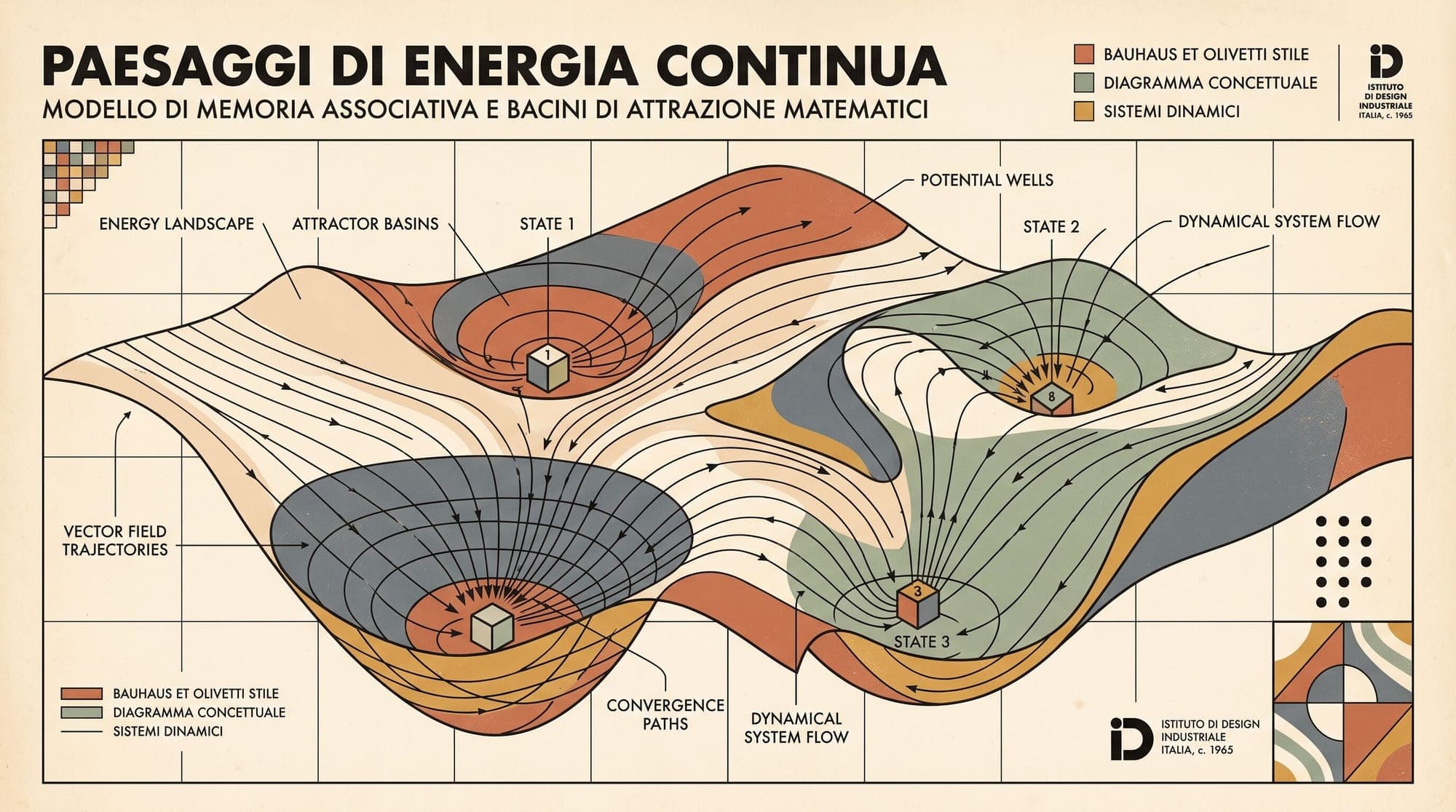
Because the energy is monotonically non-increasing under these updates and bounded from below, the state space trajectory is guaranteed to converge to a local energy minimum (an attractor basin). When presented with a noisy or incomplete query vector , the network rolls downhill into the nearest attractor, reconstructing the original memory pattern.

The Linear Capacity Limit
Despite its mathematical elegance, the classical Hopfield network suffered from a severe limitation that prevented its scaling: catastrophic memory interference.
In 1985, Amit, Gutfreund, and Sompolinsky established the theoretical storage capacity bound (the AGS bound) for classical binary Hopfield networks:
If the number of stored patterns exceeds approximately 14% of the feature dimension , the energy basins of individual memories begin to overlap and interfere destructively. Spurious local minima (chimera states that are linear combinations or random corruptions of stored patterns) proliferate across the energy landscape. When queried, the network gets trapped in these spurious minima rather than recalling any true stored pattern.
For decades, this capacity ceiling constrained Hopfield networks to toy problems. Storing thousands of high-dimensional vectors required impractically large state dimensions.
2. Dense Associative Memory: Non-Bilinear Energy Functions
The breakthrough that unlocked exponential storage capacity occurred in 2016 when Dmitry Krotov and John Hopfield introduced Dense Associative Memory (often called Modern Hopfield Networks).
Krotov and Hopfield realized that the classical capacity limit stemmed directly from the quadratic interaction terms in the energy function (), which only model pairwise correlations between neurons. By replacing the quadratic matrix interaction with higher-order polynomial or non-polynomial potential functions , the energy function could be generalized to:
where is the dot product between the state vector and the -th stored pattern.
In 2017, Demircigil et al. extended this framework by choosing an exponential interaction function:
Yielding the exponential energy function:
By introducing exponential sharpness, the energy landscape around each stored pattern drops dramatically into an ultra-deep, steep potential well. Demircigil et al. proved that under this exponential potential, the maximum storage capacity scales exponentially with dimension:
Rather than being limited to memories, a network with state dimension could theoretically store billions of distinct patterns without spurious overlap.
3. Continuous Modern Hopfield Networks and the Attention Equivalence
While Krotov, Hopfield, and Demircigil demonstrated exponential capacity in discrete binary states, modern deep learning architectures operate in continuous vector spaces .
In 2020, Ramsauer et al. formulated the continuous version of Modern Hopfield Networks. They defined a continuous state vector and a memory matrix containing continuous stored patterns.
The Continuous Energy Function
Ramsauer et al. defined the energy function for continuous states using the Log-Sum-Exp (LSE) operator:
where:
- $\text{lse}(\beta, v) = \beta^{-1} \ln \left( \sum_{i=1}^N \exp(\beta v_i) \right)$ is the smoothed soft-maximum function.
- is the inverse temperature parameter (scaling factor).
- is the quadratic regularization term that bounds the continuous state magnitude.
- is the maximum norm among stored patterns, ensuring that energy remains strictly positive and bounded.
Deriving the Update Rule via the Concave-Convex Procedure (CCCP)
To minimize over continuous space, standard gradient descent can be applied. However, Ramsauer et al. showed that the Concave-Convex Procedure (CCCP), a majorization-minimization algorithm that splits the energy into convex and concave components, yields a discrete-time update rule with guaranteed monotonic energy decrease:
where and .
Setting the gradient of the next state equal to the negative gradient of the current state :
Evaluating the gradients yields:
The Direct Mapping to Transformer Self-Attention
Expanding this vector equation reveals the exact mathematical equivalence to transformer attention:
- Let the current state vector correspond to a projected query vector .
- Let the stored pattern matrix correspond to the projected key matrix .
- Set the inverse temperature scaling parameter .
- Map the memory matrix across the output projection to values .
The Hopfield state update produces:
This proves that a single forward pass through a scaled dot-product attention head is identical to one synchronous retrieval step of a continuous Modern Hopfield Network.
Standard Transformer Attention:
Query (Q) ──────┐
                ├──> Dot-Product ──> Scale (1/√d) ──> Softmax ──> Multiply (V) ──> Output
Keys (K)  ──────┘

Continuous Modern Hopfield Update:
State (ξ) ──────┐
                ├──> Projection (X ξ) ──> Scale (β) ──> Softmax ──> Memory (Xᵀ) ──> Next State (ξ⁺)
Patterns (X) ───┘
4. The Three Fundamental Theorems of Modern Hopfield Retrieval
The theoretical mapping between attention and continuous Hopfield networks allowed Ramsauer et al. to prove three core properties that explain why transformer attention behaves with such high empirical stability:
Theorem 1: Exponential Storage Capacity in Continuous Space
For a continuous Modern Hopfield Network with state dimension , inverse temperature , and minimum separation between stored normalized patterns (), the number of patterns that can be stored and reliably retrieved scales exponentially with dimension:
where and are constants depending on the pattern separation and sphere radius.
In a transformer block where or , the associative capacity of the attention mechanism over the sequence context is astronomically larger than the sequence lengths encountered in practical LLM serving.
Theorem 2: Single-Step Convergence
In classical Hopfield networks, converging to a stable attractor requires multiple iterative asynchronous updates ().
Ramsauer et al. proved that under standard conditions where stored patterns are well-separated and the scaling factor satisfies:
the state update converges to the vicinity of a fixed point in a single iteration (). Subsequent iterations produce exponentially vanishing adjustments:
This single-step convergence theorem provides the theoretical justification for why non-recurrent Transformer feedforward layers can process context in a single pass without needing recurrent relaxation loops.
Theorem 3: Exponentially Small Retrieval Error
When a query lies within the basin of attraction of a specific stored pattern , the distance between the retrieved state and the true pattern decays exponentially:
As the inverse temperature increases or as key-query alignment improves, the retrieval error approaches zero.
5. The Energy Landscape: Fixed Points and Phase Transitions
A critical insight provided by the energy formulation is the classification of fixed points. The continuous energy function exhibits three distinct operational regimes depending on the temperature parameter and the geometric distribution of patterns:
Low β (High Temperature):             Intermediate β:                     High β (Low Temperature):
Flat Basin                            Metastable Saddle Wells             Deep Isolated Basins
┌──────────────────────────────┐     ┌──────────────────────────────┐    ┌──────────────────────────────┐
│                              │     │       __            __       │    │  │\        /│        │\      │
│     \                  /     │     │      /  \          /  \      │    │  │ \      / │        │ \     │
│      \________________/      │     │  \__/    \________/    \__/  │    │  │  \____/  │        │  \____│
│                              │     │                              │    │  │          │        │       │
│     Uniform Average          │     │    Context Superposition     │    │  │ Isolated Memory Recall    │
└──────────────────────────────┘     └──────────────────────────────┘    └──────────────────────────────┘
1. Global Average Fixed Point (Uniform Softmax)
When (or when inner products are nearly identical), the softmax distribution approaches uniform weights (). The energy landscape possesses a single broad global minimum at the center of mass of the dataset:
In transformer language models, this corresponds to uniform attention distribution, where an attention head gathers unweighted global context across all tokens.
2. Metastable Mixed States (Context Integration / Superposition)
When multiple stored patterns share high cosine similarity with the query (e.g. semantic clusters of related tokens), the energy landscape forms shallow metastable valleys that represent convex combinations of multiple memories:
This explains how self-attention constructs rich contextual token representations. Rather than strictly retrieving a single token, attention forms a semantic superposition that combines syntactic, relational, and domain features from multiple context positions simultaneously.
3. Isolated Point Attractors (Exact Associative Retrieval)
When is sufficiently high and a query aligns strongly with a specific pattern , the energy landscape forms a steep, deep well around . The softmax assigns near-unity weight to that single entry, and the network executes precise associative memory recall.
This state corresponds to sharp attention heads, such as induction heads copying previous tokens or copy-paste retrieval in long-context lookup tasks.
6. Architectural Implications for LLMs and Beyond
Reframing transformer attention as an energy-based modern Hopfield update provides several concrete insights for model architecture and interpretability:
Why Attention Scaling () Matters
In standard self-attention, dot products scale with the hidden dimension . If dot products grow unchecked, becomes very large, driving the softmax into extreme saturation where gradients vanish. Conversely, if dot products are too small, falls below the critical threshold required for pattern separation, collapsing the energy landscape into a single global average.
The standard scaling factor balances the system precisely at the phase boundary between sharp isolated retrieval and flexible context superposition.
In-Context Learning and Memory Retrieval
In-context learning can be interpreted through the lens of continuous Hopfield dynamics: the prompt tokens form a dynamic memory matrix written into the activation space. As later tokens pass through attention layers, they query this transient memory matrix, descending into attractor basins created by earlier definitions, demonstrations, and instructions.
Hopfield Layers Beyond Standard Transformers
The formulation of continuous Modern Hopfield Networks led to the development of dedicated Hopfield layers (Hopfield, HopfieldPooling, HopfieldLayer) that have been successfully deployed in non-NLP domains:
- Tabular Data: Using stored reference patterns to model complex feature correlations without tree-based ensembles.
- Immunology and Structural Biology: Predicting TCR-epitope binding by matching variable-length amino acid sequences against continuous memory banks of known immune receptors.
- Reinforcement Learning: Associative episodic memory buffers that retrieve historical trajectory states based on continuous environmental cues.
Summary
The equivalence established by Ramsauer et al. bridges statistical physics, classical neural network theory, and modern transformer architectures:
- Classical binary Hopfield networks were constrained by quadratic energy functions to a linear capacity ceiling of .
- Modern Hopfield networks introduced exponential energy potentials, expanding storage capacity to (discrete) and (continuous).
- Continuous Modern Hopfield energy minimization via the Concave-Convex Procedure directly derives the scaled dot-product attention equation: .
- Scaled dot-product attention is an exact single-step associative memory lookup on a continuous energy landscape, explaining why transformers can perform both sharp information retrieval and multi-token semantic superposition within a single feedforward pass.
Sources
- Ramsauer, H., Schäfl, B., Lehner, J., Seidl, P., Widrich, M., Adler, T., Gruber, L., Holzleitner, M., Pavlović, M., Sandve, G. K., Greiff, V., Kreil, D., Kopp, M., Klambauer, G., Brandstetter, J., & Hochreiter, S. (2020). Hopfield Networks is All You Need. arXiv:2008.02217
- Hopfield, J. J. (1982). Neural networks and physical systems with emergent collective computational abilities. Proceedings of the National Academy of Sciences, 79(8), 2554-2558.
- Krotov, D., & Hopfield, J. J. (2016). Dense Associative Memory for Pattern Recognition. arXiv:1606.01164 / Advances in Neural Information Processing Systems 29 (NeurIPS 2016).
- Demircigil, M., Heubeck, J., Franco, P., & Sompolinsky, H. (2017). On a Model of Associative Memory with Huge Storage Capacity. Journal of Statistical Physics, 168(2), 288-299.
- Amit, D. J., Gutfreund, H., & Sompolinsky, H. (1985). Storing Infinite Numbers of Patterns in a Spin-Glass Model of Neural Networks. Physical Review Letters, 55(14), 1530-1533.
- Vaswani, A., Shazeer, N., Parmar, N., Uszkoreit, J., Jones, L., Gomez, A. N., Kaiser, Ł., & Polosukhin, I. (2017). Attention Is All You Need. arXiv:1706.03762 / Advances in Neural Information Processing Systems 30 (NeurIPS 2017).



