
Low-Rank Adaptation (LoRA) and QLoRA: Parameter-Efficient Fine-Tuning, Matrix Decomposition, and 4-Bit Quantization
Training a large language model from scratch requires massive compute. Adapting a pre-trained model to a downstream task through full fine-tuning requires storing optimizer states, gradients, and activations for every parameter — often multiple terabytes for a 70B model. Low-Rank Adaptation (LoRA) and its quantized successor QLoRA changed that calculus: they make task-specific adaptation feasible on a single GPU by freezing the base model and training only a tiny fraction of injected parameters.
1. The Low-Rank Hypothesis
The foundational observation behind LoRA comes from Aghajanyan et al. (2021) Intrinsic Dimensionality Explains the Effectiveness of Language Model Fine-Tuning. They showed that pre-trained language models reside on a low intrinsic dimension: the minimal number of parameters needed to describe a task-specific solution is orders of magnitude smaller than the full parameter count. Hu et al. (2021) LoRA: Low-Rank Adaptation of Large Language Models hypothesized that the weight updates during adaptation also have low intrinsic rank.
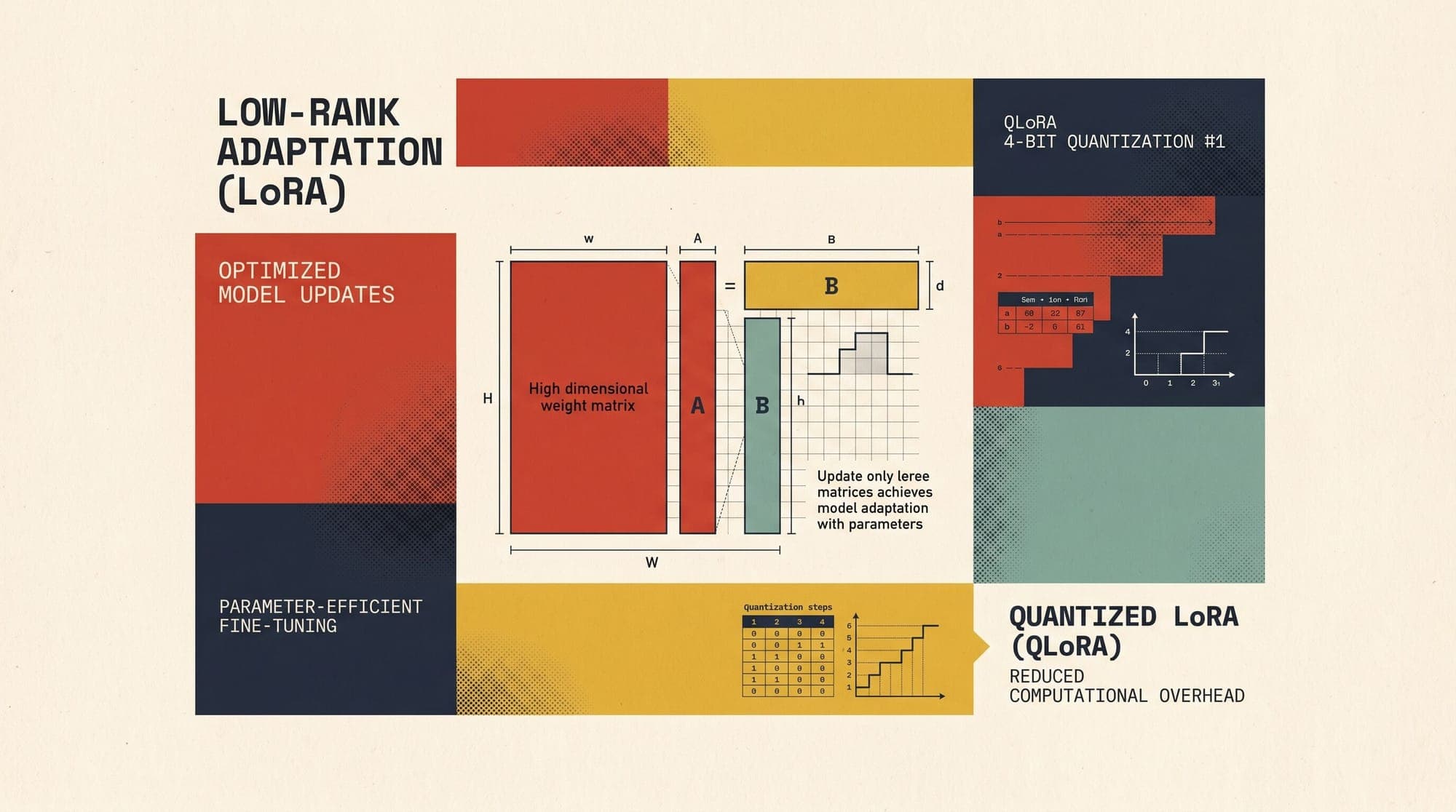
For a pre-trained weight matrix W₀ ∈ ℝ^{d×k}, full fine-tuning learns a dense update ΔW ∈ ℝ^{d×k}. LoRA constrains this update to a low-rank factorization:
ΔW = B A
where B ∈ ℝ^{d×r}, A ∈ ℝ^{r×k}, and r ≪ min(d, k). During training W₀ remains frozen; only A and B receive gradients. The forward pass becomes:
h = W₀ x + (α/r) B A x
The scaling factor α/r (with hyperparameter α, typically 16 or 32) controls the magnitude of the adapter contribution relative to the frozen base. A is initialized with Kaiming-uniform; B is initialized to zero so the adapter starts as an identity perturbation.
2. Parameter and Memory Savings
Consider a 7B parameter model with 32 transformer layers, each containing attention projections (Q, K, V, O) and MLP up/down projections of dimension 4096. Applying LoRA with rank r = 8 to all linear layers adds roughly 0.8M trainable parameters — about 0.01% of the base model. Memory for optimizer states (AdamW: 2×fp32 per parameter) drops from ~56 GB to ~6 MB. Activation memory is unchanged because the base model runs in inference mode; only the tiny adapter matrices require gradient checkpointing.
| Configuration | Trainable Params | Optimizer States (AdamW) | VRAM (7B, fp16 base) | |---------------|------------------|--------------------------|----------------------| | Full FT | 7.0B | 56 GB | ~80 GB (multi-GPU) | | LoRA (r=8) | 0.8M | 6 MB | ~14 GB (1×A100) | | QLoRA (r=8) | 0.8M | 6 MB | ~6 GB (1×RTX 3090) |
3. QLoRA: 4-Bit NormalFloat and Double Quantization
LoRA still requires loading the full fp16/bf16 base model into GPU memory. Dettmers et al. (2023) QLoRA: Efficient Finetuning of Quantized LLMs asked: can we quantize the frozen base model to 4-bit without degrading adapter training?
3.1 NormalFloat (NF4) Data Type
Standard 4-bit floats (FP4) use uniform spacing between quantization levels. Neural network weights, however, follow an approximately normal distribution — most values cluster near zero with long tails. NF4 constructs 16 quantization levels at the quantiles of a standard normal distribution 𝒩(0, 1). This allocates more levels where the density is high and fewer in the tails, minimizing expected quantization error for normally distributed weights.
The NF4 values (scaled to [-1, 1]) are:
[-1.0, -0.696, -0.525, -0.395, -0.284, -0.185, -0.091, 0.0,
 0.079, 0.161, 0.246, 0.338, 0.441, 0.562, 0.723, 1.0]
During inference, each 4-bit weight block is dequantized on the fly: w = c · q, where q is the NF4 index and c is a per-block fp32 scaling constant (quantization constant).
3.2 Double Quantization
The per-block scaling constants c (fp32, one per 64 weights) add ~0.5 bits/parameter overhead. Double Quantization quantizes these constants a second time using 8-bit floats (E5M2) with a block size of 256 constants. Since the constants are positive, their mean is subtracted before quantization to center the distribution. This reduces the quantization constant footprint from 0.5 bits/param to ~0.125 bits/param — a 4× reduction — with no measurable degradation on benchmarks.
3.3 Paged Optimizers
Gradient checkpointing and optimizer state updates can cause memory spikes. QLoRA uses NVIDIA's paged optimizer (via bitsandbytes): optimizer states are kept in CPU memory and paged to GPU only for the active parameter blocks during each step. This avoids OOM on consumer GPUs with 24 GB VRAM.
4. LoRA Variants and Extensions
Since 2021, dozens of LoRA variants have addressed its limitations:
| Variant | Core Idea | Key Reference | |---------|-----------|---------------| | AdaLoRA | SVD-based parameterization PΛQᵀ with learnable singular values Λ; importance-aware rank pruning during training | Zhang et al. (2023) arXiv:2303.10512 | | LoRA+ | Asymmetric learning rates: higher LR for A (input-side) than B (output-side) to stabilize gradient norms across ranks | Hayou et al. (2024) arXiv:2402.12354 | | rsLoRA | Rank-stabilized scaling: divide adapter output by √r instead of α/r, yielding rank-invariant gradient norms | Kalajdzievski (2024) arXiv:2312.03732 | | DoRA | Weight-decomposed adaptation: reparameterize W = m · (W/‖W‖), apply LoRA only to the direction component, learn magnitude m separately | Liu et al. (2024) arXiv:2402.09353 | | DyLoRA | Dynamic rank: train a single adapter with nested low-rank structure; at inference, truncate to any r' ≤ r | Valipour et al. (2022) arXiv:2210.07558 |
5. Inference: Merging and Zero-Latency Deployment
A key practical advantage of LoRA: at inference, the adapter can be merged into the base weights:
W_merged = W₀ + (α/r) B A
This is a single matrix add. The merged model has identical latency to the original — no adapter forward pass, no extra kernels. For multi-tenant serving, multiple task-specific LoRA adapters can share the same frozen base model in memory; only the tiny A/B matrices are swapped per request (dynamic LoRA loading, supported by llama.cpp, vLLM, TGII).
6. When LoRA Falls Short
- Continual learning: LoRA adapters trained sequentially on Task A then Task B suffer catastrophic forgetting unless rehearsal or orthogonal gradient projection is used.
- Large distribution shift: If the downstream domain is far from pre-training (e.g., code → protein sequences), low-rank updates may lack capacity; full fine-tuning or higher ranks (r=64–256) are needed.
- Attention vs. MLP: Early LoRA applied only to attention projections. QLoRA and later ablations (Biderman et al. 2024) found MLP adaptation critical for reasoning tasks; modern recipes apply LoRA to all linear layers.
7. Production Checklist
- Rank selection: Start with r = 8, α = 16. Sweep r ∈ {4, 8, 16, 32} on a validation split.
- Target modules:
q_proj, k_proj, v_proj, o_proj, gate_proj, up_proj, down_proj(all linear layers). - Precision: QLoRA 4-bit NF4 + double quantization + paged AdamW 8-bit for consumer GPUs; LoRA bf16 for datacenter GPUs.
- Learning rate: 1e-4 to 5e-4 for adapters (10–100× base model LR). Use LoRA+ asymmetric LR if training is unstable.
- Merge before serving: Export merged weights for zero-overhead inference.
Sources
- Hu, E.J., Shen, Y., Wallis, P., Allen-Zhu, Z., Li, Y., Wang, S., Wang, L., Chen, W. (2021). LoRA: Low-Rank Adaptation of Large Language Models. arXiv:2106.09685. https://arxiv.org/abs/2106.09685
- Aghajanyan, A., Gupta, S., Zettlemoyer, L. (2021). Intrinsic Dimensionality Explains the Effectiveness of Language Model Fine-Tuning. ACL-IJCNLP 2021. https://aclanthology.org/2021.acl-long.568
- Dettmers, T., Pagnoni, A., Holtzman, A., Zettlemoyer, L. (2023). QLoRA: Efficient Finetuning of Quantized LLMs. arXiv:2305.14314. https://arxiv.org/abs/2305.14314
- Zhang, Q., Chen, M., Bukharin, A., He, P., Cheng, Y., Chen, W., Zhao, T. (2023). AdaLoRA: Adaptive Budget Allocation for Parameter-Efficient Fine-Tuning. arXiv:2303.10512. https://arxiv.org/abs/2303.10512
- Hayou, S., Ghosh, S., Yu, B. (2024). LoRA+: Efficient Low Rank Adaptation of Large Models. arXiv:2402.12354. https://arxiv.org/abs/2402.12354
- Kalajdzievski, D. (2024). A Rank Stabilization Factor for Fine-Tuning with LoRA. arXiv:2312.03732. https://arxiv.org/abs/2312.03732
- Liu, S.-Y., Wang, C.-Y., Yin, H., Molchanov, P., Wang, Y.-C.F., Cheng, K.-T., Chen, M.-H. (2024). DoRA: Weight-Decomposed Low-Rank Adaptation. arXiv:2402.09353. https://arxiv.org/abs/2402.09353
- Valipour, M., Rezagholizadeh, M., Kobyzev, I., Ghodsi, A. (2022). DyLoRA: Parameter-Efficient Tuning of Pre-trained Models Using Dynamic Search-Free Low-Rank Adaptation. arXiv:2210.07558. https://arxiv.org/abs/2210.07558



