Google Sets Android Memory Limits as AI Data Centers Strain Chip Supply

Google is implementing strict new memory performance thresholds for Android applications on the Google Play Store, directly citing component shortages driven by the artificial intelligence data center buildout. In an update on the Android Developers Blog, Google detailed new app quality requirements targeting dynamic memory allocation, bitmap memory usage, and execution efficiency. The policy changes reflect supply chain shifts in semiconductor manufacturing, where massive demand for high-bandw

2 min
Google Sets Android Memory Limits as AI Data Centers Strain Chip Supply

Google is implementing strict new memory performance thresholds for Android applications on the Google Play Store, directly citing component shortages driven by the artificial intelligence data center buildout.

In an update on the Android Developers Blog, Google detailed new app quality requirements targeting dynamic memory allocation, bitmap memory usage, and execution efficiency. The policy changes reflect supply chain shifts in semiconductor manufacturing, where massive demand for high-bandwidth memory (HBM) and enterprise DRAM has constrained memory availability for entry-level and mid-tier consumer devices.

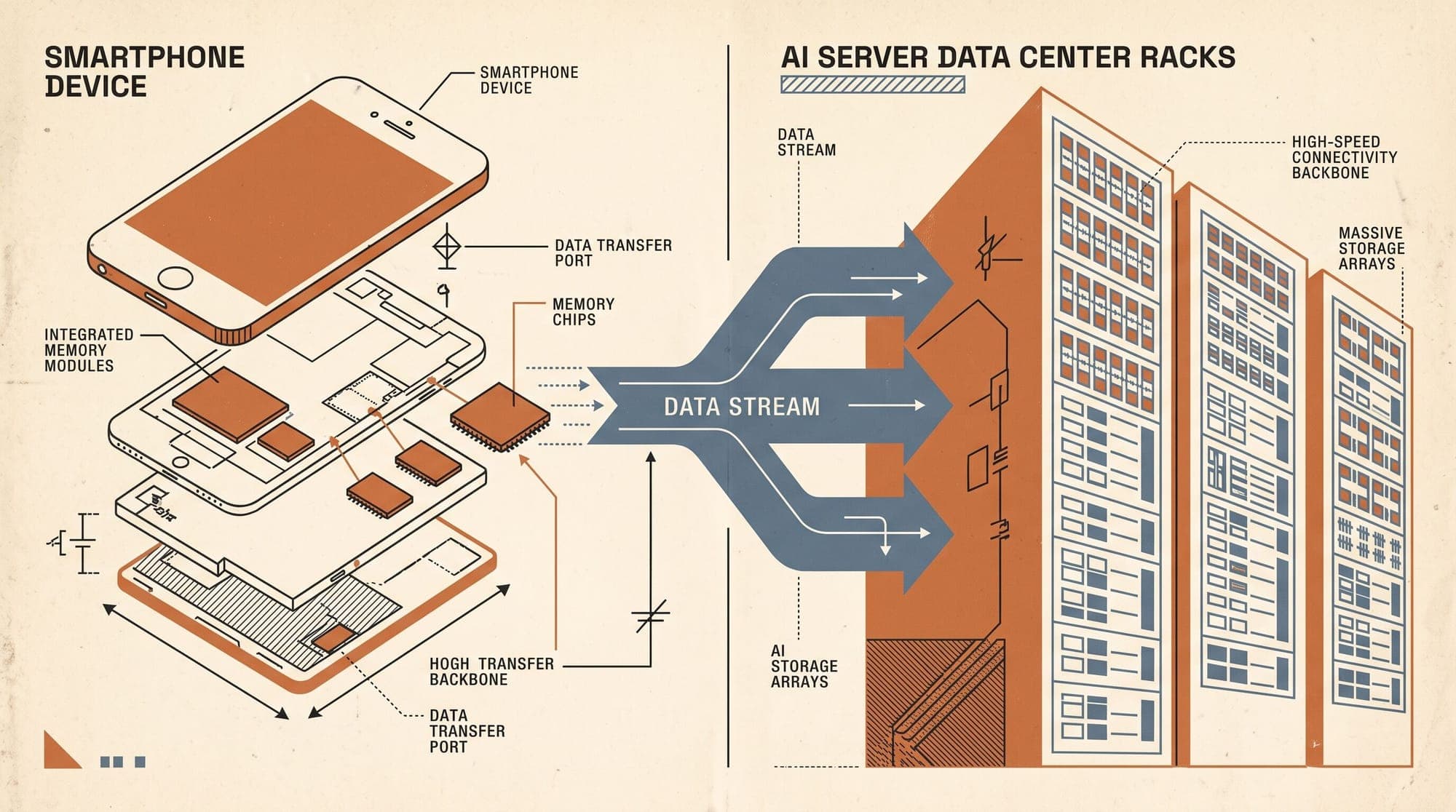
Technical diagram illustration of mobile RAM thresholds and memory allocation boundaries

AI Infrastructure and Mobile Component Pressures

The rapid scaling of hyperscale AI clusters has shifted semiconductor wafer allocation toward server-grade HBM and dense DDR5/LPDDR5 modules. Google noted that the mobile hardware ecosystem now faces "significant hardware supply constraints that are altering device memory availability."

To prevent app crashes, background termination, and degraded user experiences on memory-constrained devices, Google is enforcing technical thresholds across several core areas:

  • Dynamic Memory Ceilings: Strict limits on peak dynamic allocations to reduce out-of-memory (OOM) exceptions.
  • Bitmap and Asset Optimization: Explicit bounds on uncompressed image buffers and graphical asset retention in system memory.
  • Code Optimization Baselines: Mandatory compilation profiles and execution optimizations to reduce total app footprint.

Developers have until February 2027 to bring existing and new Play Store applications into compliance with the updated thresholds.

Diagnostic Tooling and the Memory Limiter

To assist engineering teams in debugging memory profiles, Google is rolling out updated performance dashboards in the Google Play Console and Android Studio.

The company is also integrating diagnostic capabilities into the Android Open Source Project (AOSP), including a dedicated Memory Limiter framework. This utility allows developers to simulate low-memory runtime conditions and verify app behavior against impending OS-level eviction rules.

Alongside memory restrictions, Google announced that all Play Store applications supporting user authentication must integrate the Android Restore Credentials API by April 2027, enabling automated Zero Tap Sign-In restoration during device migrations.


Sources

Written by

More to read

  • Process Reward Models (PRMs) and Step-Level Verification: Mathematical Foundations, Intermediate Credit Assignment, Monte Carlo Value Estimation, and Search-Time Compute Scaling

    Large language models have established chain-of-thought prompting as a standard paradigm for multi-step reasoning tasks across mathematics, formal logic, and software engineering. However, generating extended reasoning chains introduces a severe compounding error vulnerability: a single invalid deduction at an intermediate step invalidates all subsequent steps, even if the final generated tokens appear coherent. Evaluating and guiding these reasoning trajectories requires robust reward modeling

    1 min
  • Nvidia Supply Commitments Reach 79 Billion Across Multi-Year AI Hardware Pipeline

    Nvidia has significantly expanded its forward supply chain obligations, reporting total component and manufacturing capacity commitments of $279 billion in its fiscal second-quarter disclosures. The figure marks a 134 percent sequential increase from $119 billion reported in the preceding quarter and $95.2 billion at the close of fiscal 2026. The multi-year commitments reflect efforts to secure critical semiconductor fabrication, advanced packaging, and high-bandwidth memory (HBM) capacity nece

    1 min
  • Anthropic Hires Google TPU Architect Amir Salek for In-House Silicon Push

    Anthropic has hired Amir Salek, the engineer who established Google's custom silicon program and led the development of its first seven Tensor Processing Unit (TPU) generations, to expand the AI lab's in-house semiconductor engineering initiatives. Salek joins Anthropic's compute infrastructure organization, reporting to James Bradbury. The appointment signals that Anthropic is laying foundational engineering capability for proprietary AI accelerator design alongside its existing multi-provider

    1 min