
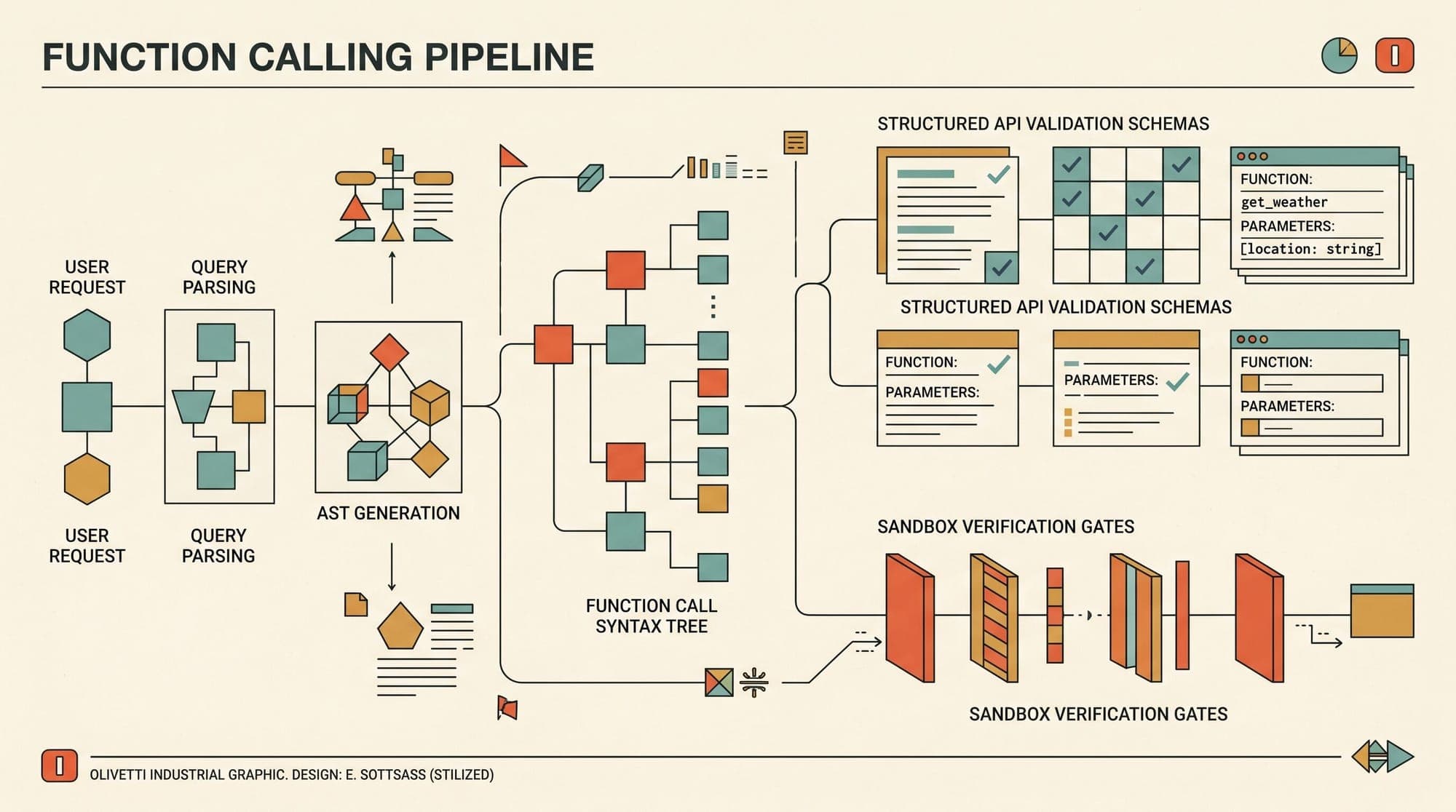
Production AI systems increasingly rely on Large Language Models not merely as conversational generators, but as deterministic execution routers that select and invoke external software tools. While general-purpose LLM evaluations such as MMLU or Chatbot Arena measure semantic fluency and broad reasoning, they provide little insight into whether a model can reliably format API parameters, adhere to strict JSON schemas, or maintain consistency across multi-step execution graphs.
In real-world agent runtimes, a single malformed parameter, an unhandled type mismatch, or an invented function name causes downstream API failures, breaking automated workflows. Evaluating function calling requires a multi-layered verification stack that spans static schema validation, Abstract Syntax Tree (AST) argument parsing, sandboxed execution verification, and stateful multi-turn evaluation.
The Limitations of Text-Based and String-Matching Evals
Early attempts to evaluate tool use relied on naive string comparison, checking whether model outputs matched a reference string (such as exact regex matches on raw text). This approach fails immediately in practice:
- Syntactic Variation: A model invoking
get_weather(city="London", units="metric")is functionally identical toget_weather(units="metric", city="London")orget_weather("London", units="metric"), but string matching treats them as errors. - Type Equivalence: Formatting differences, such as floating-point precision (
temperature=20.0vstemperature=20) or whitespace inside serialized JSON payloads, trigger false rejections. - Optional and Default Arguments: When an API schema defines default parameters, explicitly passing the default value is semantically equivalent to omitting it, yet string diffing cannot evaluate semantic equivalence.
To overcome these issues, production evaluation frameworks decompose tool verification into distinct architectural layers.
Layer 1: Schema Compliance and Syntactic Validation
The first layer tests whether the model generates syntactically valid function calls conforming to formal specifications like JSON Schema.
At this layer, the evaluation framework asserts:
- Structural Integrity: The output must parse into a valid JSON object or language-native function invocation without syntax errors.
- Type Rigidity: Every parameter value must match its declared type schema (
string,integer,number,boolean,array,object). For example, sending"123"instead of123when an integer is required represents a type violation unless explicit coercion rules are defined. - Required Fields: All mandatory fields must be present, while unrecognized keys (parameter hallucination) are flagged as failures.
- Constraint Boundaries: Range constraints (
minimum,maximum), array length bounds, and enumerated value sets (enum) must be strictly satisfied.
While schema compliance is necessary, it is insufficient on its own: a function call can be schema-compliant while supplying entirely incorrect parameter values or calling the wrong endpoint.
Layer 2: Abstract Syntax Tree (AST) Normalization and Matching
To evaluate semantic parameter accuracy across diverse languages and formats without executing live side effects, frameworks employ Abstract Syntax Tree (AST) matching.
As pioneered by the Berkeley Function Calling Leaderboard (BFCL) developed by UC Berkeley's Gorilla team, AST evaluation parses the model's generated invocation into a formal syntax tree. This tree is then evaluated against ground-truth parameter specifications.
Model Output (JSON or Code)
           │
           ▼
   AST Parser & Normalizer
   ├── Normalize argument ordering (kwargs sorting)
   ├── Resolve positional-to-keyword mappings
   ├── Fill or prune schema-defined default values
   └── Cast type-equivalent representations
           │
           ▼
    AST Equivalence Checker ──► Pass / Fail with Detailed Parameter Diff
AST evaluation normalizes several operational variations:
- Keyword Argument Permutation: Reorders keyword arguments alphabetically so parameter order does not influence evaluation.
- Positional vs Keyword Mapping: Uses the target function's reflection signature to map positional arguments into their corresponding keyword equivalents.
- Default Parameter Harmonization: Automatically injects default argument values into ground-truth comparisons if omitted by the model, or strips them if present.
- Cross-Language Coverage: Supports parsing across Python functions, Java methods, JavaScript APIs, and REST endpoints.
AST matching scales to thousands of test cases without requiring live network calls or mock server configurations, making it suited for high-throughput continuous integration benchmarks.

Layer 3: Executable Verification in Sandboxed Environments
Certain API interactions cannot be fully validated through static AST matching alone. In REST APIs, database queries, and dynamic tool suites, valid invocations may take multiple semantically distinct forms that achieve identical outcomes. For these scenarios, evaluation frameworks run executable tests in isolated sandboxes.
Executable evaluation operates by executing the model's generated tool call against live or hermetically mocked environments, validating:
- HTTP/RPC Execution: The API returns a successful status code (such as HTTP
200 OK) and matching response headers. - State Mutations: If the function performs a state change (such as inserting a row into a database or modifying an object store), the post-execution environment state is asserted against expected invariants.
- Response Key Consistency: Verifying that downstream parsing code can successfully consume the returned response keys and payload types.
In frameworks like ToolBench / ToolLLM, executable evaluation connects models to thousands of real-world RESTful APIs indexed from RapidAPI, measuring whether the generated requests succeed against active endpoints.
Industry Benchmark Architectures
Modern tool evaluation has progressed through several generations of benchmark architectures:
| Benchmark | Primary Evaluation Mode | Scope & Scale | Multi-Turn / Statefulness | | :--- | :--- | :--- | :--- | | BFCL v1-v2 | AST Matching & Executable Verification | Simple, parallel, and multiple function calls across Python, Java, JS, REST | Stateless single-turn | | BFCL v3-v4 | Multi-Turn State Machine & AST/Execution | Web search, persistent memory, format sensitivity, multi-step dependencies | Stateful multi-turn | | ToolBench / ToolEval | Depth-First Search Trees & LLM Judge | 16,000+ real-world REST APIs from RapidAPI | Multi-step planning paths | | API-Bank | Executable System Sandbox | 2,000+ APIs covering planning, retrieval, and execution | Single- and multi-turn | | HammerBench | Fine-Grained AST & Execution Verification | Complex nested parameters and dynamic error injection | Multi-step error recovery |
The evolution from BFCL v1 to v4 highlights the transition from isolated syntax checks to comprehensive agentic evaluation. While top frontier models achieve near-perfect scores on simple single-turn Python function calls, performance degrades significantly when models face:
- Parallel Independent Calls: Executing multiple disjoint tool calls simultaneously (e.g. querying five stock tickers in one turn).
- Serial Dependent Chains: Using the output of tool A as an input parameter for tool B across successive turns.
- Abstention Scenarios: Recognizing when a user query does not require any tool invocation and returning a conversational response instead of hallucinating an API call.
- Format Sensitivity: Maintaining consistency across varying system prompt formats (such as OpenAI tool-calling syntax vs Anthropic XML blocks vs raw JSON).
Key Failure Modes in Production Function Calling
Engineering teams evaluating models for production tool use systematically test for four primary failure categories:
1. Parameter Hallucination and Schema Drift
Models frequently invent plausible-sounding parameters that do not exist in the target API signature (e.g., adding timeout=30 or format="json" to a function that does not accept those kwargs). Evaluation harnesses catch this by enforcing strict additionalProperties: false rules during schema validation.
2. False-Positive Tool Invocations
When models are presented with broad tool sets, they can develop an over-trigger bias, invoking tools for conversational queries that require no external data. Benchmark suites measure Function Relevance Detection and Abstention Precision to quantify false invocation rates.
3. Error Cascades in Dependent Chains
In multi-turn workflows, if tool A returns a partial failure or unexpected schema, models often fail to parse the error message and instead repeat the identical malformed call in a loop. Evaluating error-recovery trajectories tests whether the model can inspect error codes (e.g. HTTP 400 bad request) and re-parameterize the subsequent call.
4. Context-Length Tool Retrieval Saturation
When the number of available tools grows into dozens or hundreds, providing all schemas directly in the system prompt degrades attention and increases token costs. Evaluation harnesses measure how model accuracy changes when combined with semantic tool retrieval layers (such as embedding-based tool selection).
Constructing an Enterprise Function-Calling Regression Suite
To ensure model upgrades, prompt adjustments, or schema modifications do not introduce regressions, teams implement automated CI/CD evaluation pipelines:
- Deterministic Golden Datasets: Maintain curated test cases pairing user intents with expected AST signatures and allowable parameter ranges.
- Dynamic Mock Server Harnesses: Use mock servers that validate incoming request headers, body payloads, and query parameters before returning canned responses, avoiding reliance on flaky external third-party APIs during CI runs.
- Multi-Metric Scorecard:
- Schema Pass Rate (SPR): Percentage of calls passing strict JSON schema validation.
- AST Exact Match Rate (AEMR): Percentage of calls matching normalized argument syntax trees.
- Abstention F1 Score: Balance between invoking tools when necessary and abstaining when appropriate.
- Task Completion Rate (TCR): End-to-end success rate across multi-turn stateful task executions.
Systematic evaluation across these layers allows engineering teams to deploy tool-using LLMs with predictable reliability, catching parameter hallucinations and schema drift before models hit production.
Sources
- Berkeley Function Calling Leaderboard (BFCL) V4
- Gorilla: Berkeley Function Calling Leaderboard Technical Details
- ToolLLM: Facilitating Large Language Models to Master 16000+ Real-World APIs (arXiv:2307.16789)
- API-Bank: A Benchmark for Large Language Models using Tools (arXiv:2304.08244)
- HammerBench: Fine-Grained Function-Calling Evaluation (arXiv:2412.16516)
- JSON Schema Specification



