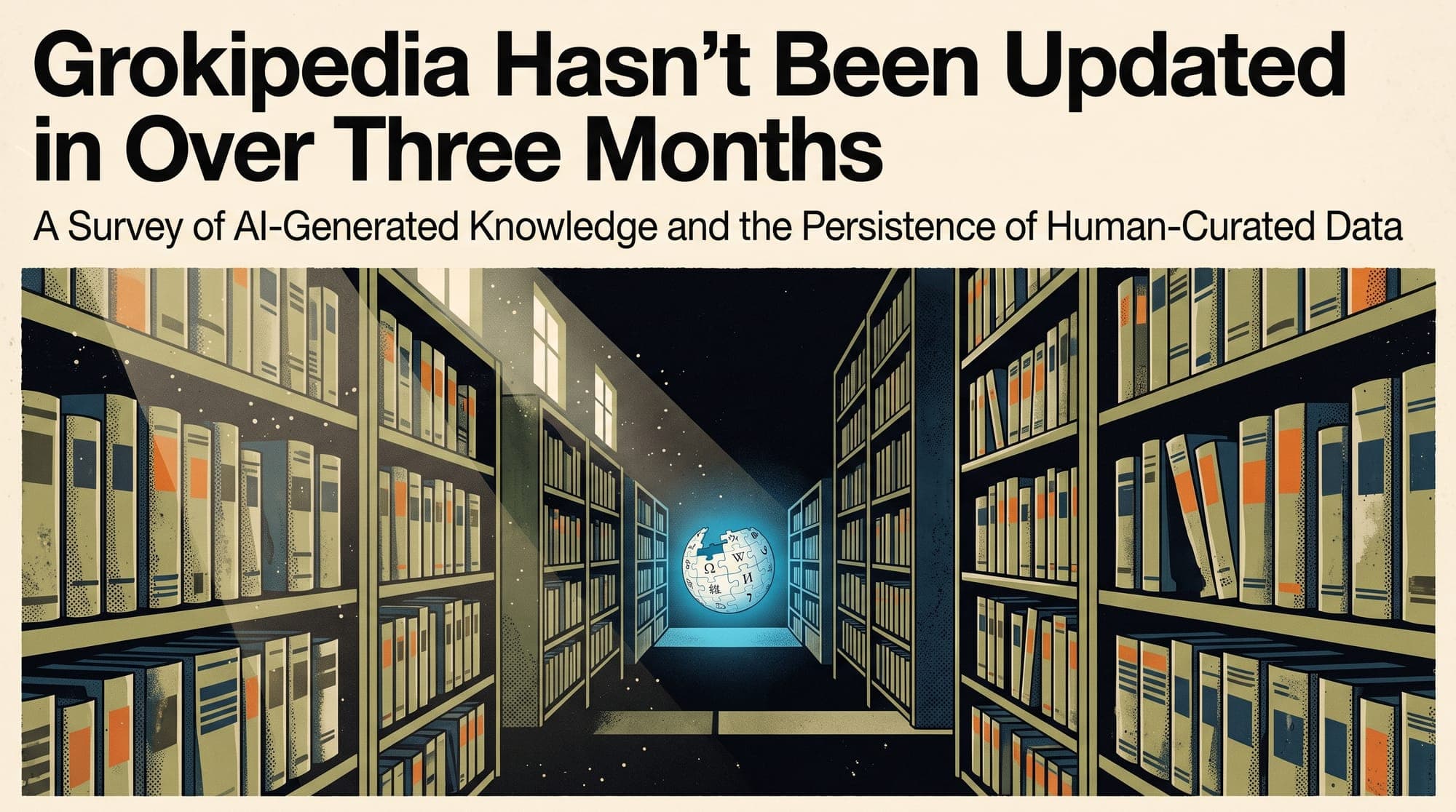
Elon Musk's Grokipedia Hasn't Been Updated in Over Three Months

When Elon Musk launched Grokipedia in October 2025, he called it a "massive improvement" over Wikipedia. Eleven months later, the xAI-built AI encyclopedia appears to have been quietly abandoned, with no edits accepted since April 24. A Lawfare investigation found that across a sample of 34,519 pages containing 225,496 recommended edits, not a single correction has been accepted or rejected in more than three months. The site's own live page, which once tracked recent changes, now displays the

1 min
Elon Musk's Grokipedia Hasn't Been Updated in Over Three Months

When Elon Musk launched Grokipedia in October 2025, he called it a "massive improvement" over Wikipedia. Eleven months later, the xAI-built AI encyclopedia appears to have been quietly abandoned, with no edits accepted since April 24.

A Lawfare investigation found that across a sample of 34,519 pages containing 225,496 recommended edits, not a single correction has been accepted or rejected in more than three months. The site's own live page, which once tracked recent changes, now displays the message "No live edits available right now."

Grokipedia launched with 885,000 AI-generated articles and later expanded to over 6 million entries with its v0.2 release in November 2025. Users can still suggest edits and new articles through the interface, but the review pipeline appears to have been switched off entirely. Lawfare's analysis found neither accepted nor rejected corrections dated after April.

Users on Reddit and X have been asking whether Grokipedia is "dead" for weeks. Musk himself last mentioned the project on X in February, according to Lawfare. xAI did not respond to a request for comment from The Verge.

The silent abandonment mirrors a pattern seen across other Musk ventures where ambitious product launches are followed by quiet neglect. Grokipedia was pitched as a direct competitor to Wikipedia, but without an editorial process its AI-generated entries stagnate while Wikipedia's community continues updating thousands of articles daily.

The project's apparent death also raises questions about the viability of AI-generated encyclopedias at scale. Without human review, machine-generated articles risk propagating errors, and without an active editing pipeline they cannot keep pace with current events. A static encyclopedia, AI-generated or not, stops being useful the moment it stops updating.

Sources

The Verge: Elon Musk's attempt at an AI Wikipedia hasn't been updated in months - https://www.theverge.com/ai-artificial-intelligence/976004/elon-musk-grokipedia-ai-wikipedia-not-updating-dead

Lawfare: Grokipedia Stopped Reviewing Edits in April. It Didn't Tell Anyone. - https://www.lawfaremedia.org/article/grokipedia-stopped-reviewing-edits-in-april.-it-didn-t-tell-anyone


Written by

More to read

  • Synthetic Data Pipelines for LLM Post-Training: Generation, Quality Filtering, Deduplication, and Contamination Auditing

    As frontier model post-training expands beyond the limits of human-annotated datasets, synthetic data generation (SDG) has become the core driver of alignment. Public disclosures from major research labs confirm that synthetic data now comprises the vast majority of tokens used in supervised fine-tuning (SFT) and preference alignment. For example, NVIDIA reported that over 98% of the data used in the alignment pipeline for Nemotron-4 340B was synthetically generated. Similarly, models across the

    1 min
  • IBM Research Evaluates Agentic Memory Sizing Across 8 Models: Dosage Calibrations, Ceiling Effects, and Token Efficiency

    In a technical report published on August 18, 2026, researchers at IBM Research detailed empirical evaluations on sizing and calibrating agentic memory across eight large language models. The study, conducted using the open-source ALTK-Evolve framework across the AppWorld benchmark, demonstrates that agentic memory performance is governed by capability-dependent dosage rather than uniform prompt accumulation. Agentic memory architectures typically extract procedural guidelines from prior execut

    1 min
  • Google Opens Gemini in Chrome to All U.S. Android Users and Extends Auto Browse to Mobile

    Google expanded Gemini in Chrome to all Android users across the United States on August 18, 2026. The update introduces the browser's built-in AI assistant to mobile handsets and extends "auto browse," Google's agentic web automation feature, to smartphones for Google AI Pro and AI Ultra subscribers. The Android rollout follows the initial launch of Gemini in Chrome for desktop environments in September 2025. On mobile devices, the assistant provides on-page article summaries, contextual answe

    1 min