
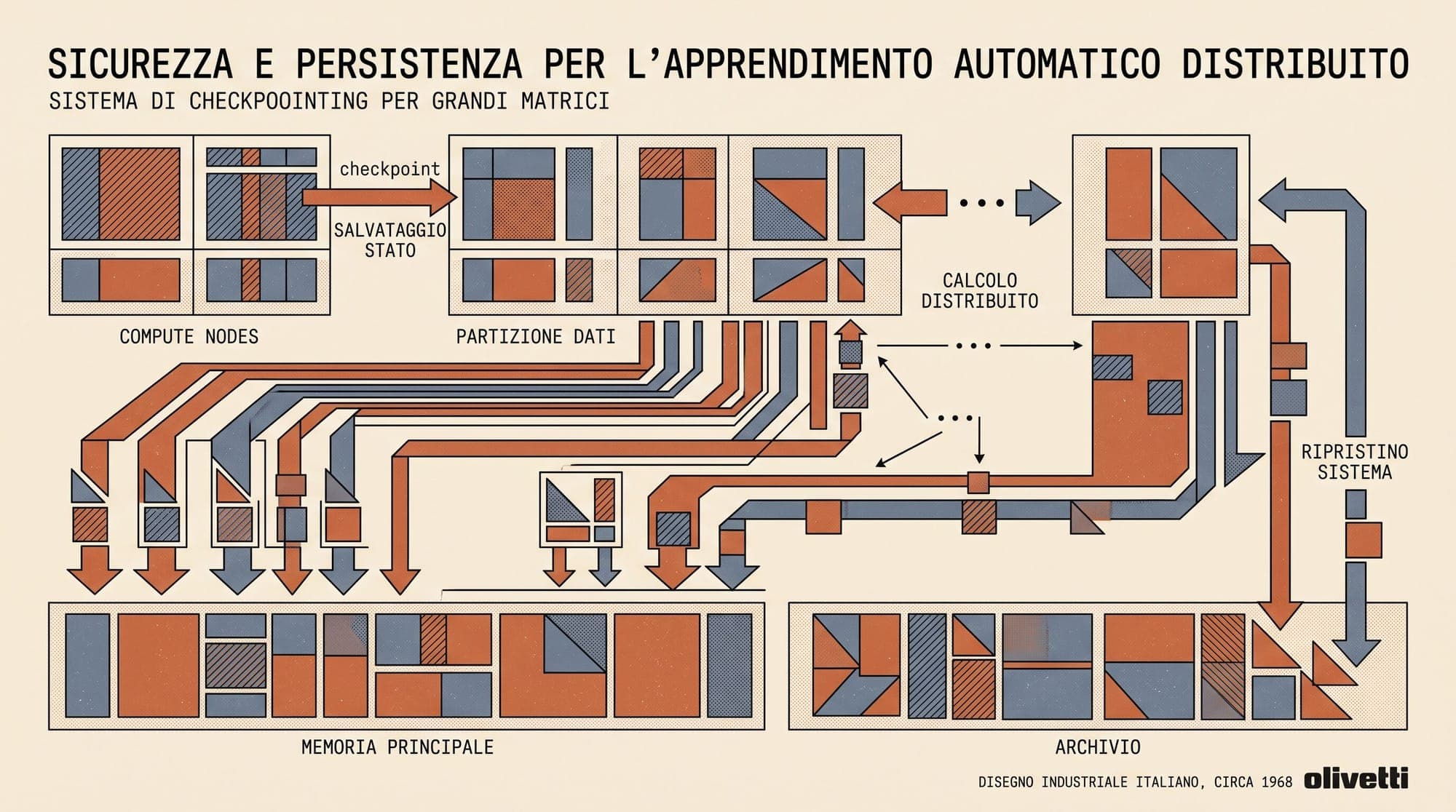
Distributed Checkpointing in Production: PyTorch DCP, Asynchronous Staging, and Topology Resharding
In multi-node distributed deep learning, checkpointing is often the largest single source of unforced downtime and degraded Model Flops Utilization (MFU). As models scale to tens or hundreds of billions of parameters across thousands of GPUs, saving model weights and optimizer states using traditional serialization primitives creates severe cluster stalls, memory exhaustion on root ranks, and rigid dependencies on fixed cluster topologies.
Distributed Checkpoint (DCP), integrated into the core PyTorch distributed stack (PyTorch Distributed Checkpoint Documentation), replaces legacy monolithic serialization with parallel single-program multiple-data (SPMD) persistence. Combined with asynchronous memory staging and dynamic load-time resharding, modern distributed checkpointing enables high-frequency state persistence with minimal compute interruption.
The Checkpoint Bottleneck in Distributed Training
During large-scale pre-training or fine-tuning, the state footprint of a model far exceeds the memory required for the parameter weights alone. When training with standard 32-bit floating-point master weights and AdamW optimizers, each parameter requires substantial memory across training stages:
- Model Weights (BF16/FP16): 2 bytes per parameter
- Gradients (BF16/FP16): 2 bytes per parameter
- FP32 Master Weights: 4 bytes per parameter
- AdamW First Moment (): 4 bytes per parameter
- AdamW Second Moment (): 4 bytes per parameter
A 70-billion parameter model requires approximately 140 GB of VRAM for parameters and gradients, but its full training state dict spans between 1.12 TB and 1.4 TB across the cluster. When saving this state using legacy primitives such as torch.save(), two structural failures emerge:
- Root Rank Memory Exhaustion: Aggregating sharded tensors (such as those managed by Fully Sharded Data Parallelism or DeepSpeed ZeRO-3) to rank 0 before serialization creates massive all-gather memory spikes that trigger fatal CUDA Out of Memory (OOM) errors.
- Synchronous Compute Stalls: Pausing distributed training while hundreds of ranks synchronously serialize hundreds of gigabytes across shared network storage (such as NFS, Lustre, or GPFS) halts all GPU compute for 30 to 180 seconds per checkpoint.
If a cluster checkpoints every 500 iterations and each save blocks execution for two minutes, checkpoint overhead directly reduces training efficiency by 10% to 20%.

PyTorch Distributed Checkpoint (DCP) Architecture
PyTorch DCP (PyTorch DCP GitHub Module) redesigns state serialization around sharded tensors (ShardedTensor and DTensor). Instead of gathering tensors to a single rank or dumping fragmented, uncoordinated pickle files, DCP operates as a coordinated SPMD system.
The architecture decouples planning from physical I/O through four core abstractions:
- SavePlanner / LoadPlanner: Orchestrates metadata extraction, computes tensor chunk layouts, and determines the mapping between in-memory tensor slices and storage targets without performing direct I/O.
- StorageWriter / StorageReader: Interfaces with underlying persistence layers. Built-in implementations include
FileSystemWriterfor POSIX and parallel filesystems, with extension points for cloud object stores such as AWS S3 or Google Cloud Storage. - Distributed Tensor Integration (
DTensor): Natively tracks global tensor shapes, sharding placement specs (e.g.,Shard(0),Replicate()), and process mesh coordinates (PyTorch DTensor Design). - Consolidated Metadata: Each rank writes its own shard data into binary chunk files (such as
__0_0.distcp), while rank 0 coordinates the generation of a lightweight.metadataindex documenting global tensor geometries and shard byte offsets.
By writing sharded chunks in parallel directly from each worker process, aggregate write bandwidth scales linearly with cluster size up to the throughput limit of the underlying storage fabric.
Asynchronous Staging: Eliminating GPU Idle Time
While parallel I/O reduces total write duration, synchronous disk access still forces the training loop to wait on storage latency. PyTorch DCP resolves this via torch.distributed.checkpoint.async_save, which splits checkpointing into a two-stage commit pipeline.
[Training Iteration N]
       │
       ▼
[Stage 1: D2H Memory Staging (Synchronous Stall: ~200-500ms)]
  GPU VRAM ──(CUDA D2H Copy / DMA)──► Pinned CPU Host Buffer
       │
       ▼
[Training Iteration N+1 Resumes Immediately on GPU]
       │
       ▼
[Stage 2: Storage Persistence (Asynchronous Worker)]
  Pinned CPU Buffer ──(Background Worker Thread/Process)──► NVMe / Lustre / S3
Stage 1: Device-to-Host (D2H) Staging
When a checkpoint is triggered at iteration , the main execution thread pauses only long enough to copy local tensor shards from GPU High Bandwidth Memory (HBM) to pinned host RAM across the PCIe bus.
Using dedicated staging buffers (async_stager=DefaultStager()), this copy utilizes non-blocking Direct Memory Access (DMA). For an 8-GPU node with 160 GB of local training state, the D2H transfer completes across PCIe Gen5 in 300 to 600 milliseconds, compared to a 45-second stall for direct network storage serialization.
Stage 2: Background Persistence and GIL Management
Once data lands in host memory, the main training thread immediately resumes forward and backward passes for iteration . A background thread or detached sub-process manages serialization, file creation, and disk writes.
To prevent the Python Global Interpreter Lock (GIL) from impeding CUDA kernel launching during background I/O, production frameworks utilize dedicated I/O worker processes or C++ background runners (TorchTitan Distributed Training Recipes).
Dynamic Load-Time Resharding
A persistent operational headache in large-scale machine learning is checkpoint rigidity. Traditional checkpoint formats save tensor shards mapped directly to the specific 3D parallelism topology used during training (such as Tensor Parallelism degree , Pipeline Parallelism , Data Parallelism ).
If an engineering team needs to resume training on a cluster with fewer GPUs, scale up to a larger cluster, or convert weights for inference serving (such as or ), monolithic files require complex offline conversion scripts that reconstruct full model weights in host memory.
Saving Topology (Cluster A: 64 GPUs)
┌──────────────────────────────────────────────────────────┐
│ TP=8, PP=2, FSDP=4                                       │
│ Saves: Sharded DTensors + Global Geometry Index (.metadata)│
└────────────────────────────┬─────────────────────────────┘
                             │
                             ▼
                 [DCP Storage Directory]
                             │
                             ▼
Loading Topology (Cluster B: 16 GPUs / Inference Engine)
┌──────────────────────────────────────────────────────────┐
│ TP=2, PP=1, FSDP=8 (or Standalone Single-Node Serving)   │
│ DCP LoadPlanner calculates overlapping byte ranges       │
│ Reads slices directly into target model in-place         │
└──────────────────────────────────────────────────────────┘
DCP implements zero-copy load-time resharding (Universal Checkpointing Research). Because .metadata records the global tensor shape alongside the exact coordinate bounding box of every stored chunk, the target processes do not need to match the original rank count or sharding strategy.
When torch.distributed.checkpoint.load executes:
- Each target rank initializes its local model with its desired parallelism layout.
- The target rank provides its expected local
state_dictstructure toDefaultLoadPlanner. - The planner queries
.metadata, calculates which chunk files contain the required tensor slices, and reads only the relevant byte offsets directly into the destination tensor memory.
Production Implementation: Asynchronous DCP with FSDP
The following implementation demonstrates asynchronous distributed checkpointing with PyTorch DCP, utilizing sharded state dictionaries, host memory staging, and clean synchronization hooks.
import os
import torch
import torch.distributed as dist
import torch.distributed.checkpoint as dcp
from torch.distributed.checkpoint.state_dict import (
    get_model_state_dict,
    get_optimizer_state_dict,
    set_model_state_dict,
    set_optimizer_state_dict,
    StateDictOptions,
)
from torch.distributed.fsdp import FullyShardedDataParallel as FSDP

class DistributedCheckpointManager:
    def __init__(self, checkpoint_dir: str):
        self.checkpoint_dir = checkpoint_dir
        self.active_async_request = None
        os.makedirs(checkpoint_dir, exist_ok=True)

    def save_checkpoint_async(self, model: FSDP, optimizer: torch.optim.Optimizer, step: int):
        # Wait for any prior asynchronous save operation to finish
        if self.active_async_request is not None:
            self.active_async_request.result()

        save_path = os.path.join(self.checkpoint_dir, f"step_{step}")
        options = StateDictOptions(
            full_state_dict=False,      # Retain sharded representation
            cpu_offload=True            # Offload state dictionaries to CPU
        )

        # Extract sharded state dicts without aggregating to rank 0
        model_state = get_model_state_dict(model, options=options)
        optim_state = get_optimizer_state_dict(model, optimizer, options=options)

        checkpoint_state = {
            "model": model_state,
            "optimizer": optim_state,
            "step": step,
        }

        # Initialize storage writer
        writer = dcp.FileSystemWriter(save_path)

        # Launch non-blocking asynchronous persistence
        # Copies data to pinned host memory, then delegates disk I/O to background thread
        self.active_async_request = dcp.async_save(
            state_dict=checkpoint_state,
            storage_writer=writer,
        )

    def load_checkpoint(self, model: FSDP, optimizer: torch.optim.Optimizer, step: int):
        load_path = os.path.join(self.checkpoint_dir, f"step_{step}")
        if not os.path.exists(load_path):
            raise FileNotFoundError(f"Checkpoint directory {load_path} does not exist.")

        options = StateDictOptions(
            full_state_dict=False,
            cpu_offload=True
        )

        # Prepare target state structures for in-place population
        model_state = get_model_state_dict(model, options=options)
        optim_state = get_optimizer_state_dict(model, optimizer, options=options)

        checkpoint_state = {
            "model": model_state,
            "optimizer": optim_state,
        }

        reader = dcp.FileSystemReader(load_path)

        # Load-time resharding handles any change in world size or FSDP mesh automatically
        dcp.load(
            state_dict=checkpoint_state,
            storage_reader=reader,
        )

        set_model_state_dict(model, model_state_dict=checkpoint_state["model"], options=options)
        set_optimizer_state_dict(model, optimizer, optim_state_dict=checkpoint_state["optimizer"], options=options)
Storage Topologies and Tiered Persistence Strategies
In high-scale infrastructure, checkpoint performance depends directly on the storage hierarchy. Production AI platforms implement multi-tier checkpoint pipelines:
- Tier 1: Local NVMe Burst Buffers: Each compute node writes checkpoints directly to local PCIe Gen5 NVMe drives. Because local drive write bandwidth easily exceeds 6 to 12 GB/s per node, checkpoints complete rapidly with minimal network overhead. High-frequency checkpoints (e.g., every 100 to 200 steps) reside locally to enable fast restarts after single-worker preemption.
- Tier 2: Parallel Shared Storage (Lustre / GPFS / Vast Data): A background synchronization daemon streams completed local checkpoints to shared network-attached storage every 500 to 1,000 steps. This shields training from cluster-wide node dropouts where local NVMe storage becomes unreachable.
- Tier 3: Cloud Object Storage (S3 / GCS): Long-term golden checkpoints and evaluation milestones are archived asynchronously to S3 using multi-part uploads with standard erasure coding.
To maintain cluster consistency during sudden hardware failures, checkpoint directories must always be committed atomically. Workers write into temporary directories (step_N.tmp), and rank 0 executes an atomic filesystem rename to step_N only after all rank files and the consolidated .metadata manifest are verified.
Sources
- PyTorch Distributed Checkpoint (torch.distributed.checkpoint) Documentation
- PyTorch Tutorials: Asynchronous Saving with Distributed Checkpoint (DCP)
- TorchTitan: Optimizing Checkpointing Efficiency with PyTorch DCP
- Universal Checkpointing: A Flexible and Efficient Distributed Checkpointing System for Large-Scale DNN Training
- PyTorch Getting Started with Distributed Checkpoint (DCP)



