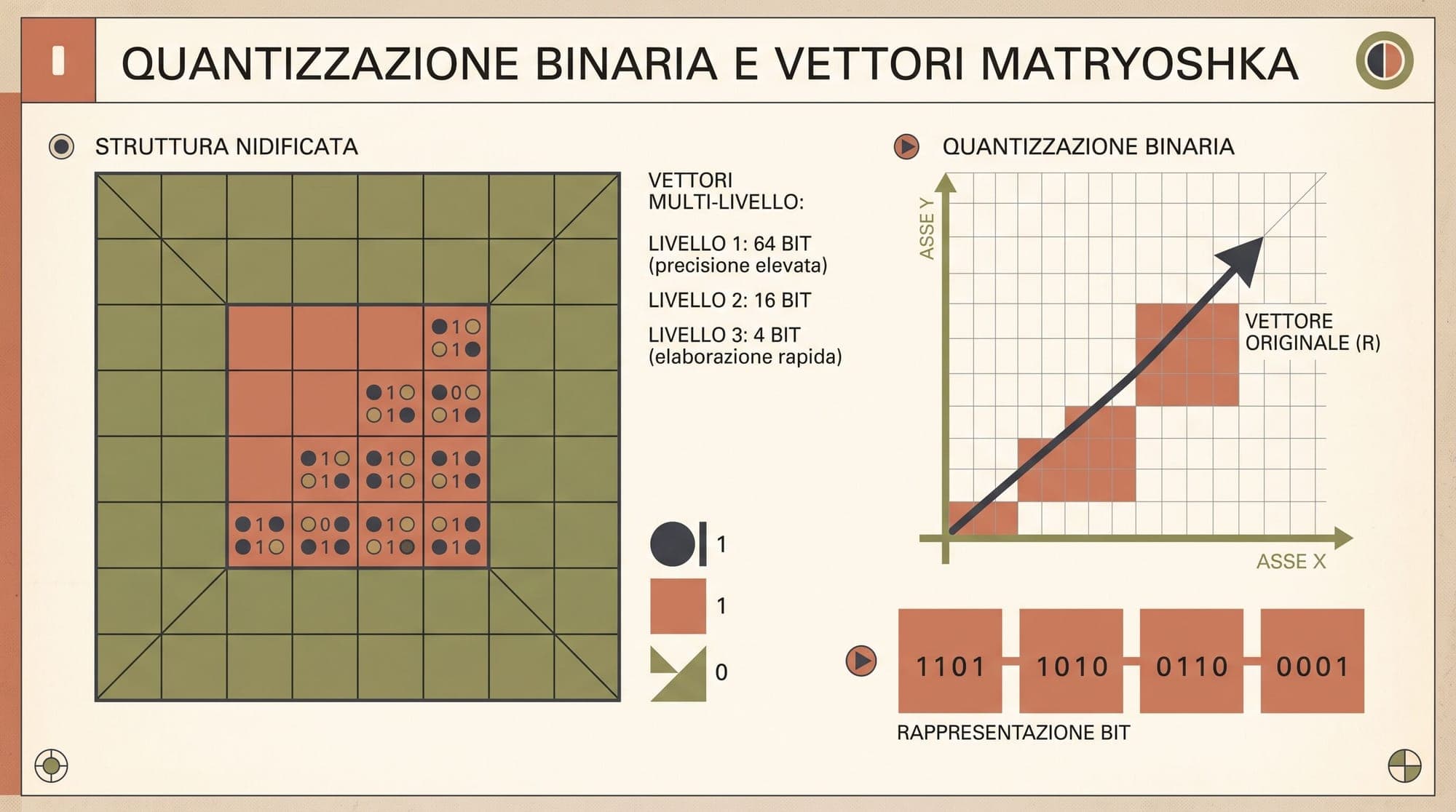
Production vector search workloads face a severe memory scaling bottleneck. In retrieval-augmented generation (RAG) and semantic search architectures, indexing tens of millions of high-dimensional embeddings in raw 32-bit floating-point (FP32) format exhausts memory capacity and drives up infrastructure costs. Indexing 100 million 1536-dimensional vectors requires 614.4 GB of RAM purely for vector payloads, before accounting for graph edges and memory fragmentation in Approximate Nearest Neighbor (ANN) structures like Hierarchical Navigable Small World (HNSW).
To break this memory wall without sacrificing retrieval quality, production systems combine Binary Quantization (BQ) with Matryoshka Representation Learning (MRL) inside a two-stage coarse-to-fine retrieval pipeline. This architecture reduces in-memory index footprints by 90% to 96% and accelerates candidate generation via single-cycle SIMD Hamming distance instructions, while recovering 97% to 99.5% of raw FP32 retrieval accuracy through precision rescoring.
The Memory Wall in High-Dimension Vector Retrieval
Vector retrieval memory consumption is governed by vector dimensionality and data type precision:
- Payload Memory:
Memory (bytes) = Number of Vectors × Dimensions × Bytes per Dimension - FP32 Storage: 4 bytes per dimension (1536 dimensions = 6,144 bytes per vector).
- FP16 / BF16 Storage: 2 bytes per dimension (1536 dimensions = 3,072 bytes per vector).
- Scalar Quantization (SQ8): 1 byte per dimension (1536 dimensions = 1,536 bytes per vector, a 4x reduction).
- Binary Quantization (BQ): 1 bit per dimension (1536 dimensions = 192 bytes per vector, a 32x reduction over FP32).
For a 100-million vector index using 3072-dimensional embeddings (such as OpenAI text-embedding-3-large), raw FP32 storage requires 1.23 TB of RAM. Storing these vectors on high-memory cloud instances (such as AWS r6i.32xlarge or r7i.metal-24xl) costs thousands of dollars per node per month.
While Scalar Quantization (INT8) cuts memory to ~307 GB, it remains too large for single standard instances. Binary Quantization compresses the 1.23 TB dataset to 38.4 GB, allowing the entire primary search index to reside comfortably within standard system memory.
Mathematical Mechanics of Binary Quantization
Binary quantization converts continuous floating-point vectors into compact bitstrings through 1-bit zero-thresholding:
For an embedding vector x in R^d, the binary quantized vector b in {0, 1}^d is generated by:
b_i = 1 if x_i > 0, else 0
These bits are packed into standard integer words. A 1024-dimensional vector is represented by 1024 bits, mapped directly to 128 bytes (16 uint64 integers).
Angular Similarity and Hamming Distance Equivalence
According to Goemans-Williamson hyperplane rounding and Locality Sensitive Hashing theory, for zero-centered normalized vectors u and v, the probability that their binarized components differ across a random dimension is proportional to the angle theta between the original vectors:
Pr(b_u_i != b_v_i) = theta / pi = arccos(CosineSimilarity(u, v)) / pi
Consequently, the expected normalized Hamming distance H(b_u, b_v) / d between the binary vectors is monotonically related to the cosine angle:
E[H(b_u, b_v) / d] = arccos(CosineSimilarity(u, v)) / pi
Cosine similarity can be approximated directly from normalized Hamming distance:
CosineSimilarity(u, v) ≈ cos(pi * H(b_u, b_v) / d)
Hardware Acceleration via SIMD and POPCNT
Calculating cosine similarity between two 1536-dimensional FP32 vectors requires 1536 multiply-accumulate operations, involving hundreds of CPU floating-point instructions.
In contrast, calculating Hamming distance between two 1536-bit binary vectors requires only 24 64-bit bitwise XOR operations followed by population count (POPCNT) instructions:
- XOR: Computes bitwise difference (
u ^ v), setting bits to 1 where vector components differ. - POPCNT: Counts the number of set bits in the resulting word (
__builtin_popcountllon x86-64 SSE4.2/AVX-512 orVCNTon ARM NEON).
Modern AVX-512 hardware can evaluate 512 bits per vector comparison in a single instruction cycle, enabling 20x to 40x higher query evaluation throughput on candidate scans compared to floating-point kernels.
Synergy with Matryoshka Representation Learning
Binary quantization operates perpendicularly to Matryoshka Representation Learning (MRL). MRL trains neural encoders across nested representation sizes simultaneously (such as 64, 128, 256, 512, 1024, and 3072 dimensions) by applying loss functions across multiple prefix slices during optimization.
When combining MRL dimension truncation with Binary Quantization:
- Full FP32 Vector (3072 dims): 12,288 bytes per vector.
- MRL Truncation (512 dims, FP32): 2,048 bytes per vector (6x reduction).
- MRL Truncation (512 dims, Binary): 64 bytes per vector (192x total reduction).
- MRL Truncation (256 dims, Binary): 32 bytes per vector (384x total reduction).
Because MRL models concentrate the most significant variance and semantic signals in the earliest dimensions, binarizing a truncated MRL vector produces a compact representation that retains structural clustering fidelity.
The Two-Stage Coarse-to-Fine Retrieval Architecture
Pure 1-bit binary search causes precision loss because fine-grained magnitude differences and subtle angular distinctions are collapsed into binary signs. In practice, unrescored binary search drops Top-10 recall to 70% to 76% across standard benchmarks.
Production systems resolve this by implementing a Two-Stage Coarse-to-Fine Pipeline utilizing oversampling and rescoring:

Stage 1: Coarse Candidate Generation (In-Memory Binary Search)
- The incoming query is converted into a floating-point embedding and immediately thresholded into a binary bitstring.
- An in-memory index (such as an HNSW graph or Flat vector array built over binary bitstrings) executes fast Hamming distance searches.
- The engine retrieves an oversampled candidate pool of size N = k * oversampling_factor. For a requested k=20 with an oversampling factor of 3x, the binary index yields the top 60 candidates.
Because the binary index and graph connectivity require less than 10% of standard RAM, the entire first-stage index resides in memory, delivering sub-millisecond candidate generation across millions of records.
Stage 2: Precision Rescoring (Disk-Backed Float Reranking)
- The search engine reads the unquantized FP32 or FP16 embeddings (or high-dimension MRL slices) for only the N retrieved candidate IDs from memory-mapped NVMe SSD storage.
- The engine computes exact dot products or cosine similarities between the original float query vector and the N candidate vectors.
- The candidate list is re-sorted according to the exact float similarity scores, returning the final top-k results to the client.
Recall Recovery Benchmarks
Empirical evaluations published by Qdrant and AWS Database Blog demonstrate that oversampling with rescoring eliminates the binary accuracy penalty:
- OpenAI text-embedding-3-large (3072d, DBpedia 1M): Recall@10 increases from 76.2% (unrescored binary) to 99.66% with 3x oversampling and FP32 rescoring.
- OpenAI text-embedding-3-small (1536d, DBpedia 100K): Recall@10 reaches 98.47% with 3x oversampling and rescoring.
- Cohere embed-english-v3.0 (1024d): Retains over 98.5% recall@50 with 2x oversampling.
Because precision rescoring is performed on only 50 to 200 candidate vectors per query, the computational overhead of Stage 2 is negligible compared to the cost of scanning millions of floating-point vectors in a flat search.
Implementation Across Production Vector Engines
Qdrant Implementation
Qdrant provides native binary quantization with configurable memory residency and automatic rescoring:
{
  "quantization_config": {
    "binary": {
      "always_ram": true
    }
  }
}
At query time, oversampling and rescoring parameters are supplied directly in the search payload:
{
  "params": {
    "quantization": {
      "ignore": false,
      "rescore": true,
      "oversampling": 3.0
    }
  },
  "limit": 20
}
Setting always_ram: true keeps the lightweight binary bitstrings and HNSW graph locked in memory while the full FP32 vectors remain on NVMe disk, fetching candidate vectors during the rescoring phase.
PostgreSQL and pgvector (v0.7.0+)
pgvector introduced native support for binary quantization using the PostgreSQL bit data type and bit_hamming_ops index access methods:
-- Create an HNSW index over binary-quantized embeddings
CREATE INDEX ON documents
USING hnsw ((binary_quantize(embedding)::bit(1536)) bit_hamming_ops)
WITH (m = 16, ef_construction = 64);

-- Execute Two-Stage Retrieval: Stage 1 (Hamming Filter) + Stage 2 (Cosine Rescore)
WITH coarse_candidates AS (
    SELECT id, embedding
    FROM documents
    ORDER BY (binary_quantize(embedding)::bit(1536)) <~> binary_quantize($1::vector)::bit(1536)
    LIMIT 60 -- 3x oversampling for target k=20
)
SELECT id
FROM coarse_candidates
ORDER BY embedding <=> $1::vector -- Exact Cosine Distance
LIMIT 20;
The operator <~> executes hardware-accelerated Hamming distance over the bit index, while <=> computes exact cosine distance on the filtered candidate subquery.
Vespa Multi-Phase Ranking
Vespa natively supports combining Matryoshka embeddings with binary quantization using multi-phase ranking profiles:
- First Phase (Hamming Match): Evaluates packed binary tensors to populate the candidate hit list.
- Second Phase (Float Rescore): Computes exact dot products on full-precision tensors for the top N candidates before document blending.
Architectural Trade-Offs and Failure Modes
1. Dimensionality Lower Bound
Binary quantization requires sufficient geometric dimensionality to maintain angular resolution. In high-dimensional spaces (dimensions >= 768), the number of potential binary hyperplanes (2^d) is massive, ensuring distinct angular partitions.
On lower-dimensional models (such as 384-dimensional all-MiniLM-L6-v2), binary quantization causes severe information loss. Experiments show that oversampling fails to fully recover recall on models below 512 dimensions because multiple semantically distinct vectors collapse into identical binary signatures.
2. Anisotropy and Centering Requirements
The mathematical guarantee of Locality Sensitive Hashing assumes zero-centered distributions where dimensions are split evenly by the zero hyperplane:
- If an embedding model suffers from anisotropy (where embeddings cluster in a narrow cone with non-zero mean values), thresholding at zero results in saturated bitstrings (vectors consisting almost entirely of 1s or 0s).
- When using non-centered models, systems must compute a dataset mean vector mu during indexing and apply mean-centering (x - mu) prior to binary quantization.
Modern models like text-embedding-3, Cohere embed-v3, and nomic-embed-text are trained with explicit normalization and zero-centering constraints, making them compatible with direct zero-thresholding.
3. NVMe Random-Read IOPS Sizing
While Stage 1 runs entirely in RAM, Stage 2 requires loading N unquantized vectors from disk for each query. Under high concurrent query loads (such as 1,000 QPS with N=100), the storage subsystem must handle up to 100,000 random vector reads per second.
Mitigation strategies in production include:
- Sequential Block Layouts: Storing vector payloads sequentially by document ID to enable batch memory-mapped I/O (
mmap). - OS Page Cache Sizing: Allocating sufficient spare RAM for the Linux page cache so frequently accessed candidate vectors remain warm in system buffers.
- Intermediate Tiering (Binarized + INT8): Keeping binary vectors in RAM for Stage 1, INT8 vectors in RAM for Stage 2 rescoring, and archiving full FP32 vectors to cold object storage.
Sizing and Storage Economics
Comparing architectural profiles for an index of 100 million 1536-dimensional embeddings:
- Raw FP32 (Flat / HNSW): Requires 6,144 bytes per vector, amounting to ~614 GB of RAM (plus HNSW graph overhead). Estimated monthly cloud compute costs range from $3,800 to $5,500. Top-10 recall stands at 99.9% with baseline QPS capacity.
- Scalar Quantization (SQ8): Requires 1,536 bytes per vector, amounting to ~154 GB of RAM (plus HNSW graph overhead). Estimated monthly cloud compute costs range from $1,100 to $1,600. Top-10 recall achieves 98.5% to 99.2% with 2.5x to 4.0x throughput gains.
- Binary Quantization + Precision Rescore: Requires 192 bytes per vector, amounting to ~19.2 GB of RAM (plus binary HNSW overhead). Estimated monthly cloud compute costs range from $180 to $350. Top-10 recall achieves 98.0% to 99.6% with 8.0x to 25.0x throughput gains.
- MRL (512d) + Binary Quantization + Rescore: Requires 64 bytes per vector, amounting to ~6.4 GB of RAM (plus binary HNSW overhead). Estimated monthly cloud compute costs range from $80 to $150. Top-10 recall achieves 97.2% to 98.8% with 15.0x to 35.0x throughput gains.
By offloading the bulk storage requirement to inexpensive NVMe storage while retaining a lightweight binary index in memory, two-stage binary vector retrieval provides an order-of-magnitude reduction in infrastructure costs while maintaining the retrieval quality required for enterprise LLM systems.
Sources
- Binary Quantization: Vector Search, 40x Faster - Qdrant
- Binary and Scalar Embedding Quantization for Significantly Faster & Cheaper Retrieval - Hugging Face
- Scale pgvector with Binary Quantization on Amazon Aurora PostgreSQL - AWS Database Blog
- Matryoshka Representation Learning - arXiv:2205.13147
- Matryoshka & Binary Vectors: Slash Vector Search Costs with Vespa - Vespa Blog
- Optimizing OpenAI Embeddings with Binary Quantization - Qdrant
- What's New in pgvector v0.7.0 - Supabase