Anthropic posts first-ever quarterly profit as revenue tops $11.5 billion

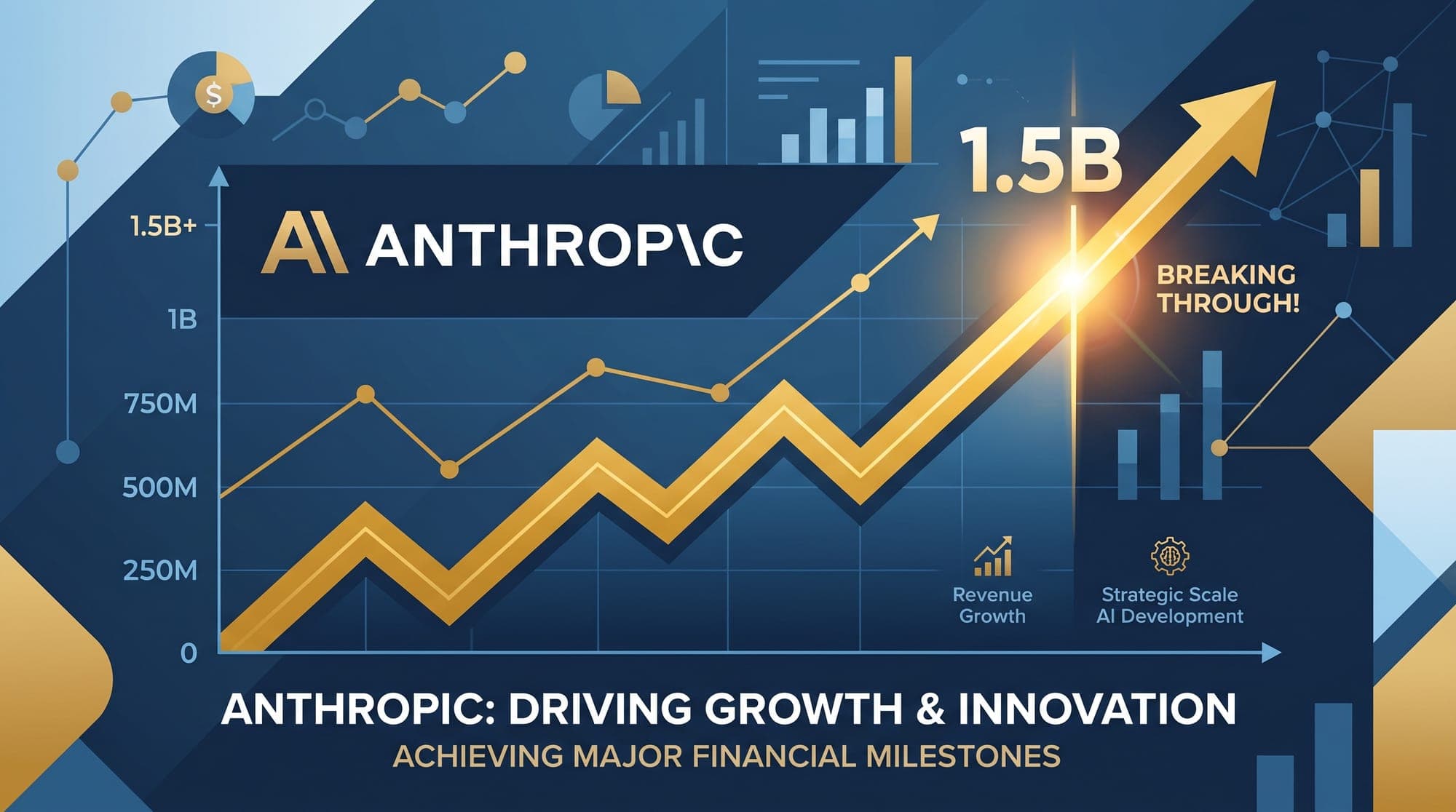
Anthropic has reported its first profitable quarter, with second-quarter revenue exceeding $11.5 billion — a 14-fold increase from $787 million a year earlier and more than double the $4.73 billion recorded in Q1 2026, according to documents seen by Bloomberg and reported by Reuters and The Decoder. The company posted positive adjusted operating income in Q2, a milestone no other leading AI lab has publicly reached. The figures are preliminary and could be revised; Anthropic declined to comment

2 min
Anthropic posts first-ever quarterly profit as revenue tops $11.5 billion

Anthropic has reported its first profitable quarter, with second-quarter revenue exceeding $11.5 billion — a 14-fold increase from $787 million a year earlier and more than double the $4.73 billion recorded in Q1 2026, according to documents seen by Bloomberg and reported by Reuters and The Decoder.

The company posted positive adjusted operating income in Q2, a milestone no other leading AI lab has publicly reached. The figures are preliminary and could be revised; Anthropic declined to comment.

Revenue acceleration

Anthropic quarterly revenue growth chart showing 14x year-over-year increase

Revenue growth is accelerating. Anthropic's run-rate revenue was approximately $45 billion in May 2026; internal projections now target roughly $190 billion to $200 billion for 2028. The company reportedly plans a confidential IPO filing with Morgan Stanley, Goldman Sachs, and JPMorgan, targeting a valuation near $1 trillion in late September or early October.

The profit inflection arrives as investor pressure forces Nvidia to scale back its OpenAI data-center guarantee from $250 billion to just under $120 billion for the first construction phase, the Wall Street Journal reports. Nvidia's reduced risk exposure contrasts with Anthropic's trajectory, which suggests proprietary AI demand continues to surge despite bubble warnings.

Claude Code drives growth

Claude Code, Anthropic's coding agent, is a primary revenue driver. Its annualized revenue grew from $500 million in September 2025 to $8 billion by May 2026, according to FutureSearch analysis. Ramp data shows a slight flattening in enterprise token demand recently, but the overall curve remains steep.

Sources

Bloomberg, "Anthropic Revenue Surges to Over $11.5 Billion in Second Quarter" (Aug 15, 2026): https://finance.yahoo.com/technology/ai/articles/anthropic-revenue-surges-over-11-210857853.html

The Decoder, "Investor pressure forces Nvidia to shrink its OpenAI bet just as Anthropic's numbers defy bubble warnings" (Aug 15, 2026): https://the-decoder.com/investor-pressure-forces-nvidia-to-shrink-its-openai-bet-jjust-as-anthropics-numbers-defy-bubble-warnings/

Reuters via The Decoder, "Anthropic's revenue more than doubled in a single quarter" (Aug 15, 2026)

The Next Web, "Anthropic's quarterly revenue passed $11.5bn" (Aug 15, 2026): https://thenextweb.com/news/anthropic-q2-2026-revenue-11-5-billion-operating-income

Wall Street Journal, "Mind-Blowing Growth Is About to Propel Anthropic Into Its First Profitable Quarter" (Aug 14, 2026): https://www.wsj.com/tech/ai/mind-blowing-growth-is-about-to-propel-anthropic-into-its-first-profitable-quarter-7edbf2f4


Written by

More to read

  • Automated Prompt Optimization in Production: Signatures, Teleprompters, and Metric-Driven Compilation with DSPy

    Manual prompt engineering remains one of the largest sources of technical debt in modern LLM applications. Teams routinely spend weeks hand-crafting multi-paragraph system prompts, hardcoding few-shot examples, and tweaking phrasing to extract reliable outputs from specific model checkpoints. When the underlying model is upgraded, migrated to an open-weight alternative, or integrated into a multi-step pipeline, these hand-crafted strings break, requiring another cycle of trial-and-error adjustme

    1 min
  • Model Merging in Large Language Models: How Task Arithmetic, TIES, and DARE Combine Checkpoints Without Training

    Fine-tuning foundation models for specialized tasks typically produces isolated checkpoints. A model adapted for mathematical reasoning retains high numerical precision but often degrades in general dialogue or code generation. Traditionally, unifying these capabilities required multi-task training: gathering mixed datasets, re-running optimization across multiple GPUs, and managing gradient conflicts during backpropagation. Model merging provides an alternative paradigm. By operating directly

    1 min
  • Harvey Introduces Tenet, Its First In-House Legal LLM Trained on Moonshot's Kimi K3

    Legal AI startup Harvey has announced Harvey Tenet, its first proprietary, in-house foundation model tailored for legal workflows. The release marks a strategic shift for the $11 billion legal tech company, which has historically relied on API access to third-party frontier models from OpenAI and Anthropic. Tenet is post-trained on top of Kimi K3, an open-weights model released in July 2026 by Chinese AI lab Moonshot AI. The initiative is part of a broader platform update titled Harvey II, whic

    1 min