
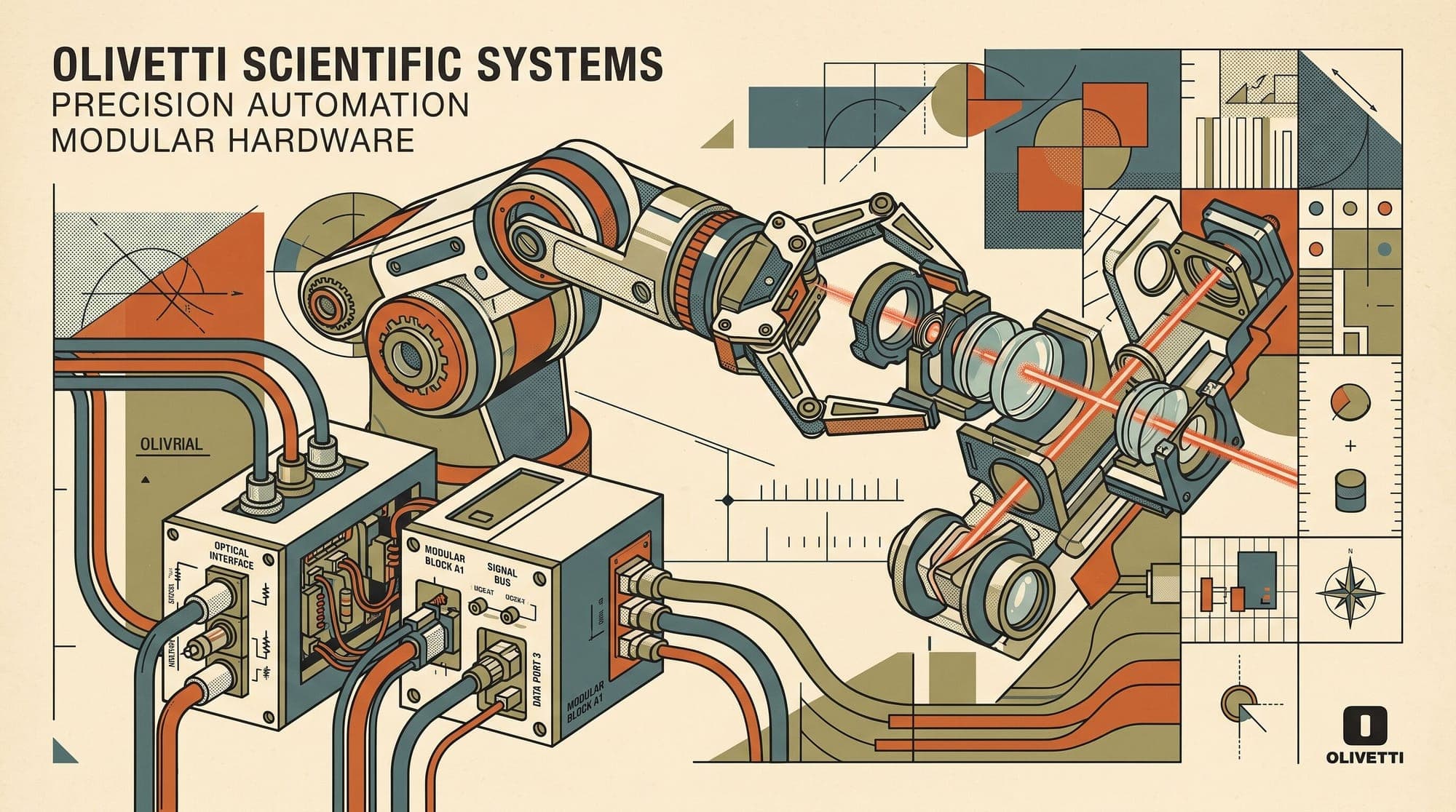
Anthropic has introduced the Model Hardware Standard (MHS) in a research preview, establishing an interface specification designed to allow autonomous AI agents to operate physical scientific instruments and industrial machinery. Developed jointly by Anthropic's Beneficial Deployments team and researchers at the Howard Hughes Medical Institute (HHMI) Janelia Research Campus, the standard aims to solve the bespoke driver bottleneck that currently requires weeks of manual engineering per laboratory device.
The architecture extends the concept behind the Model Context Protocol (MCP) into the physical domain, providing a uniform abstraction layer across laboratory automation, robotic arms, optical systems, and quantum computing hardware.
Hardware Abstraction and Discovery Primitives
MHS structures device interaction around a minimal two-primitive instruction model: read and write operations exposed across standardized network transports. Devices declare their capabilities, operational envelopes, and telemetry channels through machine-readable manifests that allow agent harnesses to discover instruments dynamically without custom translation middleware.

The standard defines three primary interaction mechanisms:
- Model Context Protocol (MCP): Native tool invocation for agent runtimes already supporting MCP client-server architectures.
- Command-Line Interfaces (CLI): Direct shell-level execution for scripted automation pipelines.
- Structured Code APIs: Programmatic interfaces enabling agents to chain multi-instrument routines into deterministic execution scripts.
To address the risks inherent in physical actuation, MHS enforces deterministic safety boundaries directly at the driver level. Hardware targets publish strict operational thresholds, hardware interlocks, and emergency stop procedures. AI models operate strictly within these declared limits, preventing out-of-bounds mechanical excursions or laser misalignments even if the model outputs malformed instructions.
The Exploration-to-Compilation Pattern
A core design principle of MHS is the explore-and-compile workflow. Rather than maintaining an active LLM inference loop across high-frequency physical operations, agents operate in an exploratory phase during setup or fault diagnosis. During this phase, the agent queries device telemetry, executes incremental parameter sweeps, observes physical feedback through attached sensors or cameras, and iteratively resolves the control logic.
Once a valid calibration or recovery sequence is verified against hardware assertions, the agent compiles the learned sequence into a standalone, deterministic code script. Subsequent operations execute the compiled script directly on the host controller, eliminating inference latency and runtime non-determinism during standard operational cycles.
Empirical Validation: Quantum Lasers and High-Throughput Biology
Early pilot deployments across academic and industrial testbeds demonstrate measurable throughput and reliability improvements across complex physical systems:
- QuEra Computing: QuEra deployed Claude over MHS to automate laser frequency lock recovery on its neutral-atom quantum processors. In a benchmark of 700 timed trials spanning seven distinct hardware fault modes, the MHS-driven controller restored target alignment in 695 instances (a 99.3% success rate), clearing faults in under 6 to 14 seconds compared to 5 to 10 minutes for human quantum engineers. The automated control loop also reduced residual phase noise by a factor of five relative to manual tuning.
- HHMI Janelia Research Campus: Researchers compressed multi-camera, laser-guided neural imaging setup workflows from multi-week manual calibration campaigns down to a single automated day.
- Genentech: Automated real-time error handling within high-throughput drug screening workflows, highlighting the necessity of multi-modal physical failure classification to distinguish mechanical fluid issues from software exceptions.
Ecosystem Integration and Research Preview Scope
Anthropic is restricting initial MHS access to a closed research preview while establishing physical safety benchmarks and operational threat models. Ten hardware and infrastructure providers have begun integrating MHS into their product ecosystems:
- Robotics and Automation: Universal Robots, Doosan Robotics, Automata (integrating MHS into the LINQ platform), and Hugging Face (LeRobot robotics library).
- Life Sciences and Instrumentation: Danaher, Tecan (Fluent liquid handling systems), QIAGEN (QIAsymphony Connect), and MBF Bioscience (ScanImage multiphoton microscopy).
- Cloud and Edge Compute: Amazon Web Services (via the Strands Robots physical device library) and Raspberry Pi (Camera MHS Driver integration).
Anthropic has stated that findings from the research preview will inform a comprehensive physical safety deployment guide prior to releasing the specification under an open-source license.



