
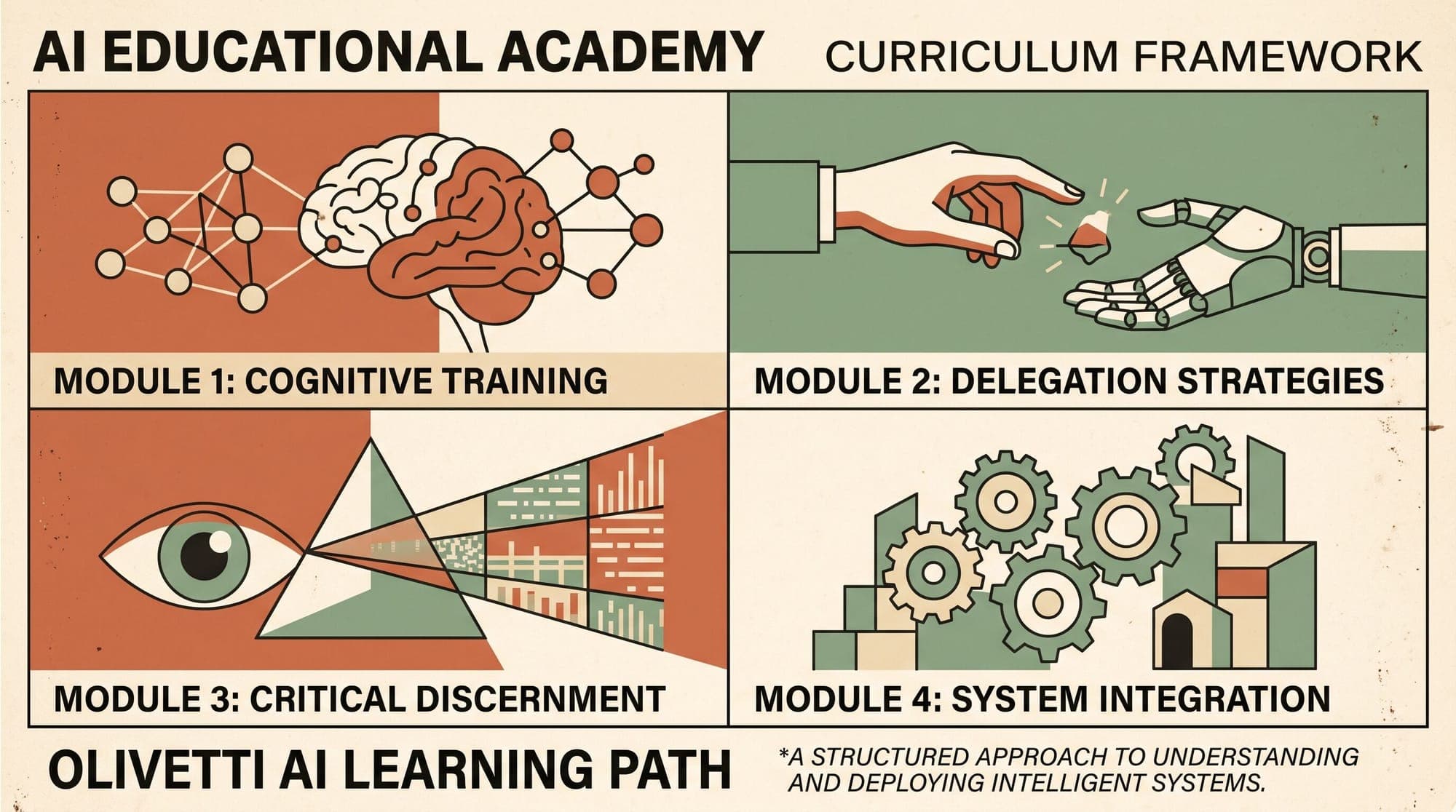
Anthropic has launched Claude Academy, an interactive training platform aimed at standardizing how individuals and enterprise teams learn, deploy, and evaluate AI systems. Available via academy.claude.com and directly inside the Claude profile interface, the program couples tool-specific training modules with a foundational curriculum designed to cultivate systematic AI interaction patterns.
The initiative comes as enterprise adoption shifts from ad-hoc prompting toward autonomous agent workflows, where unstructured experimentation often leads to unpredictable outputs, silent model errors, and security misconfigurations. Rather than focusing solely on transient UI features, Anthropic has structured the curriculum around durable operational principles and risk-managed delegation.

The 4D AI Fluency Framework
At the core of the educational platform is the 4D AI Fluency Framework, developed in collaboration with Professor Rick Dakan of Ringling College of Art and Design and Professor Joseph Feller of University College Cork. The framework defines 24 specific, observable behaviors organized across four functional pillars:
- Delegation: Determining which analytical or generative tasks are appropriate to assign to an LLM versus keeping under human execution. This involves scoping task boundaries, assessing failure tolerance, and defining handoff criteria.
- Description: Structuring task context, operational constraints, system instructions, and target output specifications to minimize ambiguity before invocation.
- Discernment: Evaluating model outputs critically, auditing step-by-step reasoning chains, and identifying subtle hallucinations or ungrounded claims based on the operational stakes of the task.
- Diligence: Executing iterative refinement loops, verifying external tool calls, enforcing provenance, and maintaining transparent disclosure standards across generated artifacts.
Curriculum Structure and Product Tracks
The platform splits its coursework between model-agnostic foundations and specialized product tracks. Foundational modules cover prompt architecture, prompt injection risks, multi-turn context degradation, and automated evaluation concepts.
Product-specific paths focus on Anthropic's developer and enterprise toolchains:
- Claude.ai: Advanced document analysis, conversational reasoning, and Artifacts management.
- Claude Cowork: Multi-step project handoffs, asynchronous collaboration, and team-level artifact generation.
- Claude Code: Terminal-based software development, codebase navigation, debugging workflows, and execution sandboxing.
- Claude Platform: API architecture, prompt caching optimization, system prompts, and custom tool orchestration using the Model Context Protocol (MCP).
Each course includes interactive exercises executed directly within Claude, accompanied by automated progress tracking and role-based completion badges. To assist with team onboarding, Anthropic also released a dedicated Claude Academy Skill that analyzes a user's prompt interaction patterns and suggests tailored learning paths.
Empirical Insights from the AI Fluency Index
Alongside the academy launch, Anthropic published research detailing conversational metrics from internal and external usage, titled the AI Fluency Index. The study measured how behavioral interventions influence output accuracy and user verification habits.
According to the report, users who engage in deliberate multi-turn iteration exhibit double the fluency behaviors compared to single-turn prompt sessions (2.67 additional behaviors versus 1.33). Furthermore, iterative refinement cycles made users 5.6 times more likely to actively scrutinize and question the model's intermediate reasoning, and 4 times more likely to identify missing background context.
The report noted a behavioral divergence across workflow types: users generating creative or long-form copy became increasingly directive but less evaluative over extended sessions, whereas technical users debugging code or analyzing structured data maintained tighter verification loops. Anthropic indicated it plans to expand the platform with adaptive, personalized learning tracks as new agentic capabilities roll out.



